BETWEEN RIVERS

BETWEEN RIVERS: NOVEMBER 2025 THE WORK OF JOHN AND MARILYN DAVIES – ALAN HORNE

Welcome to another edition of Between Rivers. In this edition we look at the work of John and Marilyn Davies: poetry and a variety of visual art, especially carvings of wild birds.
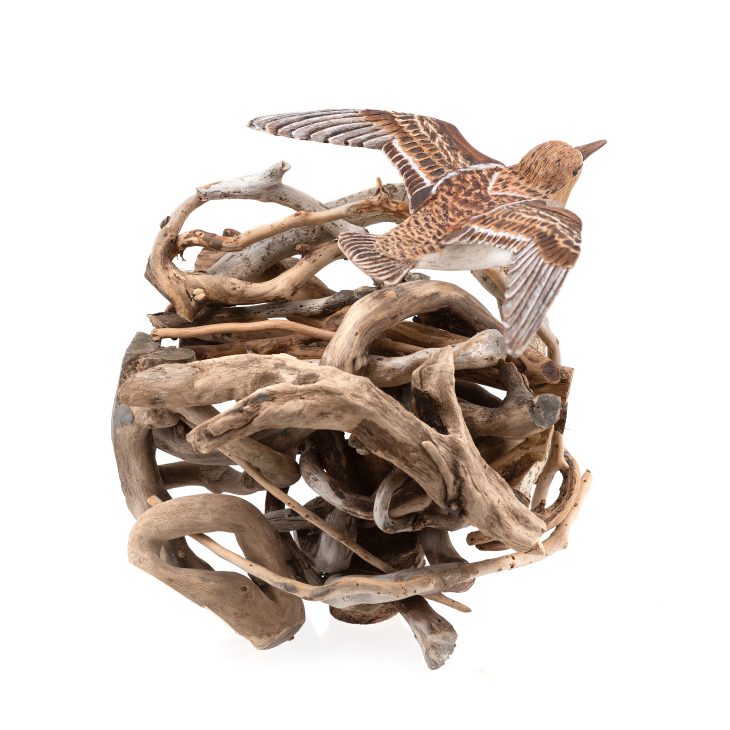
‘Little Stint’ by John and Marilyn Davies


When I arrived in Prestatyn to meet John and Marilyn Davies it was September, just as in John’s poem Things To Do When The Town’s Closed. Rain and the start of the school term had chased most visitors away, and it was easy to get into the mood of the poem. Like the others quoted here it was first published in his collection Flight Patterns (Seren 1991).

Things To Do When The Town’s Closed

Our choir dressed as guerrilla butlers
has driven the holidaymakers back.
It is September. Seagulls
are critics prying over spilt ink.
The town’s scraped off its silver lining
to get at the cloud instead.

In search of a bit of life,
Ron has started taxidermy, juggling
bags of skin like a homicidal vet.
They grin from furry cells,
near-squirrels.
You can’t keep a good man up.

And Mr. S has emptied his firm’s safe.
Self-bloodied, he faked
assault then described the villain
so well for the police photofit,
like a shout his own face rang out.

On the library wall: ANACKY.
Draughts from the Mersey Tunnel quicken
across the Dee. Wait,
slow down
at the station.
You can find yourself elsewhere.

Balloons were released in August
from Frith Beach for Holiday Fun
with addressed labels. W’s returned
all the way from Builth. His prize?
First cash, soon a court appearance:
winds blew north that day so how come W’s balloon
went south? Well, live in town
and wind is just a ghost. The label went
via his aunt in Builth, both ways by post.

Yesterday, high on a ladder with acres
to paint, Mr. S was whistling ‘Born Free’.
And although the Pleasant Sunday Afternoon Society
now meets all week, although the slipper women
at the launderette seem lively
and waves roll up in fits watching dunes
fail to outwit caravans,
it’s a bad time.

We are alone together.
Even our jeweller’s stopped twinkling.
You can’t help but feel
someone out there might be planning chainsaw
psychiatry or florist pressing.


Arriving at the Davies’ home I felt some slight trepidation, having contacted them out of the blue and invited myself round, but they were most welcoming. Marilyn, a small, bright woman, came out to conduct me in, and then here was John, slower, but very thoughtful, and remarkably open in our discussions. I straight away encountered some of Marilyn’s stained glass in the windows. As we ate lunch and discussed some of John’s poems, I started to realise that the house is full of art objects which the couple have created.
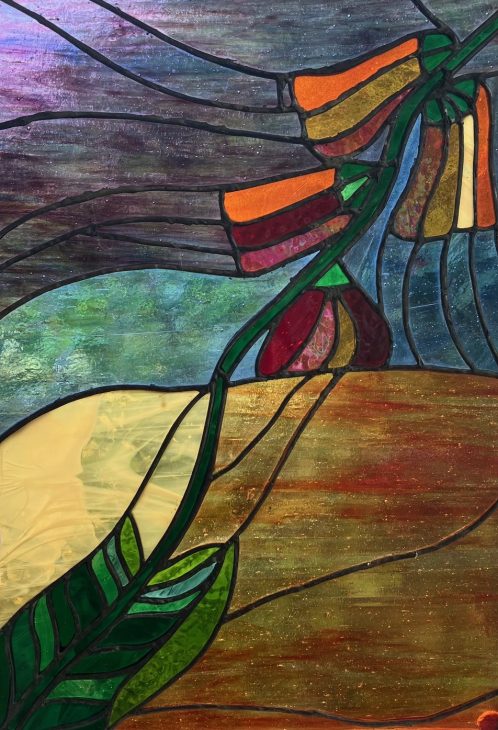
Stained glass by Marilyn Davies


I first encountered John’s poems when I was looking for material for Between Rivers, and David Selzer pointed me to A Clwyd Anthology, edited by Dewi Roberts and published by Seren Books. Not all the items in the book were on topic, but one that I knew we had to use was Downing, a Davies poem set in Whitford, near Holywell in Flintshire, on the former estate of Thomas Pennant, the eighteenth-century  traveller and natural historian.

Downing

Seventy, rasping, he lives in the saddlery

of the estate now run out of paths.

He keeps the tv. busy. The past? The brisk squire

who toured the eighteenth century and met Voltaire?

Not interested. But around pleasure garden, summer house,

Bob Weston cleared gullies for parched ironworks,

lopped trees in the dingles, was tolerant it seems

of poachers. The house, burned down as an insurance job,

is a DIY kit. Its drive can’t find the gateway.

Tunnels though and waterways built by miners

are intact, theirs or land’s revenge on stateliness

where ponds sag under weed.


Below on Mostyn sands, cockles have been found

by diggers in balaclavas linked to the underground economy.

Jobs, they’re rare as oysters. Unmarked trucks

sidled, and from dunes, they say, the DHSS took photos.

Bob Weston’s watched – Dunkirk again, another

scramble, grab what you can then home, the brass

will know the score. Except the brass aren’t on your side.


Now that it’s wanted for caravans, what no one could visit

is lamented. People will flood in, there’ll be petitions.

But he’ll not be collecting who likes that brandnew

pub at the junction and leaves his dog at home.


I found a copy of his Flight Patterns and was much taken with the vivid characterizations, humour and the sharply cut phrasing. This led me to other volumes of his poetry: The Visitor’s Book (Poetry Wales Press, 1985), Dirt Roads (Seren 1997), and North by South: New and Selected Poems (Seren 2002) which also includes poems from his earlier books, At the Edge of Town (Gomer, 1981) and The Silence in the Park (Poetry Wales Press, 1982). There was also a book of short stories by Welsh authors which he had edited, The Green Bridge (Seren 1988), which introduced me to several unfamiliar voices, notably Caradoc Evans, who unfortunately can in no way be construed as a Between Rivers author. Some of the poems were about belonging or not belonging in small towns on the coast of North Wales or around the Dee estuary. Before our meeting John had already sent me typed notes he had made in 1986 preparatory to the poem Downing. What really struck me was a handwritten marginal note, about the cargoes shipped in via Mostyn Dock on the Dee: bulk phosphate, woodpulp, sulphur, potash. These were not drafts of poetic lines so much as a gathering of ideas and information: to get the poem going, as John said to me. Now over lunch he produced yellowed sheets of typed and annotated historical material about the Flintshire town of Holywell, it’s mythical origins and industrial heyday, out of which he had made the sonnet sequence Burying the Waste. At the time, he said, he thought his poems had to rhyme, and the rhymes helped him to get to the images. Here is the sequence.


Burying The Waste

(Holywell)

Trapped by Caradoc, favourite of a king,

even Winifred could not deny his sword.

Where hair leaked blood, a well of healing

sprang, then the stream hurrying its hoard

of news woke up the valley. Winifred

drew pilgrims limping, eager to be whole.

He signed up slaves of cotton, copper, lead.

Her stream, severed by water wheels, rolled

machines. When Winifred spread her arms wide

to make from shadows trees, he cut them down

but she thinned the Dee channel. Its quayside

became silent, the valley a ghost town.

Now buildings sprawl headless. All around,

sprung green, half-buried: still misshapen ground.

*

Not just the Church preferred its blessings high.

This cotton mill snatched six storeys of sky

with stone from the nearby abbey’s shell

then, power untapped, St. Winifred’s Well.

An act of God, a world in seventy days.

High too squire Pennant’s recorded praise:

all the workers flourished, dined on meat,

fish, “in commodious houses”. Work was sweet.


Poet Jones of Llanasa, muffled voice

of the backwater – why couldn’t he rejoice?

“Rods doom’d to bruise in barb’rous dens of noise

the tender forms of orphan girls and boys.”

Poets. They build nothing. Just hover, stare,

write maudlin history. Except he’d worked there.

*

Ingenuity flowers in such fumes.

New copper bolts were roots helping great ships

spread wide. Brass beakers moistening the lips

of Africa, exchanged for slaves, seemed blooms.


Up there, notice, a fly-wheel gouged the wall.

In this bank, too, an opening faced with brick

like an oven gone drowsily rustic;

no grass, webs or wormcasts though. Earth, that’s all


almost. Hereabouts being where the knack

of refining human brushes took hold –

twigs bound in rags who carefuly swept back

arsenic from this flue and lived to rot –

last year they found a skull, some ten-year-old

ingenuity planted then forgot.

*

The wall keeps on haemorraging dark green

through the bricked-up centuries, through soil

Meadow Mill injected with copper spoil.

And its damp spillway is coloured gangrene

in memory of times, as Pennant said,

when workers obeyed the “antient law”

of sluicing thoroughly before meals or

watched “eruptions of a green colour” spread.

(They knew dogs, if they licked the sheeting, slept

for good.) So justice as well, urbane,

copper-bottomed, is remembered here. Yet

though the wall’s washed scrupulously by rain,

strange that metal still heaves through. Dogs drop.

It has tasted men and starves and cannot stop.

*

For three years, Frederick Rolfe alias

Baron Corvo, the Crow, pecked at the shell

of Holywell. He saw in it himself,

more idea than place, a proud man mostly

beak who squabbled, wrote and painted, furious

with “Sewer’s End”, obscurity’s rebel

till fury grew him wings. Two crows he left

in painted banners still caw “Look at me!”


Flashing, art’s narrowed gaze will open

on polluted water and turn even stones

to mirrors. The Well running wheels ran men.

Its stream’s “uproll and downcarol” Manley

Hopkins sang rang walls from where Poet Jones,

apprenticed to heartache, jumped to sea.

*

Ice tore a trench to the estuary.

Grass healed its sides. Water devised a well.

An idea, grown around it like a tree

surviving as an arched stone spell,

towered so pilgrims are still beckoned here,

a welling of belief that named a town.

When another idea for water

bricked up the flow, its weight wore people down.


The centuries keep waking to change dreams.

Dug from the undergrowth: brickwork’s feud

with stone for possession of the stream.


And voices insisting water is alive –

those pursuing always and, pursued,

those in need of miracles to survive.
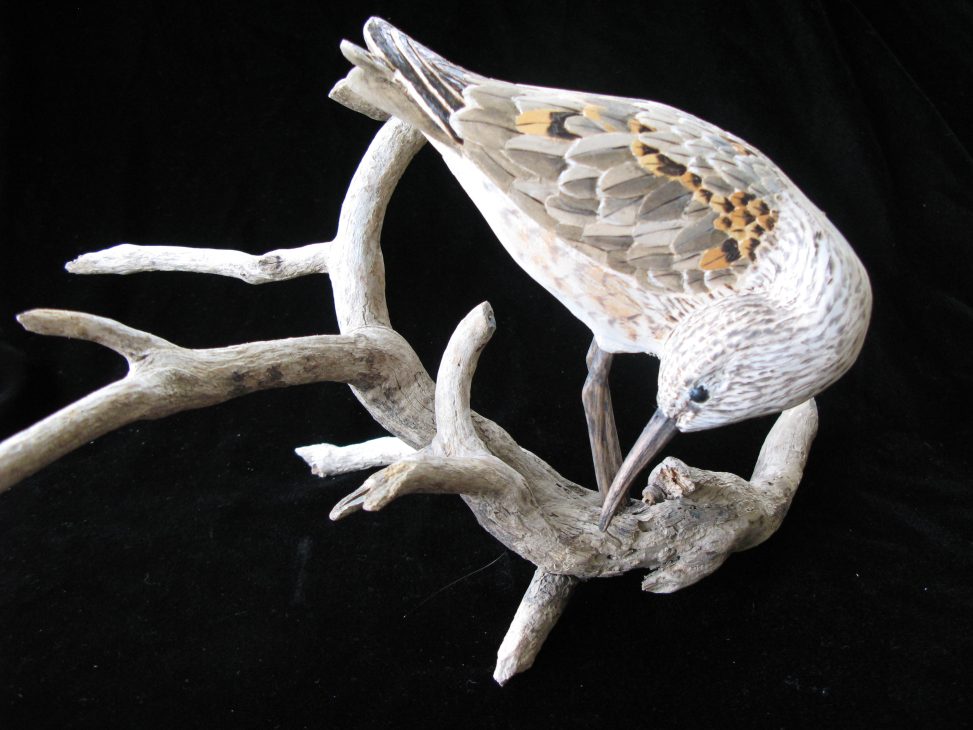
 

‘Curlew Sandpiper’ by John and Marilyn Davies


We took a break from lunch and I was shown around the house and garden. There were birds carved by John and painted by Marilyn, and artworks in various media created by Marilyn, especially ceramics.
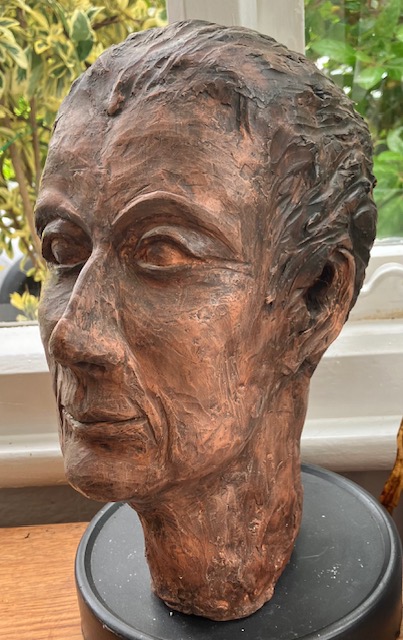
 

‘Ceramic Head’ by Marilyn Davies


Outside, under a tree was a little sculpture garden.
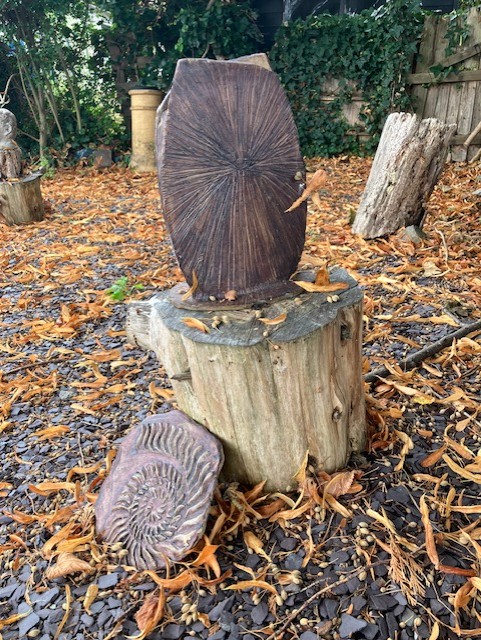
Ceramics and found objects by Marilyn Davies


Unlike John, who comes from Cymmer Afan in South Wales and does not speak Welsh, Marilyn comes from Pwllheli in the north-western heartland of the Welsh language, and spent her career teaching in Welsh-medium schools. She did not seem to push her own creations forward, though we were surrounded by them, but indicated that she had been a lifelong maker of art objects. John was more specific. When he was eleven there had been a school eisteddfod, he was encouraged to contribute some poetry and was hooked, haunting the school magazine with his poems, and continuing through a long teaching career, notably as head of English at Prestatyn High School. Important too were some sabbaticals he spent teaching creative writing at universities in the United States, in Michigan, Washington and Utah: alongside the poems about Deeside, the North Wales coast and the wider Welsh scene, his books have many poems derived from his experiences in America, contrasting but clearly linked with his depiction of Wales: there are miners, displaced first nations, powerful religion and a host of sharply-drawn characters, some of them carvers of birds in wood.

While John could pinpoint the origin of his involvement in poetry, the origin of his interest in woodcarving, and especially in carving birds, seemed less clear, but grew somehow out of a childhood love of making things like Airfix model aircraft. He recalled his mother questioning whether it was worth doing, a discouragement which nonetheless spurred him on. The skill did not come easily, perhaps in contrast to his facility for writing, but the carving of birds in wood ran alongside and perhaps behind his writing of poetry throughout his adult life, and was given a big push by his contact with others who carved birds in wood in the United States. He talks about the process at length in his most recent book, Bird River (Carreg Gwalch, 2023), from which most of the illustrations of bird carvings in the present feature are taken. The book is an absorbing mix of encounters related to the carving of birds, descriptions of the creative process, discussion of influences, poems, and photographs.  The title points to the amount of time John spends walking the banks of the nearby river, the Clwyd, collecting driftwood for the mounts which have become such a feature of the carvings. As we spoke, he suddenly interjected that he loves collecting the driftwood and putting it together with the birds. Really, he told me, the driftwood has become the main event, a sort of gift that appears twice, first when he finds it, and again when he opens up the store in which it has been left to dry. He felt so thankful for it.

As in the poetry collections, Bird River contains a good deal of humour:

Then there was the small tribe of young men living by the Clwyd for about four months last summer, on a muddy creek at Rhyl. Some lived in a sod hut they’d built, flying a Welsh flag. Some lived in tents. Nearby was a handsome structure made of driftwood and a large bakery tray. By the time I encountered them, they were shooting rabbits and fishing but had decided not to kill pheasants because it was the breeding season. They were jobless. A lot of the money saved on accommodation went on drinking in the scenery. And they left behind, filling two burned-out cars already there when they’d arrived, hundreds of beer cans shining silver against the rust-brown like an Arts Council installation. I admired their enterprise, living, as one of them put it, ‘the rock ’n’ roll lifestyle’. So when later one of them checked out my armful of wood and driftwood-collecting costume and asked, ‘Sleeping rough, are you?’, I felt oddly flattered.

John carves the birds and they are then coloured by Marilyn:

Once John has finished the carving, it’s usually over to me. The first stage is to use a pyrography tool to produce the texture of the feathers… A low temperature will produce a light mark and hundreds of these barbs are required to give the bird a feathery look. At a high temperature, the tool can also be used to produce dark brown markings. Sometimes, with a bird such as a curlew, which is basically white and brown, white paint or dye and the use of pyrography is all that is required. Compared with a paintbrush, even a very fine one, it’s more accurate. But most birds will be painted. Many British birds are what birders call ‘little brown jobs’, so achieving shades of brown and grey is vital. The colours I use most are earth tones: Raw Umber, Burnt Umber, Raw Sienna, Burnt Sienna, and White.

(Marilyn Davies, quoted in Bird River)

My tour of the Davies’ house and garden concluded in John’s workshop.
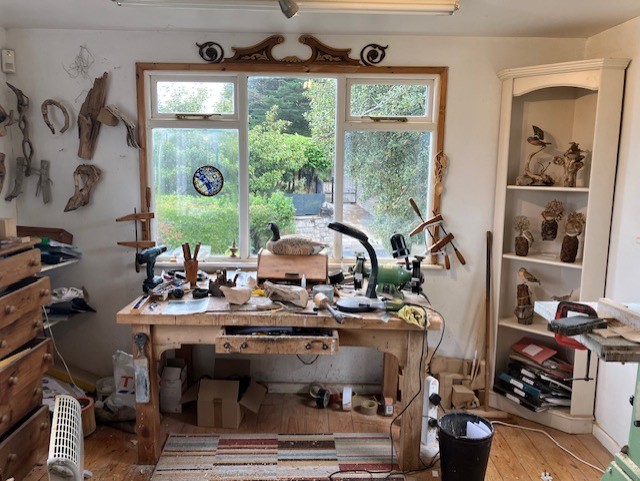
Workbench in John Davies’ workshop.


Surrounded by tools, partly fashioned carvings and driftwood pieces waiting for use, it was the tactile nature of it all that struck me. I asked John if carving the birds had replaced writing poetry. He was emphatic: yes, that was right. How did that happen? Again he was quite direct: he had found that he was writing rubbish, and it was embarrassing when editors who had once eagerly accepted his work now sent it back with a more or less polite rejection. He thought that poets commonly ran out of steam as they got older: the reactiveness that fires the images becomes less, one is not so much moved by events. I asked him if the tactile nature of carving and the fact that driftwood is a found object – a gift, as he put it – helped him to get the artwork going. He seemed to think that this was right. He was so grateful, he said, that the carving was there when his poetry gave out. It was the second time in our conversation that he spoke of his gratitude for what this form had given him.

In Bird River, John adapts a poem from Flight Patterns which ties together his preoccupations with woodcarving, birds and the environment of the estuary. This is Decoys. It takes the form of a dialogue between the poet and the Parkgate wildfowler Harold Gill. Gill was and remains a somewhat legendary figure in his locality, one of the last people to earn his living by wildfowling in the Dee estuary, and certainly the only one to record much about the life, in a remarkable memoir Dee Wildfowler: the last professional (1982), edited and published by Leslie Brockbank. Here is the complete original version of the poem.

Decoys

(in memory of Harold Gill)

My timber for carving’s from the shore,
driftlumps water sluices out
so it dries fast and won’t crack. Elm most of all.
Bones in the woodshed’s drought,
they clench. Opened months later, a store
of ripeness surprised is the windfall.

We’d leave for Mostyn, cross
the Shrouds. You had to know the water.
What use is a duck-punt once a week?
You’re not informed. Birds on the ebb won’t stir,
just sit there packed. The flood brings chaos.
High tide meant hide-and-seek.

I carve birds, ducks often: pintail
and mallard, a teal, shapes wood lays for the hand.
Bandsaw for roughing out — check the grain
runs with the bill. Chisels, rasp. Elm is hard sand.
With oil or polish, what’s been fingered stale,
another late surprise, is sunburnt terrain.

Each day — start early. We liked a NE
in the face when we picked our spot:
no wobblings, steady as she… Sixty yards
for a clean kill. 20 ounces. AA shot.
But for food, I wouldn’t have killed — at least
not birds. Smooth the feathers, keep no scorecard.

Best I like the curve where crown, cheek,
sweep down through the swell of chest,
the sweptback, cleared-for-action prow
of a poised gathering unrest
that, from the moment’s peak,
though wood, might just take off, go anyhow.

It wasn’t the birds mainly,
that’s something I can’t nail.
One chap I took, a February morning,
sang for hours — threats to shoot him failed.
Never sung before. The estuary
was fine, I lived on dusk and dawn.

Beyond wood: an airy something
from nothing wood’s a pretext for.
Alone at last with the whole mind’s scope,
you drift. Almost a familiar shore.
Stirrings, gleams are stalked, and springing
this time they are yours, you hope.

Not that bird carving is entirely without drawbacks. John told me that it was hard to find others working in the same field locally, or even further afield. In the United States he appears to have found a vigorous community of fellow carvers of birds, leading to various escapades which find their way into the poems; but not in the UK. He thought that this might be because of the time the work takes: he recalled a woodworker at a craft fair who had “Bloody Ages” printed on the back of his jacket, in answer to the question which is always asked. But John said that the slowness of the work did not bother him: it was the whole process, not so much the end product, which was engaging.

As I made my goodbyes, the Davies’ thanked me for taking an interest in their work, as if few people noticed it. I confessed myself baffled: there is so much there to take an interest in. I hope you have enjoyed reading about their art in this edition of Between Rivers. If you would like to find out more about their carvings of birds you can visit their website, Birds In The Wood, or visit their Facebook page.
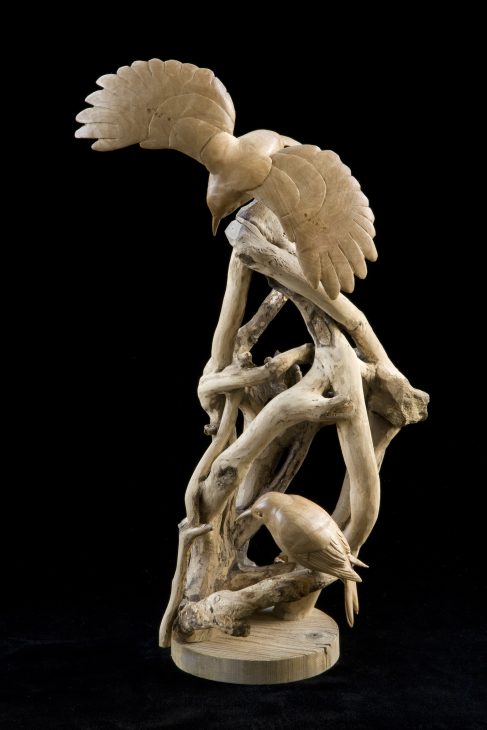
‘Treecreepers in Sycamore’ by John and Marilyn Davies


BETWEEN RIVERS is a quarterly series edited by Alan Horne. It is focused on the area bounded by the rivers Alun, Dee and Gowy, on the border between England and Wales in Flintshire, Denbighshire and Cheshire. You can read about the background to Between Rivers in the Introduction

BETWEEN RIVERS: AUGUST 2025 KING RICHARD II AT FLINT CASTLE – ALAN HORNE

David Selzer By David Selzer0 Comments11 min read3.3K views

To introduce this edition of Between Rivers we have a poem by David Selzer. And With A Little Pin was first published on this website in 2009.

And With A Little Pin

On liberty’s last morning, he said mass

in the Great Tower – the chapel was cold

as winter. August’s sun warmed the rebels

riding along the estuary shore,

their drums silent. He watched from the walls.

At his back, the seas breaking on Ireland. King

and Usurper, first cousins, exchanged

purple words in the base court, a surfeit of

epithets: bombast, self-pity. Serfs

were indifferent but Richard’s dog fawned

on new majesty. The epicure

who bespoke a coat of cloth of gold

rode captive from Flint to London in the same

suit of clothes. Through Chester he was jeered, stoned.

Twenty miles inland, a sandstone hill

– sheer to the west – rises from the plain.

Parliament’s army sacked the castle.

Westwards there is the estuary’s mouth,

the livid sea. Above twitching fern,

a hawk stoops. Stones, flung into the well’s blackness,

fall through the hill seawards and never sound.

The poem connects Flint castle, on the Dee estuary, with Beeston castle on the Cheshire sandstone ridge. Flint castle is now an eroded stump surrounded by recent development, and you can read about this in David’s poem The Optimism of Engineers. But in medieval times it was an important stronghold, guarding the principal ford across the Dee to Neston, and controlling major routes not only into Wales but onward to Ireland.

Selzer takes the title And With A Little Pin from a line in Shakespeare’s Richard II. The doomed Richard surrendered at Flint to his friend turned rival, Bolingbroke – the future Henry IV – and Shakespeare turns the surrender in the castle into the pivotal scene of the play. But first, on the way to Flint, Richard is given what must be one of the most remarkable speeches in all of Shakespeare’s writings, from which David takes his title. Richard’s attachment to his royal pomp has always seemed brittle, and now, following news of the desertion or death of supporters, he falls into a despairing monologue about the vanity of kingship. It veers between being an expression of maudlin self-pity – what Richard later calls ‘that sweet way I was in to despair’ – and a cynical review of the real position of the leader. Here it is, from Act 3 scene 2. It repays being read aloud. Excerpts from the play are from the Folger Shakespeare Library.

Of comfort no man speak.
Let’s talk of graves, of worms, and epitaphs,
Make dust our paper, and with rainy eyes
Write sorrow on the bosom of the earth.
Let’s choose executors and talk of wills.
And yet not so, for what can we bequeath
Save our deposèd bodies to the ground?
Our lands, our lives, and all are Bolingbroke’s,
And nothing can we call our own but death
And that small model of the barren earth
Which serves as paste and cover to our bones.
For God’s sake, let us sit upon the ground
And tell sad stories of the death of kings—
How some have been deposed, some slain in war,
Some haunted by the ghosts they have deposed,
Some poisoned by their wives, some sleeping killed,
All murdered. For within the hollow crown
That rounds the mortal temples of a king
Keeps Death his court, and there the antic sits,
Scoffing his state and grinning at his pomp,
Allowing him a breath, a little scene,
To monarchize, be feared, and kill with looks,
Infusing him with self and vain conceit,
As if this flesh which walls about our life
Were brass impregnable; and humored thus,
Comes at the last and with a little pin
Bores through his castle wall, and farewell, king!
Cover your heads, and mock not flesh and blood
With solemn reverence. Throw away respect,
Tradition, form, and ceremonious duty,
For you have but mistook me all this while.
I live with bread like you, feel want,
Taste grief, need friends. Subjected thus,
How can you say to me I am a king?

Samuel West playing Richard in 2000. Photo by Manuel Harlan, RSC archive.


Richard is briefly rallied by his retainers, but news of a further betrayal seems to prove the case for despair, and he proceeds hopelessly to Flint.

The historical Richard was born in 1367, during the reign of his grandfather, Edward III, who is usually portrayed as a competent monarch. Richard’s father was the charismatic Edward, otherwise known as the Black Prince, but he died in 1376, leaving Richard to inherit the throne at the age of 10 on his grandfather’s death. In the early years of his kingship he was much guided by his father’s brother, John of Gaunt. There was serious conflict about the influence of courtiers and also the Peasants’ Revolt in 1381 – bloodily put down in the end – but Richard was able to keep the upper hand with the support of his uncle and other advisers. But as he grew older and began to rule in his own right, certain weaknesses emerged. He took an elevated view of his kingly status, chose the sun as his emblem, and held a grand court with much patronage of the arts. This may have encouraged a wider flowering of middle English culture. Chaucer, who was close to the court, was at work during his reign, but so were William Langland the author of Piers Plowman in Worcestershire; the unknown author of Sir Gawain and the Green Knight in Cheshire; the anchoress Julian of Norwich; and the mystic Margery Kempe in Kings Lynn. Richard himself is the subject of a contemporary portrait in Westminster Abbey, probably painted in the 1390s, which is unique in northern Europe as a surviving full-length portrait from the period:


Yet Richard’s grandeur led him into conflict with the nobility at large. He was accused of depriving his nobles of their traditional rights and giving preference to court favourites. He does not appear to have had the ruthlessness or determination necessary to prevail, and Shakespeare’s play dramatizes this fatal weakness. Richard exiled John of Gaunt’s son, Henry Bolingbroke, in 1398 – the period of exile is exaggerated in the play – and took over John of Gaunt’s lands when the latter died in 1399, effectively disinheriting Henry, who returned from exile, rallied disaffected nobles against Richard, took him prisoner at Flint and usurped his throne.

The play turns on Act 3 scene 3. We see Bolingbroke arrive outside Flint castle, with Richard already within. He and his followers are torn between their respect for the king and their wish to defeat him.

Enter with Drum and Colours Bolingbroke, York, Northumberland, with Soldiers and Attendants.

BOLINGBROKE 

So that by this intelligence we learn
The Welshmen are dispersed, and Salisbury
Is gone to meet the King, who lately landed
With some few private friends upon this coast.

NORTHUMBERLAND

The news is very fair and good, my lord:
Richard not far from hence hath hid his head.

YORK 

It would beseem the Lord Northumberland
To say “King Richard.” Alack the heavy day
When such a sacred king should hide his head!

NORTHUMBERLAND

Your Grace mistakes; only to be brief
Left I his title out.

YORK

The time hath been, would you have been so brief with him,
He would have been so brief to shorten you,
For taking so the head, your whole head’s length.

BOLINGBROKE

Mistake not, uncle, further than you should.

YORK

Take not, good cousin, further than you should,
Lest you mistake. The heavens are over our heads.

BOLINGBROKE 

I know it, uncle, and oppose not myself
Against their will.

Royce Pierreson as Bolingbroke, Bridge Theatre, 2025. Photo Manuel Harlan.


Bolingbroke sends messages to Richard, ostensibly submissive but backed up with threats, and invites him to parlay. Then Richard himself appears high above them on the castle wall.

Bolingbroke’s Soldiers march, the trumpets sound.
Richard appeareth on the walls with Aumerle.

BOLINGBROKE

See, see, King Richard doth himself appear
As doth the blushing discontented sun
From out the fiery portal of the east
When he perceives the envious clouds are bent
To dim his glory and to stain the track
Of his bright passage to the occident.

YORK

Yet looks he like a king. Behold, his eye,
As bright as is the eagle’s, lightens forth
Controlling majesty. Alack, alack for woe
That any harm should stain so fair a show!

KING RICHARD, to Northumberland, below

We are amazed, and thus long have we stood
To watch the fearful bending of thy knee,
Because we thought ourself thy lawful king.
An if we be, how dare thy joints forget
To pay their awful duty to our presence?
If we be not, show us the hand of God
That hath dismissed us from our stewardship,
For well we know no hand of blood and bone
Can gripe the sacred handle of our scepter,
Unless he do profane, steal, or usurp.
And though you think that all, as you have done,
Have torn their souls by turning them from us,
And we are barren and bereft of friends,
Yet know, my master, God omnipotent,
Is mustering in his clouds on our behalf
Armies of pestilence, and they shall strike
Your children yet unborn and unbegot,
That lift your vassal hands against my head
And threat the glory of my precious crown.
Tell Bolingbroke—for yon methinks he stands—
That every stride he makes upon my land
Is dangerous treason.

Richard regains his regal self-assurance, but not for long. The loyal Aumerle urges him to play for time. He cannot, and we learn this from another passage of memorable poetry.

KING RICHARD  To Aumerle. 

We do debase ourselves, cousin, do we not,
To look so poorly and to speak so fair?
Shall we call back Northumberland and send
Defiance to the traitor and so die?

AUMERLE

No, good my lord, let’s fight with gentle words,
Till time lend friends, and friends their helpful swords.

KING RICHARD

O God, O God, that e’er this tongue of mine
That laid the sentence of dread banishment
On yon proud man should take it off again
With words of sooth! O, that I were as great
As is my grief, or lesser than my name!
Or that I could forget what I have been,
Or not remember what I must be now.
Swell’st thou, proud heart? I’ll give thee scope to beat,
Since foes have scope to beat both thee and me.

AUMERLE

Northumberland comes back from Bolingbroke.

KING RICHARD

What must the King do now? Must he submit?
The King shall do it. Must he be deposed?
The King shall be contented. Must he lose
The name of king? I’ God’s name, let it go.
I’ll give my jewels for a set of beads,
My gorgeous palace for a hermitage,
My gay apparel for an almsman’s gown,
My figured goblets for a dish of wood,
My sceptre for a palmer’s walking-staff,
My subjects for a pair of carvèd saints,
And my large kingdom for a little grave,
A little, little grave, an obscure grave;
Or I’ll be buried in the King’s highway,
Some way of common trade, where subjects’ feet
May hourly trample on their sovereign’s head;
For on my heart they tread now whilst I live
And, buried once, why not upon my head?

At this point the play makes use of the castle setting and the opportunities afforded by the Elizabethan playhouse to depict Richard’s descent from his elevated station to ground level. Modern stagings have expended much ingenuity as to how this is done. The photograph below shows Richard Pascoe as Richard II, descending ‘like glist’ring Phaëton’ in the Royal Shakespeare Company production of 1973.

Photo by Donald Cooper, from RSC archive.


KING RICHARD

Well, well, I see
I talk but idly, and you laugh at me.
Northumberland approaches the battlements.
Most mighty prince, my Lord Northumberland,
What says King Bolingbroke? Will his Majesty
Give Richard leave to live till Richard die?
You make a leg, and Bolingbroke says ay.

NORTHUMBERLAND

My lord, in the base court he doth attend
To speak with you, may it please you to come down.

KING RICHARD

Down, down I come, like glist’ring Phaëton,
Wanting the manage of unruly jades.
In the base court—base court, where kings grow base,
To come at traitors’ calls and do them grace.
In the base court come down—down court, down king,
For nightowls shriek where mounting larks should sing.
Richard exits above and Northumberland returns to Bolingbroke.

BOLINGBROKE

What says his Majesty?

NORTHUMBERLAND

Sorrow and grief of heart
Makes him speak fondly like a frantic man,
Yet he is come.

Richard enters below.

BOLINGBROKE

Stand all apart,
And show fair duty to his Majesty. 

He kneels down.

To the end, Bolingbroke conducts himself as a faithful subject who only seeks redress of wrongs, while keeping the threat of force close to hand. In the wider play there is the sense that, although much steelier and more determined than Richard, he is keenly aware of the blasphemous rupture in the order of things entailed in displacing an anointed king. Richard’s refusal of Bolingbroke’s protestations of loyalty seem to take the place of any effective assertion of his own kingship.

KING RICHARD

Fair cousin, you debase your princely knee
To make the base earth proud with kissing it.
Me rather had my heart might feel your love
Than my unpleased eye see your courtesy.
Up, cousin, up. Your heart is up, I know,
Thus high at least indicating his crown, although your knee be low.

BOLINGBROKE, standing

My gracious lord, I come but for mine own.

KING RICHARD

Your own is yours, and I am yours, and all.

BOLINGBROKE

So far be mine, my most redoubted lord,
As my true service shall deserve your love.

KING RICHARD

Well you deserve. They well deserve to have
That know the strong’st and surest way to get.—
Uncle, give me your hands. Nay, dry your eyes.
Tears show their love but want their remedies.—
Cousin, I am too young to be your father,
Though you are old enough to be my heir.
What you will have I’ll give, and willing too,
For do we must what force will have us do.
Set on towards London, cousin, is it so?

BOLINGBROKE

Yea, my good lord.

KING RICHARD  Then I must not say no.

They exit.

So Richard gives himself up to Bolingbroke’s custody, evidently before he needs to. As in David’s poem, they travel from Flint via Chester to London, where Richard is imprisoned. At the end of the play, Bolingbroke has Richard killed; and then kills the man he hired to do it, seemingly out of hatred for his own regicidal action. Richard’s actual fate is unclear, but he appears to have died in Bolingbroke’s custody.

There are a series of excerpts from the 2013 RSC production of the play with David Tennant as Richard which are well worth viewing. Tennant’s comic gift seems to have given the production a real twist.


I hope that you have enjoyed David’s poem and the selections from Shakespeare’s play. Shakespeare was not the only major artist to base work around Flint Castle. The painter JMW Turner visited it repeatedly over his lifetime and made many artworks depicting the area, which we will look at in a future edition.

****************************************************************************************************

BETWEEN RIVERS is a quarterly series edited by Alan Horne. It is focused on the area bounded by the rivers Alun, Dee and Gowy, on the border between England and Wales in Flintshire, Denbighshire and Cheshire. You can read about the background to Between Rivers in the Introduction.


BETWEEN RIVERS: MAY 2025 ‘IRON AND STEEL’ – ALAN HORNE

David Selzer By David Selzer3 Comments9 min read1.9K views

BETWEEN RIVERS is a quarterly series edited by Alan Horne. It is focused on the area bounded by the rivers Alun, Dee and Gowy, on the border between England and Wales in Flintshire, Denbighshire and Cheshire. You can read about the background to Between Rivers in the Introduction.

In this edition we feature four pieces of writing related to the iron and steel industries of the Between Rivers area. Much of the heavy industry which was characteristic of the area within living memory involved extractive industries: coalmining, mines for iron, lead and other minerals, and quarrying for limestone. But the co-occurrence of these resources, together with easily available water power and charcoal from local woodlands led to the development of iron smelting on the eastern slopes of the Denbighshire hills around Bersham and Rhiwabon by the time of the Civil War in the middle of the seventeenth century. In the nineteenth century, the industry consolidated at the ironworks which later, with the development of blast furnace technology, became the steelworks at Brymbo, near Wrexham. Then, at the end of the nineteenth century the Summers family took advantage of the chance to build on land reclaimed from the Dee estuary to create what became a very large steelworks at Shotton, where raw materials and finished steel could be shipped in or out by sea. Brymbo steelworks closed in 1990. Steelmaking ceased at Shotton in 1980, when the blast furnaces were closed and a large part of the site shut down with many redundancies, but the works still exists on a smaller scale, coating and providing other treatments for steel brought in from elsewhere.

Bersham ironworks was in the valley of the Afon Clywedog near Wrexham. You can still see it today, and a few original buildings form a small museum. It had an important role in the industrial revolution under the Wilkinson family. John Wilkinson developed a method for the accurate boring of cannon. When James Watt patented the steam engine in 1769, he struggled to get cylinders bored to the standard he needed, but Wilkinson adapted his cannon technology for the purpose, and cylinders from Bersham were an essential component of the Watt steam engines ubiquitous at this stage of industrial development.

Part of Bersham Ironworks today. Photo: Alan Horne


Here we have David Selzer’s Lament for Bersham Ironworks. It was first published on David’s site in 2011, and captures just how novel this enterprise would have been at the time.

Lament for Bersham Iron Works

Not for the hard, life-denying graft of it

or the danger, not for the polluting smoke

or the banishing of bird song,

not for the exploitation and social

upheaval, least of all for its cannons

at Naseby, Bunker Hill, Waterloo,

but for its madness, the sheer reach of it,

the invention of it, the ambition,

the defiance, the rhythmical creak

of the horse-drawn gin pumping water

from the river, the sulphurous roars

of the furnace, the forge hammers pounding

through the ancient woods, along Offa’s Dyke,

their echoes dying…


By the time the linguist and writer George Borrow (1803-1881) was active, the Romantic movement was in full swing, and he is best known for travel writing and novels which feature picturesque scenery and picaresque action among the Welsh, Spanish and Romany subjects whom he saw as having more real character than his unimaginative English fellows. For some mysterious reason Wild Wales, his account of a walking tour through the country in 1854, was something of a set book in my family when I was growing up, and I continue to find Borrow engaging, as he walks long distances, drinks remarkable amounts of ale, tries out his Welsh on passers-by, and barges into isolated farmsteads to question the inhabitants about their life and locality.

Borrow’s account is of a largely agricultural, or indeed wild, Wales, but when he encounters industrial settlements his descriptions are just as vivid. During a stay at Llangollen he walked out in the Wrexham direction to explore the various settlements around Rhiwabon. Industry had taken off around here with the arrival at the start of the nineteenth century of the canal, which crossed the Dee valley by the spectacular Pontcysyllte aqueduct, subject of David’s poem The Aqueduct  published on this site in 2015. (The anglophone may easily romanticise about this gorgeous Welsh name, Pontcysyllte, polysyllabic and so hard to pronounce. It means Connecting Bridge.) Borrow got to the village of Cefn after dark.

I struck across the fields and should probably have tumbled half-a-dozen times over pales and the like, but for the light of the Cefn furnaces before me which cast their red glow upon my path. I debauched upon the Llangollen road near to the tramway leading to the collieries. Two enormous sheets of flame shot up high into the air from ovens, illumining two spectral chimneys as high as steeples, also smoky buildings, and grimy figures moving about. There was a clanging of engines, a noise of shovels and a falling of coals truly horrible. The glare was so great that I could distinctly see the minutest lines upon my hand. Advancing along the tramway I obtained a nearer view of the hellish buildings, the chimneys, and the demoniac figures. It was just such a scene as one of those described by Ellis Wynn in his Vision of Hell. Feeling my eyes scorching I turned away, and proceeded towards Llangollen, sometimes on the muddy road, sometimes on the dangerous causeway.

George Borrow, Wild Wales (1862), chapter 62.


We now leap forward by more than a century, into the era of large-scale steel production under the auspices of a nationalised industry, British Steel. I have spent some time looking for contemporary poems or other writing about the local iron and steel industry, but have not found much. They are probably there, and I may have been looking in the wrong places: I would be very happy to be directed to writings or other artistic productions about the industry. As it is I will, for the first time in Between Rivers, make use of two of my own poems.


Shotton Steelworks. Photo: BBC.


I do have some slight claim on the subject. As an undergraduate in 1973 and 1974 I spent the summer working at Shotton steelworks, first as a cleaner and then – a real step up – as an electrician’s mate, mostly in the cold strip mill, which is where coils of steel sheet were taken to be trimmed, heat-treated and otherwise finished off. After that, by a curious reversal, my father followed in my footsteps and spent the last few years of his working life as a cleaner in the hot strip mill. This was the previous stage of the steelmaking process, in which slabs of red-hot steel were squeezed through a press, shooting out at the other end as a long thin sheet, which flew down a runway of rollers and coiled itself around a spindle. Safety rails surrounding the area were buckled and bent at all angles, as things did not always go to plan.

The experience of the steelworks stuck in my mind, and about ten years ago I wrote three poems about it. One, The Electrical Cellars, became part of an early edition of Other People’s Flowers on David’s site. Here are the other two, Clearing Scrap and Overhead Crane. As with almost anything that is – at least in the United Kingdom – disappearing, it is easy to feel a nostalgia for heavy industry, so I should record that my main memory of the actual work was of considerable boredom, in an environment which retained some risks even if these were much less than in earlier days. At the same time, the scale of the works and the undeniable drama of some of the industrial processes made a strong impression which for me is always linked with the ubiquitous smell of hot steel and oil. It was the last hurrah of nationalised industry, providing quite well-paid jobs to large numbers of employees who were not continually policed to maximise productivity; when steelmaking ended in 1980, 6,500 people were made redundant, my father being one. On YouTube you can find a series of atmospheric amateur videos of the cold strip mill, shot just before final closure of the mill in 2003. You can see one of them here.


The vast majority of the workforce were men, and this was plainly a traditional masculinity which had plenty wrong with it. I recall the commotion when women from the offices appeared in the mill one day; and some parts of the works had a hard-drinking culture that must have caused terrible problems for family members. Conditions which were often squalid evoked a sordid response in some. And like many another young and naïve person, I was sent to the stores to ask for items that did not exist. (In fairness, I can add that this also happened to me when I first started working in the female-dominated environment of a hospital.) But I think that the old hands often showed a care and concern for apprentices and people like myself, and a wish to guide. Some of these features emerge in the poems.

As one of the main tasks in the mill where I worked was the trimming of coils of steel sheet to a set width, large quantities of jagged offcuts were produced, which have a role in both poems. The first, Clearing Scrap, recalls an incident, trivial in itself, that happened to me one day while gathering this scrap together. The poem first appeared in the Poynton Poetry Trail in 2017.


Clearing Scrap

Lined with carved old concrete, slick oil-grey,

sunk in the factory floor like a diving pool

abandoned and long dry, was a five yard hole

down which we threw the steel scrap that day.

Snaking pieces shook like rough-toothed eels

and snapped at face and hand as we whipped them away

into the smoky space.  The lengths lay

on the air, then piked from view, jangling in the well.

But up then flew in Scouse and Welsh a voice,

which begged with kindly swearing that we cease

(should we not mind) while yet its owner lived;

plus other efficacious words. We peered with silly faces

down the rim. We’d cornered one of the hard cases

who grinned leniently, sought an underground door, and left.


The second poem, Overhead Crane, is an amalgam of the kinds of experience which would have been common to a young man, as I was, in that environment. The cranes were a characteristic, seemingly animate part of the mill, and their drivers were the aristocracy of the workforce, given the precision of their work and the chance that they could drop tons of hot metal on unsuspecting heads below. Rumour suggested that they were the most highly paid of the workers; whether this was true I do not know.


Overhead Crane

Child.

Look up.

And up you look.

Lewis at your elbow

looks up also,

here’s no solitary world.

Smeared faces, turning to the lights.


On tracks high up there in the eaves

a crane is rolling with a popping roar

towards you, hoisting an electromagnet

to which cling, as iron filings might,

a bale of shards trimmed from the coiled steel,

severally hurled in a pit and now

en masse extracted for the scrap-mill,

each one yards long,

hooked, torn along the edge.


Had your boyish idiocy stirred

a mobile footbridge into affronted life

it would be so: cornering you

in the bay with hot, non-human breath

of plastics and electric cables,

flicking its metal tongues,

drumming on the wall, hooting now.

You look about for the cab

as for a sentient eye, seeing at last

he who is at the controls.


Marring the stillness of his lordly role

the crane driver makes movement at the wrist

to shoo you from the way, or to impute

your favourite pastime, you can’t tell.

You duck, Lewis pulls you to the side,

the crane accelerates off down the bay,

its load of points a modern flail

away to the great burning.


Lewis mimes a deadly blow.

You giggle and get back to work.

But it’s a sign that’s unmistakeable,

though minor. You are yet babies.

You have not your wits about you:

losers of tools,

forgetters of basic instruction.

Later you will be more competent.

For now, balding, brawny little men

called Albert or Llewellyn

tap their pates and look up

to the Lord if you appear.

And every foolishness will draw you,

as with magnets,

to their superheated heart.


I hope you have enjoyed this collection of writings and other material about iron and steel production. It causes me to think that there are more poems to be written on the subject. And it is just one aspect of the industry which is such a feature of our area. We will come back to that in future editions of Between Rivers.


BETWEEN RIVERS: WINTER 2025 ‘DINAS BRÂN’ – ALAN HORNE

BETWEEN RIVERS is a quarterly series edited by Alan Horne. It is focused on the
area bounded by the rivers Alun, Dee and Gowy, on the border between England
and Wales in Flintshire, Denbighshire and Cheshire. You can read about the
background to Between Rivers in the Introduction .

As a child in primary school I found myself reading what we might call a boy’s
adventure story in which the young protagonist was able to pass – in a dream, I think
– into medieval Wales, and took part in warlike exploits around Castell Dinas Brân,
the fortress of the Welsh princes on the north side of the river Dee near Llangollen. I
have occasionally tried to track down this book, with no success; if anyone
recognises my description, I would be very pleased to hear. Dinas Brân is an abrupt
eminence dominating the valley of the River Dee, and there have been fortified
structures there since pre-Romas times. What we can see today is the ruin of a
medieval castle which was in active use only for part of the thirteenth century, during
the wars between Llywelyn ap Gruffudd Prince of Wales, and Edward I of England.
It has had a much longer life as an artistic subject.

The castle first appears in literature around the time that its military importance
lapsed, in a 13th century romance called Fouke le Fitz Waryn, based on the life of a
real historical figure, Fulk FitzWaryn, one of the marcher lords of Shropshire. This
only survives in a prose version in medieval French: the 16th Century antiquarian
John Leland says that there was a well-known version in middle English verse, but
like much similar material this has disappeared.

Fouke le Fitz Waryn relates numerous adventures set in the period sometimes
known as the Anarchy, a period of baronial wars and lawlessness during the reign of
the 12th Century English king Stephen. In one episode, a Norman knight, Payn
Peveril, and his men take up a challenge to stay in the ruin of an early settlement on
Dinas Brân which is haunted by the demon-inhabited corpse of a giant called
Geomagog. The translation comes from the edition made by Thomas Wright in
1855.

And when it was night, the weather became so foul, black, dark, and such a
tempest of lightning and thunder, that all those who were there became so
terrified that they could not for fear move foot or hand, but lay on the ground
like dead men.

Payn prays to God for help.

Hardly had he finished his prayer, when the fiend came in the semblance of
Geomagog ; and he carried a great club in his hand, and from his mouth cast
fire and smoke with which the whole town was illuminated.

They fight, and Payn Peveril defeats the giant. As the devil is leaving Geomagog’s
body he tells Payn the story of how he drove out King Brân, the founder of the
stronghold, and ruled the countryside around. He says that Geomagog had a hoard
of treasure inside the hill.

“What treasure”, said Payn, “had Geomagog?” “Oxen, cows, swans,
peacocks, horses, and all other animals, made of fine gold; and there was a
golden bull, which through me was his prophet, and in him was all his belief;
and he told him the events that were to come.

… “Now you shall tell me,” said Payn, “where is the treasure of which you
have spoken?” “Vassal,” said [the devil], “speak no more of that; for it is
destined for others; but you shall be lord of all this honour, and those who
shall come after you will hold it with great strife and war.

Vassal. It is a curious change of register, or note of defiance, from the defeated devil.

Dinas Brân also had a place in the Welsh-language poetry of the time. In the
fourteenth century, Myfanwy Fechan (“little Myfanwy”), the daughter of the castellan,
was the subject of an ode by Hywel ap Einion Lygliw, in which the speaker protests
his unappreciated love. Some lines from an English prose translation gives an idea
of the vigorous beauty of Hywel’s writing:

I have rode hard, mounted on a fine high-bred steed, upon thy account, O
thou with the countenance of cherry-flower bloom. The speed was with
eagerness, and the strong long-hamm’d steed of Alban reached the summit of
the high land of Bran.

There is then a gap in the record. Dinas Brân appears to slip quietly out of artistic
view for three or four hundred years, other than for a quatrain translated from Welsh
by the Victorian linguist and author George Borrow, which he ascribes to Roger
Cyffyn “who flourished at the beginning of the seventeenth century.”

Gone, gone are thy gates, Dinas Bran on the height!
Thy warders are blood-crows and ravens, I trow;
Now no one will wend from the field of the fight
To the fortress on high, save the raven and crow.

As the Romantic movement appeared in the later eighteenth century however, the
hill and castle – embodying so many of the characteristics valued by the Romantics,
yet easily accessible from industrial England – became a significant subject. At this
time it acquired the English name of Crow Castle, brân meaning crow in Welsh,
although in this case it is just as likely to be a personal name. One of the first to pay
attention to Dinas Brân in this later period was the Welsh painter Richard Wilson,
and below we see one of several studies of the hill and castle painted by him,
probably in 1771, rather in the style of the paintings of the Grand Tour fashionable at
the time.

Castell Dinas Bran. Richard Wilson. 1771.

In 1798 J.M.W. Turner toured north Wales and created several studies of the
Llangollen area. Below we have Dinas Bran, with the Dee in the Foreground. There
is a marked contrast with Wilson’s restrained and sunny image with its bucolic
figures. For Turner, hill and castle are dim and mysterious, the Dee is cold and
rough; whether we are looking at a bridge or at a bank fronted by boulders is unclear,
and the animal figures are less distinct the closer we look.

Dinas Brân, with the Dee in the Foreground. J.M.W. Turner. 1798.

A little later in the Romantic period, in 1824, William Wordsworth visited the Ladies of
Llangollen and wrote a sonnet to them. At this time he also wrote the sonnet
Composed among the Ruins of a Castle in North Wales, probably after a visit to
Dinas Brân. As well as the shattered galleries, prying stars and other images which
make the poem attractive, Wordsworth gives us a novel view of time, not a destroyer
but a creator.

COMPOSED AMONG THE RUINS OF A CASTLE IN NORTH WALES

Through shattered galleries, ‘mid roofless halls,
Wandering with timid footsteps oft betrayed,
The Stranger sighs, nor scruples to upbraid
Old Time, though he, gentlest among the Thralls
Of Destiny, upon these wounds hath laid
His lenient touches, soft as light that falls,
From the wan Moon, upon the towers and walls,
Light deepening the profoundest sleep of shade.
Relic of Kings! Wreck of forgotten wars,
To winds abandoned and the prying stars,
Time loves thee! At his call the Seasons twine
Luxuriant wreaths around thy forehead hoar;
And, though past pomp no changes can restore,
A soothing recompence, his gift, is thine!

During the 19th century there was also renewed interest in Hywel ap Einion’s
Myfanwy Fechan. It inspired Howel’s Song, written by Felicia Hemans in 1822. John
Ceiriog Hughes, writing in Welsh, produced the poem Myfanwy Fychan in 1858; this
was later set to music and popularised by Joseph Parry as the song Myfanwy. You
can find versions of this to suit all tastes on YouTube. Here is one recorded with a dance accompaniment for the Welsh-language television channel S4C by Cerys
Matthews, the broadcaster and onetime vocalist with the band Catatonia.

So there is a considerable tradition for contemporary writers to build on. Pat Sumner,
whose poetry was the subject of the Between Rivers edition in August 2024, writes
about Dinas Brân as a site which has progressed from Wordsworth’s ill-frequented
haunt of poets to become a frequent resort for a day trip. Her poem Dinas Brân
gently connects this present incarnation with its long history. It first appeared in
Beyond the Glass, published by Thynks Publications, and is also in The Promise of
Dawn: Rites of Passage for All Beliefs, from Veneficia Publications.

DINAS BRAN

We clambered the hill’s crumbling skin –
children and dogs scattering,
teetering goat-like on rims –
our breath and legs burning,
laughter snatched by the wind.
Halfway to the crown,
a tapestry stilled us – tree-and-river stitches
fading into Cheshire haze –
while dogs and children leapt upon
the darting backs of ravens.
Spiders spinning webs of story,
we scaled the slope, linked
by threads of long ago,
as bright clouds skimmed like yesterdays
over a crumbling city of crows.

Readers of this website will find David Selzer writing from time to time about the Vale
of Llangollen. He has two poems about Dinas Brân. The first appeared on the website in 2011. We might think of this as a classic Selzer poem, in free verse, taking
the long view in a cool, observant tone. It sets the recorded history of the castle
against geological history and the natural world, but also makes the link between this
apparently secluded location and the states, armies and industry of the English plain,
so close at hand.

DINAS BRÂN, LLANGOLLEN

The path zigzags upwards to the keep, like
smoke or a hare hounded. Magpies lowfly
the gorse, bank to a clump of pine, barks pink
as coral. Ravens wheel. Birds and the wind
disdain the ruins peasants carted, raised,
razed and thieved. Before allegiances, walls
was this hill, that vast, limestone precipice
and, everywhere, silent, ancient waters.
Whoever sees the turf worn with walkers’
traffic and earth’s crust shining, whoever
looks across the vanished sea to the cliff’s
myriad catacombs will imagine the hoe
snick in the furrow, the clangour of arms
and the chough’s triumphant croak.
Defenders, tousled on the battlements,
watched fields sown, leaves fall, expected Saxons.
Foes were covert. A viaduct terminates
the valley and trim, mechanical
dynasties converge on the smoky plain.
The journey from Powys to the Five Towns
was all of sixteen leagues, as ravens fly,
a thousand years and such optimism.

We end this edition of Between Rivers with David’s CROW CASTLE, which appeared on this site in 2016 which appeared on this site in 2016. It quotes from the Wordsworth sonnet and takes us across some of the ground we have already traversed, but from a novel perspective, following a
strange and fortuitous apparition. This time the poem is intimate, personal, as if we
were chatting with someone who suddenly pointed and said, “Look at that!”

CROW CASTLE

Something – among the sparse, medieval ruins
silhouetted against a powder blue sky –
is catching the sun intermittently.
Something, at the top of the steep hill – from here
by the town’s tumultuous rapids
more than a mile away – large enough
to flash in daylight like a lighthouse beacon.
A figure appears then two – small sticks
among the stones – and the light has shifted
from the stark gatehouse to the empty keep.
It shines steady and bright as a prying star –
then sun, wind, whim change and there is nothing.
Perhaps it was a weather balloon fallen
on the crags, forecasting all but its own
demise. We climbed there – we three –
more than thirty years ago and saw
the summer valleys oozing sea green,
the layers and layers of limestone cliffs.
Maybe we will climb it again – with a fourth
and fifth. Who would have predicted the light
twinkling so like a star!


BETWEEN RIVERS: AUTUMN 2024 ‘GRESFORD: THE ANATOMY OF A DISASTER’ BY STANLEY WILLIAMSON – ALAN HORNE

BETWEEN RIVERS is a quarterly series edited by Alan Horne. It is focused on the area bounded by the rivers Alun, Dee and Gowy, on the border between England and Wales in Flintshire, Denbighshire and Cheshire. You can read about the background to Between Rivers in the Introduction.

In this edition we look at Gresford: The Anatomy of a Disaster by Stanley Williamson, published in 1999 by Liverpool University Press.

Stanley Williamson (1921-2010) was a BBC journalist who worked in the north-west of England during the period following the Second World War, mainly as a producer of radio programmes. He covered the Munich plane crash, in which a number of Manchester United footballers died, and wrote a book, The Munich Air Disaster: Captain Thrain’s Ordeal, in defence of the pilot. In retirement he wrote two historical studies. One was The Vaccination Controversy (2007), about the brief post-war vogue for compulsory vaccination. The other was Gresford. This is a remarkable work of near-contemporary historiography,

At about two o’clock in the morning on Saturday 22nd September 1934 a massive explosion destroyed the Dennis Section of Gresford colliery, near the village of that name, which lies on the outskirts of Wrexham in Denbighshire, close to the border with Cheshire and England. 256 men and boys who had been working underground were killed. More died during a poorly organised rescue attempt, and after an explosion on the surface.

Despite the high death toll, the Gresford explosion was only the 6th most lethal mining disaster in Britain between 1850 and 1950: the worst, at Senghenydd in South Wales in 1913, killed 439 people. Yet the disaster, and the acrimonious inquiry that followed it, marked a significant turning point in the safety of coal mining. In later years, only the disaster at the William Pit in Cumberland, where 104 men lost their lives in 1947, was of a comparable magnitude.

One of Williamson’s successes is his evocation of the working mine. He provides a two-dimensional map of the pit (below), with its obscure nomenclature, the coal faces known by numbers which appear to follow no system, so that one might travel via 20s District and 61s District to get to 109s. The map also shows the downcast shaft, down which air was drawn – a vital issue, as we shall see – and the upcast shaft, through which it returned. But Williamson makes it clear that this does no justice to the intricate three dimensional underground maze of the real pit, with the coal faces continually moving, following the seams of coal, the exhausted workings being abandoned or filled in, other passageways opened or adapted for ventilation or drainage, and mysterious little-visited parts of the mine of which a few colliers might have a vague memory. This world was roughly half a mile below the surface and extended for about two miles.

Plan of underground workings: the Main seam of the Dennis Section at Gresford Colliery, 21 September 1934.

In what is perhaps a high-risk strategy, Williamson puts the explosion itself right at the start of his book, and we get a vivid picture of the situation some of the colliers found themselves in just outside the Dennis Section:

The blast and the gust of air had been felt at the pit bottom. Edward Williams, the attendant of the haulage engine for the Dennis Section, who had just left his cabin to try to discover why the haulage had stopped for longer than usual, heard a distant rumbling: “It came nearer until it was like thunder, and a big bang, and then the place was all black – you couldn’t see anything”.

Some way along the haulage road Isaac Williams, a young lad, was ‘minding slaughters’ –  watching for derailed tubs. As the deafening bang from the depths of the pit reached the refuge hole where he was sitting a whirlwind lifted dense clouds of dust that obscured both of his lamps. A few minutes later it began to subside and he reached for his scarf, poured water over it and wrapped it round his face to prevent himself from suffocating.

Henry Tomlinson, a rope-splicer, had been signing reports in a cabin. Rushing out at the sound of the explosion he found several men apparently amused by the state of their faces and clothing and did his best, with some success, to wipe their smiles away. Telephoning the Dennis Section and getting no reply he crossed over by way of some ventilating doors to collect stretchers from the return airway. It was filled with thick fumes and dust.

The night overman thought at first that the noise had been caused by one of the cages dropping out of control. As soon as the dust had subsided he telephoned the surface with an urgent message to the manager and under manager: “Something’s happened down the Dennis – I think it’s fired”…

Miners inside the Dennis Section who had not been immediately affected by the blast discussed what to do. The risk of carbon monoxide poisoning meant that they had to get out quickly. A collier recalled a little-used route with ventilation doors which might be viable. Six men set off on this route and called to the others to follow closely, but when they looked back, they could see no-one. They pressed on:

Between the men and their objective there was a series of faults forming steps to a height of 20 feet, which had to be negotiated by a set of ladders. The party had three lamps which had not been extinguished but the road was long, and narrow in places, and they had not travelled it before. The journey was later described by John Samuel:

We put the deputy, David Jones, down on his hands and knees and Fisher took the lead. We kept wafting these bits of rag and our caps and things around our faces. It was very hot, and a lot of gas there. We carried on until we came to a slight bend in the road, and David Jones said something about being done, but I said ‘stick it’, and we kept carrying on until we came to the bottom of the ladders. The going had been heavy and it was hot, and David Jones again said he was done. Fisher and Challoner had started up the ladder by this time, and I said to my brother “take your time, don’t be in a hurry. We won’t leave Dai here”. We got him to the foot of the ladder, and he got his hands on the rungs, and I got my shoulder underneath him and pushed him up. As we were going up the ladder he seemed to revive and the air was clearer.

On reaching the top of the ladder they were able to make better progress although one or two of the weaker men fell behind from time to time and Samuel had to stop and help them. At last, as they were approaching a junction there came “a big gust of wind”.

I said, “thank God, they’ve reversed the wind. We’re all right now”. We continued out against the wind along this junction road, and we came to a man who was dead, and then we carried on a bit further and I heard my brother shout, “we’re by the Clutch”. So I was alright then, I knew where I was.

These six were the only men to come out of the Dennis Section alive.


Rescue teams assembled. Miscommunication resulted in one team going into an area full of carbon monoxide – what the miners called ‘afterdamp’ – produced by the explosion:

There was a high concentration of gas which killed a canary at once but they pressed on, Williams, the captain, first and the others following at 20 yard intervals. After about 120 yards they found that the roof of the airway, which was supposed to be a route for men to travel, had sagged and the walls had caved in, leaving a space which the captain estimated at 3 feet high by three feet wide. Soon afterwards, crawling on hands and knees, he saw that further progress was out of the question; it was equally impossible to turn round in the confined space with his apparatus on so he worked his way backwards to the wider section. Gathering his men together and risking a dose of lethal gas he pulled aside the mouthpiece of his breathing apparatus and told them what the conditions were like and that they must retire.

But the breathing apparatus turned out to be faulty, and only one of these men survived the return journey.

Later, firefighting teams entered the pit:

When the Llay Main team [from a neighbouring colliery] reported for duty again at 5:00 AM on Sunday they found the main fire fighting force nearing the entrance to 29s junction which was blocked by one huge fall, with the fire still smouldering under it. After an hour’s work the entrance was revealed.

What a sight! The whole of the level is just one mass of flame, the coal sides of the roadway burning in one white mass, and the more stones we moved to one side, the more air we put on the flames, and the fire roaring away.

Soon, firefighters and rescue teams were withdrawn due to a fear of further explosion. This was well advised.

The immediate need was to cut off the supply of air from above that was feeding the flames. On Sunday evening, before the rescue parties were finally withdrawn, discussion took place on the advisability of trying to seal off the main roadways underground, but apart from the risk to the men who would have to do the work, analyses of the atmosphere in the main airway revealed as much as six-and-a-half per cent of gas and it was thought doubtful that seals of sufficient strength could be built underground to withstand further explosions. A decision was therefore taken to seal the shafts at the pit top and this work was completed during the early hours of Monday. On Tuesday the worst fears expressed about conditions in the pit were realised when, at about 1.30 p.m., violent explosions blew the seal off the Dennis shaft, sending out volumes of dense smoke and scattering debris which killed a surface worker some distance away. After yet another explosion at midnight more effective seals were built.

It became clear that no further survivors would emerge from the pit, and that even attempts to retrieve the dead might be long delayed.

Having described the terrible events of that night, Williamson goes back to survey the state of the pit and the industry at that time. How might the explosion have come about? There is less drama here, but it is an absorbing story. By the 1930s the British coal industry faced declining demand, notably after most shipping moved onto oil-fired engines. The usual response was to push for increased production, flooding an already declining market. In the drive for production, safety could easily be neglected. Officials known as firemen had for many years been responsible for safety, but now they were also put in charge of output, a clear conflict. Mechanization meant that the coal, previously cut by hand, was brought down by firing ‘shots’ – explosive charges – and precautions against igniting flammable gases when shot-firing were often ignored. In addition, the coalfield in North Wales still retained the butty or chartermaster system, whereby a subcontractor – the chartermaster – would agree to get the coal out for a set sum, and would hire miners to do the work: chartermasters had a reputation as bullies, with scant regard for safety.

This coalfield was also especially prone to explosions. Williamson explains the issue:

Coal gives off gas, known to miners as ‘firedamp’. Firedamp consists chiefly of carburetted hydrogen, also commonly known as methane, or marsh gas. When mixed with pure air in the proportion of not less than 5 per cent and not more than about 14 per cent it is explosive, the most dangerous level being about 10 per cent. Some coal seams produced more firedamp than others, and generally speaking the deeper the mine the greater will be the quantity of firedamp, which may be given off at great pressure. R.L. Galloway, the analyst of the coal industry, tells of a newly-sunk pit in North Wales which he does not identify in which ‘the noise made by the gas issuing from… the coal was so loud as to prevent men hearing each other speak’.

The mines of North-East Wales were especially prone to firedamp. (‘Damp’ in this context does not connote moisture but relates to the German word for vapour: Dampf.) Good ventilation was essential, and the later inquiry dwelt on a poorly-ventilated area of the mine known as 14s, the most likely seat of the explosion. But there was something else:

Once an explosive mixture had been ignited at any point, …the flame would spread in all directions through the explosive gas, gathering strength as it went, and raising a cloud of dust because of the strong wind it made. Coal dust in a pile is difficult to ignite because there is not enough air in it, ‘but if it is blown into a cloud so that it mixes with air, then it can be made to explode like a gas’. The explosion, begun in the gas by some cause or other, now has another explosive substance to feed on, becoming infinitely more violent, reaching more parts of the mine, setting fire to anything that will burn, and releasing great quantities of carbon monoxide, or afterdamp, which kills almost instantly anything left alive by the explosion.

Here was the explanation of the calamities which had struck so many mines with such grievous loss of life in the last quarter of the nineteenth century. Not all mines produce equal quantities of firedamp – in some coal fields it does not occur at all – but even a moderately ‘fiery’ mine, in the official phrase, could be turned into a raging furnace by coal dust, which would be manufactured in larger and larger amounts as machines took over from hands the job of prizing loose and transporting the coal.

Spreading inert stone dust came to be the standard method of combatting this risk, and the inquiry also questioned whether this had been correctly done at Gresford.

Williamson devotes the later chapters of the book to the inquiry carried out by the Inspectorate of Mines and chaired by the Chief Inspector, Sir Henry Walker. It opened just over a month after the disaster, and the final reports were discussed in Parliament in 1937, a very long time it was thought then, although to us it might seem rather speedy. The inquiry was extremely acrimonious, partly because the miners blamed the Inspectorate itself for failing to enforce safety standards. The North Wales Miners’ Association engaged their own counsel, separate from the national Miners’ Federation, and this was Sir Stafford Cripps, the barrister and Labour M.P. Cripps was well on his way to being expelled by the party because of his advocacy of a ‘Popular Front’ with the Communists; despite this he later held senior posts during Churchill’s wartime government, including ambassador to the U.S.S.R., and following readmission to the Labour Party he became Chancellor of the Exchequer in Atlee’s postwar administration. Cripps was a brilliant and extremely combative advocate. Throughout the inquiry he constantly returned to the theme that private ownership of the mines forced the owners to pursue profit at the expense of safety, and Williamson sees him as establishing at Gresford a key part of the argument which led to the coal industry being taken into public ownership in 1947.

The manager of the colliery, William Bonsall, appears as a pathetic, even tragic figure in the inquiry, the fall guy in a system where the owners could appoint a manager and leave to him the responsibility for any mishap:

The early stages of his examination were pure frustration for everyone. He seemed incapable of grasping what was said to him or giving a coherent answer to a question or even reading a plan of his own pit which was put in front of him so that he could identify significant features.

It is likely that real control of the mine lay elsewhere:

It was commonly said in Wrexham that Gresford was controlled not by the manager but by the owners, especially Henry Dyke Dennis, described by one who had dealings with him as ‘a very powerful man’. It was alleged that when a deputation from Hafod Colliery, by no means a timorous band of men, needed to see him they would take a minister of religion with them.

At the time of the inquiry, Dyke Dennis presented himself to the Press as ‘an old man, leaning on a walking stick’. He largely escaped scrutiny.

There was little agreement about the conclusions of the inquiry. The Chief Inspector of Mines was supposed to have two ‘assessors’, one representing the owners and one the miners. When the Chief Inspector published his report, both assessors produced rival reports, reflecting the interests they represented. Assorted charges were levelled and dropped. In the end, the manager and the company were fined a total of £140, with £350 costs, for failing to keep correct records. This was the only legal action taken to hold anyone responsible for the disaster.

For the local community, the issue at first was not only the loss of life but also the penury into which many were suddenly thrust: there were said to be 200 women widowed and 800 children who lost their father. Extremely generous and spontaneous donations were collected nationwide – this outpouring of concern and perhaps collective guilt was a repeated occurrence after mining disasters – but this led to much ill-feeling: money often given with express instruction that it go straight to the families of the dead was doled out with a pernickety insistence that no-one should be financially better off as a result of their bereavement. The mine was also closed for a long period, throwing out of work the colliers who had not been on shift that night. Williamson lists the communities from which the dead came. They were spread over a surprising distance along the local railway network, as far as Ruabon and Acrefair, about ten miles away.

But as the inquiry progressed, attention in the local community moved from the immediate personal and economic crises to the question of recovering the dead:

‘In its way… formal burial was as important to the inhabitants of a colliery village as to the Greeks of the Iliad.’ Bereavement caused by the Gresford disaster spread far beyond the confines of a single colliery village, but the response to it was no less strong and with the passage of time and the decline of hope, was intensified rather than diminished… Petitions bearing thousands of signatures expressed the general sense of outrage and resentment. ‘We, the undersigned Widows and Relatives of the entombed at the above Colliery,’ a typical one read, ‘Feel very strongly that every Possible effort should be made to recover the Bodies, Before Proceeding to Produce Coal at the Above Colliery.’

There was a public appeal for volunteers to enter the pit, and teams were assembled:

Proceeding by carefully worked out stages the rescue teams constructed an airlock of the top of the Martin shaft, then, wearing breathing apparatus, opened the seal which had been placed over the shaft shortly after the explosion, and finally ventured to the bottom… What they found there was later described to the miners’ annual conference at Rhyl by Joe Hall… The effects of the first explosion had stopped short some distance from the shaft bottom. The second explosion, following the withdrawal of the rescue workers, had produced, in Hall’s words, ‘for three hundred yards from the pit bottom… a state of things… no man could ever have seen. It was indescribable. Iron girders weighing many hundredweights were blown many yards, even heavy cutting machines were removed.’ The water, estimated at 20 to 25 million gallons, which had been pouring unchecked into the workings, was reckoned by the management to have submerged the whole area affected by the first explosion, although this was disputed by the miners.

Gradually, the affected communities began to realise that the bodies of the dead were probably beyond recovery. Certainly, they would not be recovered.

The unaffected part of Gresford colliery, the Slant Section, resumed production and continued until the 1970s. By then it was proving increasingly uneconomical, particularly because of geological faults that made it difficult to reach the remaining coal. Williamson provides a suitable epitaph:

Coal winding at Gresford ceased on 23 October 1973 and the colliery closed on 10 November. Some months were spent in bringing out of the pit everything worth salvaging. One set of pit head winding gear was left standing as a memorial to the mine and the disaster. Then, far below the farmland of Cheshire and Clwyd and the streets of Wrexham, the relentless pressures of the earth were left to destroy the Slant District, as they must long ago have crushed the deep recesses of the Dennis Section, the roads and conveyors, the scourings and headings, of 20s and 61s, 109s and 95s, 14s and 29s; leaving the men who died there on 22nd September 1934 to lie in the most impregnable of tombs.

To this there is a small coda, perhaps an emblem of fragile memory:

To accommodate the reconstruction of the main road from Wrexham to Chester, now carried on a flyover, the pit-head gear, which stood in the way, was dismantled, and a smaller memorial, consisting of a single wheel resting on plinth, was erected to one side on an unobtrusive site screened by trees.

This memorial is still in place and can be visited, beside a large road junction, close to Gresford Slag Heap or Wilderness Tip, the colliery spoil heap, now landscaped, a local viewpoint popular with trail bikers.


BETWEEN RIVERS SUMMER 2024: PAT SUMNER, POET – ALAN HORNE

BETWEEN RIVERS is a quarterly series edited by Alan Horne. It is focused on the area bounded by the rivers Alyn, Dee and Gowy, on the border between England and Wales in Flintshire and Cheshire. You can read about the background to Between Rivers in the Introduction.

In this quarter’s edition we have four poems by Patricia Sumner. Brought up on the Isle of Anglesey, Sumner was a writer from an early age. She took a degree in English Literature and Philosophy, trained as a teacher, and then taught in a primary school for ten years: she has written extensively for children, publishing picture books, adventure stories, factual books, teaching resources and a novel. She studied creative writing with teachers including Dr Gladys Mary Coles, who featured in the Winter 2024 edition of Between Rivers. As a poet, Patricia Sumner has published two collections and has won prizes for her poetry and plays. At the moment she is editing a further collection of poems by herself and three other poets, which will come out under the Veneficia Publications imprint.

She now lives in the Vale of Clwyd, runs Cilan Proofreading and Editing, and teaches creative writing to adults. One of her projects is the creative writing class Ruthin Writers, which she teaches alongside poet and sound artist Diana Sanders, who was featured in the Spring 2023 Between Rivers.

In this selection of Sumner’s poems the fundamental elements of our region – landscape, weather, climate and the passage of day and night – take on a highly physical presence, becoming the stage over which the (often troubled) human and animal actors make their way.

We begin with her poem Border, originally published in Sumner’s pamphlet Beyond the Glass, produced by Thynks Publications. The poem takes us straight into the uplands surrounding the Dee and Alyn rivers, and to the question, ever-present in Between Rivers, of boundary and frontier, given fine emphasis by the slightly hunted tone of voice in the poem.


BORDER

Snaking through Nant-y-Garth shadow,

I’m glancing back. Crossroads, Llandegla,

the dusk monotoning colour, I push on

up towards empty moorland,

bleak as doors slammed shut.


Somewhere here, where hills are waves

on a heather sea, a border lies.

Meaningless to straggled sheep, but map-real

our animal instinct, our territory marking,

our keeping out and keeping in.


The ribbon road meanders

through a land of no man.

I follow its fading thread

as tired sun abandons an indifferent sky

and night falls too heavy.


Past Rhydtalog, bedraggled ponies

and scattered farms, I think again of home,

our huddled fire and walls

we’ve built like borders

to keep unbounded dreams safe.


Another poem from Beyond the Glass is Early Morning. This is also found in Sumner’s book The Promise of Dawn: Rites of Passage for All Beliefs, produced by Veneficia Publications. Early Morning inhabits the valley just as Borders does the moor, and in this more benign environment there is an everyday transformation: the coin-flip of dawn.


EARLY MORNING

Dew glistens the grey meadow. Light seeps

through cloud strata to silver the vale.

Treading the field in reverence, heads bowed,

silent heifers commence morning prayer.

Even swishing hooves are stifled

by the closeness of cloud, the stillness of air.


From somewhere, a rook scratches at sky –

its wings, snagged threads in silk –

till reluctant mist dissipates

and pine trees castellate the hill.


Now, like a tossed coin, night flips

and the vale is gilded with morning

and every tree bursts with blackbird and robin

singing the promise of dawn.


Also from The Promise of Dawn is the poem Unfolding Like Lilies. This time we have a strictly urban poem, but now our vulnerability to the elements comes most to life, as the wind-whipped speaker is blown from one location in the city of Chester to another, hoping for a sanctuary. Weather and climate in our region are mostly addressed through clichés about how wet it is: this is a more considered treatment.


UNFOLDING LIKE LILIES

March’s blast assaults us.

Mugger-gusts knife through alleys.

Toiling up Frodsham Street, they thrash us,

then hurtle, remorseless,

over rooftops, braced

and clinging.


Storm-blown ships, we pitch on the Eastgate Rows,

where timbers groan in momentary lulls.

People group, conspiratorial,

in penguin huddles by the city wall,

or loiter in synthetic precinct

to creep out stiff as spiders.


Reminding us to be gracious,

the woolly capped faithful

stand buffeted beneath Bridge Street Cross,

handing out hot cross buns

to the reluctant grateful,

who snatch, nod, hurry off.


In Northgate Square, we are spun

in a cyclone of leaves.

So we plunge

into cathedral shadow

to find ourselves held

in rare and sudden stillness.


Entering the nave, we sigh,

unfolding like lilies on gentle water,

blossoming into

a pool of peace –

that quiet distillation

of centuries of prayer.


The final selection is a new, presently uncollected poem, September Evening. Now the weather has changed, and Sumner evokes the end of a hot day, the oppressive atmosphere relieved only in part by the starlings which gather as dusk approaches.


SEPTEMBER EVENING

The day had ached and creaked with heat.

As afternoon smouldered towards night

and the sky ignited

with magenta, gold and flame,

a murmuration of starlings

swept, swirled and dived

above undulating hills fading blue-grey.


Tiny fleeting forms on ecstatic wing

melded into breakers;

alive with flight

and their cooling breeze,

they doused the shores of evening.


Back and forth along the vale,

shrill chatters rising to shrieks,

they spun and soared

above regiments of weary maize,

stretching sycamores seeking air

and hedges sinking

into a sighing land.


I hope you have enjoyed these poems. Patricia Sumner’s The Promise of Dawn is available here along with a number of her books for children. You can find out more about her writing, teaching and other activities on her Facebook page.