Welcome to this edition of Between Rivers, in which we feature the poems and photographs of Linden Sweeney.
Between Rivers has looked in previous editions at work emanating from writing groups on the Welsh side of our area, and so I decided to even things up and see what could be found on the English side. I started searching for writing groups on the Wirral. They seemed strangely fugitive, despite an obviously active writing scene with the Wirral Festival of Firsts and Wirral Poetry Festival. Then I located an anthology called Weaving Words, produced by Neston Writers in 2025 and which included, along with other interesting work, poems by Linden Sweeney.
Linden Sweeney was born in Newcastle upon Tyne, and has written poetry throughout her life. She came to Liverpool to study English as an undergraduate, moved to the Wirral, was a school teacher for some years, and then became an academic librarian, working at Liverpool John Moores University and the University of Chester. She lives in Little Neston.
She is a keen photographer of birds, and I have interspersed some of her photography among the poems below. Watching birds is an emblematic activity around the Dee estuary where she lives, though some of the birds, like the poems, range further afield.
MEADOW PIPIT, RHÔS-ON-SEA photo: Linden Sweeney
The first two poems struck me because they are especially pure observational poems. They press no argument: one is about birds and the other about noises. They defy being paraphrased. They are what they are. Let us start with the birds. In Still sits the snipe, Sweeney brings what she has observed in the estuary into a panoptic lyric with the bird of the title as the all-seeing eye.
Still sits the snipe
Late afternoon on the marsh,
the snipe sits watchful, bulrush hidden,
as a dozen bar-tailed godwits drill the grass;
their grey heads rocking like derricks.
A pair of swans, as white clouds, settle on the scrape
where a wigeon dabbles, in his war-paint,
and the tufted duck dives and bobs
with golden eyes that stare.
Two egrets sail up, white kites against the hill,
with their long legs trailing like strings.
A thousand silver quills of grass flutter in the breeze,
their feathered heads all pointing north.
A wired line of fence posts cuts across the land
and a harsh wind corrugates the water.
The Wrexham train clatters across the horizon:
above, a factory belches steam into the clouds,
below, are the watching and the watched.
A marsh harrier circles, and a flight of lapwings
rises; swirling W’s against the sky.
A silent heron is a statue in the marsh,
waiting and watching. His arrow head poised.
His orange dagger of a beak, drawn to kill.
Stone still, as his feathers ruffle in the wind
and still sits the snipe; silent and watchful.
SNIPE photo: Linden Sweeney
The railway line which is such a feature of the English side of the Dee also runs through House sounds, one of the poems from Weaving Words. Sweeney remarks that writing poetry was rather displaced by academic writing at some points in her career, but that on retirement she took a course in writing poetry with the University of Oxford and then set up Neston Writers about six years ago: Weaving Words is one result. Here again, Sweeney gathers up many details into a meditative account, but this time organised through the slow movement of the day, with the poet herself putting in an appearance at some points but not others, declining to adopt the all-seeing eye of the previous poem.
Next, also from Sweeney’s poems in Weaving Words, is The decorated city. This moves away from the estuary to give us a completely urban poem. The street names identify the city as Liverpool. We can say that this is a poem about homelessness, but that does not do justice to the power of its grotesque imagery.
The decorated city
Blood red lanterns
swing like bodies
from the gibbets
of skeletal trees;
the hanging remains
of Chinese New Year
abandoned,
redundant,
unwanted.
The gypsy trumpeter plays
‘On the street where you live’
while the boy on the windy corner,
bearded, dirty and drugged
sleeps on a cardboard pillow,
at the level of passing dogs.
Bare legged girls with dirty knees
smoke cigarette butts
on Colquitt Street and Wood Street,
on Slater Street
and Seel.
The city is awash;
its doorways brimful,
the basement areas inundated,
overflowing into the gutters.
This is not a sudden high tide,
nor an unforeseen deluge.
It is a seepage of the unsettled,
a discharge of the disinherited,
an excretion of the exiled,
the drip, drip, drip of the houseless,
the abandoned,
the redundant,
the unwanted
decoration of the city.
HERON, BURTON MERE RSPB photo: Linden Sweeney
Our final poem, also from Weaving Words, is Remainder of the day. Sweeney tells us that this is based on Shakespeares’s Sonnet 73 (‘That time of year thou mayst in me behold/When yellow leaves, or none, or few, do hang…’) with a nod to Kazuo Ishiguro’s Remains of the Day, his novel in which the aging butler is unable to realise a long-denied love and instead, with a kind of strangled heroism, re-dedicates himself to his role as a gentleman’s gentleman. I noticed that Ishiguro was 35 when he wrote this classic novel about aging, and that put me in mind of an elderly Lancastrian who was an important mentor for me early in my own career in the National Health Service, one of those people – there are still quite a few of them in the NHS – who had retired but not gone away. He mentioned that as a young man he had written a poem about his own old age: “But it’s nothing like that…” he said. Sweeney gives us her own view.
Remainder of the day
That time of year you may just see in me
when work is done, the harvest gathered in.
When wrinkled leaves are hanging from the trees
and winter’s preparations now begin.
You think you see in me the evening shadows
of night’s dark clouds that will obscure the sun,
the summer warmth now with cold opposed
and only night’s dark promise yet to come.
But you are wrong to see me in this light.
The remainder of my day is still to come
with still time to accomplish all I might.
My time’s my own, a new life’s just begun.
You may see me now as old and grey.
You are wrong: this is the best part of the day.
SNOW BUNTING, HOYLAKE BEACH photo: Linden Sweeney
I hope you have enjoyed this edition of Between Rivers. You can find more of Linden Sweeney’s poems in Weaving Words: An anthology of short stories and poetry by Neston Writers, edited by Maureen Allsop et al and published by Pumpkin Press. And you can see more of her photography on her Instagram feed.
***
BETWEEN RIVERS is a quarterly series edited by Alan Horne. It is focused on the area bounded by the rivers Alun, Dee and Gowy, on the border between England and Wales in Flintshire, Denbighshire and Cheshire. You can read about the background to Between Rivers in the Introduction
Welcome to another edition of Between Rivers. In this edition we look at the work of John and Marilyn Davies: poetry and a variety of visual art, especially carvings of wild birds.
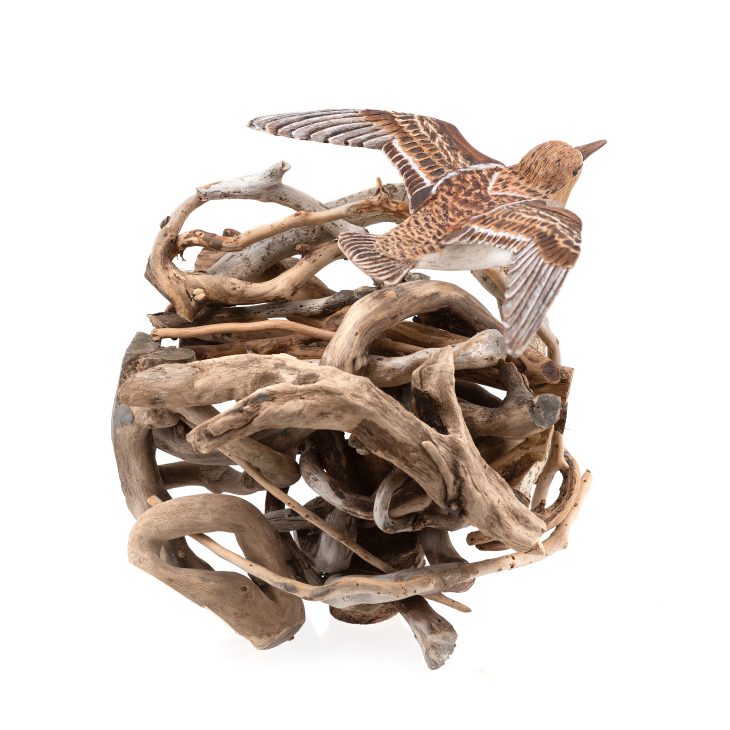
‘Little Stint’ by John and Marilyn Davies
When I arrived in Prestatyn to meet John and Marilyn Davies it was September, just as in John’s poem Things To Do When The Town’s Closed. Rain and the start of the school term had chased most visitors away, and it was easy to get into the mood of the poem. Like the others quoted here it was first published in his collection Flight Patterns (Seren 1991).
Things To Do When The Town’s Closed
Our choir dressed as guerrilla butlers
has driven the holidaymakers back.
It is September. Seagulls
are critics prying over spilt ink.
The town’s scraped off its silver lining
to get at the cloud instead.
In search of a bit of life,
Ron has started taxidermy, juggling
bags of skin like a homicidal vet.
They grin from furry cells,
near-squirrels.
You can’t keep a good man up.
And Mr. S has emptied his firm’s safe.
Self-bloodied, he faked
assault then described the villain
so well for the police photofit,
like a shout his own face rang out.
On the library wall: ANACKY.
Draughts from the Mersey Tunnel quicken
across the Dee. Wait,
slow down
at the station.
You can find yourself elsewhere.
Balloons were released in August
from Frith Beach for Holiday Fun
with addressed labels. W’s returned
all the way from Builth. His prize?
First cash, soon a court appearance:
winds blew north that day so how come W’s balloon
went south? Well, live in town
and wind is just a ghost. The label went
via his aunt in Builth, both ways by post.
Yesterday, high on a ladder with acres
to paint, Mr. S was whistling ‘Born Free’.
And although the Pleasant Sunday Afternoon Society
now meets all week, although the slipper women
at the launderette seem lively
and waves roll up in fits watching dunes
fail to outwit caravans,
it’s a bad time.
We are alone together.
Even our jeweller’s stopped twinkling.
You can’t help but feel
someone out there might be planning chainsaw
psychiatry or florist pressing.
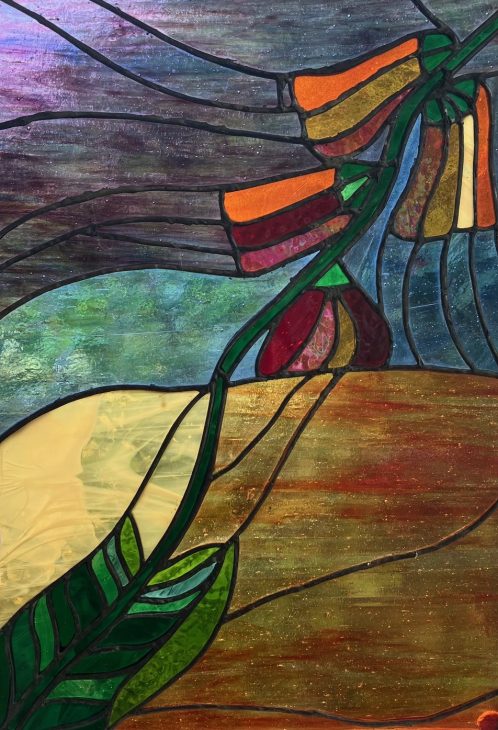
Arriving at the Davies’ home I felt some slight trepidation, having contacted them out of the blue and invited myself round, but they were most welcoming. Marilyn, a small, bright woman, came out to conduct me in, and then here was John, slower, but very thoughtful, and remarkably open in our discussions. I straight away encountered some of Marilyn’s stained glass in the windows. As we ate lunch and discussed some of John’s poems, I started to realise that the house is full of art objects which the couple have created.
Stained glass by Marilyn Davies
I first encountered John’s poems when I was looking for material for Between Rivers, and David Selzer pointed me to A Clwyd Anthology, edited by Dewi Roberts and published by Seren Books. Not all the items in the book were on topic, but one that I knew we had to use was Downing, a Davies poem set in Whitford, near Holywell in Flintshire, on the former estate of Thomas Pennant, the eighteenth-century traveller and natural historian.
Downing
Seventy, rasping, he lives in the saddlery
of the estate now run out of paths.
He keeps the tv. busy. The past? The brisk squire
who toured the eighteenth century and met Voltaire?
Not interested. But around pleasure garden, summer house,
Bob Weston cleared gullies for parched ironworks,
lopped trees in the dingles, was tolerant it seems
of poachers. The house, burned down as an insurance job,
is a DIY kit. Its drive can’t find the gateway.
Tunnels though and waterways built by miners
are intact, theirs or land’s revenge on stateliness
where ponds sag under weed.
Below on Mostyn sands, cockles have been found
by diggers in balaclavas linked to the underground economy.
Jobs, they’re rare as oysters. Unmarked trucks
sidled, and from dunes, they say, the DHSS took photos.
Bob Weston’s watched – Dunkirk again, another
scramble, grab what you can then home, the brass
will know the score. Except the brass aren’t on your side.
Now that it’s wanted for caravans, what no one could visit
is lamented. People will flood in, there’ll be petitions.
But he’ll not be collecting who likes that brandnew
pub at the junction and leaves his dog at home.
I found a copy of his Flight Patterns and was much taken with the vivid characterizations, humour and the sharply cut phrasing. This led me to other volumes of his poetry: The Visitor’s Book (Poetry Wales Press, 1985), Dirt Roads (Seren 1997), and North by South: New and Selected Poems (Seren 2002) which also includes poems from his earlier books, At the Edge of Town (Gomer, 1981) and The Silence in the Park (Poetry Wales Press, 1982). There was also a book of short stories by Welsh authors which he had edited, The Green Bridge (Seren 1988), which introduced me to several unfamiliar voices, notably Caradoc Evans, who unfortunately can in no way be construed as a Between Rivers author. Some of the poems were about belonging or not belonging in small towns on the coast of North Wales or around the Dee estuary. Before our meeting John had already sent me typed notes he had made in 1986 preparatory to the poem Downing. What really struck me was a handwritten marginal note, about the cargoes shipped in via Mostyn Dock on the Dee: bulk phosphate, woodpulp, sulphur, potash. These were not drafts of poetic lines so much as a gathering of ideas and information: to get the poem going, as John said to me. Now over lunch he produced yellowed sheets of typed and annotated historical material about the Flintshire town of Holywell, it’s mythical origins and industrial heyday, out of which he had made the sonnet sequence Burying the Waste. At the time, he said, he thought his poems had to rhyme, and the rhymes helped him to get to the images. Here is the sequence.
Burying The Waste
(Holywell)
Trapped by Caradoc, favourite of a king,
even Winifred could not deny his sword.
Where hair leaked blood, a well of healing
sprang, then the stream hurrying its hoard
of news woke up the valley. Winifred
drew pilgrims limping, eager to be whole.
He signed up slaves of cotton, copper, lead.
Her stream, severed by water wheels, rolled
machines. When Winifred spread her arms wide
to make from shadows trees, he cut them down
but she thinned the Dee channel. Its quayside
became silent, the valley a ghost town.
Now buildings sprawl headless. All around,
sprung green, half-buried: still misshapen ground.
*
Not just the Church preferred its blessings high.
This cotton mill snatched six storeys of sky
with stone from the nearby abbey’s shell
then, power untapped, St. Winifred’s Well.
An act of God, a world in seventy days.
High too squire Pennant’s recorded praise:
all the workers flourished, dined on meat,
fish, “in commodious houses”. Work was sweet.
Poet Jones of Llanasa, muffled voice
of the backwater – why couldn’t he rejoice?
“Rods doom’d to bruise in barb’rous dens of noise
the tender forms of orphan girls and boys.”
Poets. They build nothing. Just hover, stare,
write maudlin history. Except he’d worked there.
*
Ingenuity flowers in such fumes.
New copper bolts were roots helping great ships
spread wide. Brass beakers moistening the lips
of Africa, exchanged for slaves, seemed blooms.
Up there, notice, a fly-wheel gouged the wall.
In this bank, too, an opening faced with brick
like an oven gone drowsily rustic;
no grass, webs or wormcasts though. Earth, that’s all
almost. Hereabouts being where the knack
of refining human brushes took hold –
twigs bound in rags who carefuly swept back
arsenic from this flue and lived to rot –
last year they found a skull, some ten-year-old
ingenuity planted then forgot.
*
The wall keeps on haemorraging dark green
through the bricked-up centuries, through soil
Meadow Mill injected with copper spoil.
And its damp spillway is coloured gangrene
in memory of times, as Pennant said,
when workers obeyed the “antient law”
of sluicing thoroughly before meals or
watched “eruptions of a green colour” spread.
(They knew dogs, if they licked the sheeting, slept
for good.) So justice as well, urbane,
copper-bottomed, is remembered here. Yet
though the wall’s washed scrupulously by rain,
strange that metal still heaves through. Dogs drop.
It has tasted men and starves and cannot stop.
*
For three years, Frederick Rolfe alias
Baron Corvo, the Crow, pecked at the shell
of Holywell. He saw in it himself,
more idea than place, a proud man mostly
beak who squabbled, wrote and painted, furious
with “Sewer’s End”, obscurity’s rebel
till fury grew him wings. Two crows he left
in painted banners still caw “Look at me!”
Flashing, art’s narrowed gaze will open
on polluted water and turn even stones
to mirrors. The Well running wheels ran men.
Its stream’s “uproll and downcarol” Manley
Hopkins sang rang walls from where Poet Jones,
apprenticed to heartache, jumped to sea.
*
Ice tore a trench to the estuary.
Grass healed its sides. Water devised a well.
An idea, grown around it like a tree
surviving as an arched stone spell,
towered so pilgrims are still beckoned here,
a welling of belief that named a town.
When another idea for water
bricked up the flow, its weight wore people down.
The centuries keep waking to change dreams.
Dug from the undergrowth: brickwork’s feud
with stone for possession of the stream.
And voices insisting water is alive –
those pursuing always and, pursued,
those in need of miracles to survive.
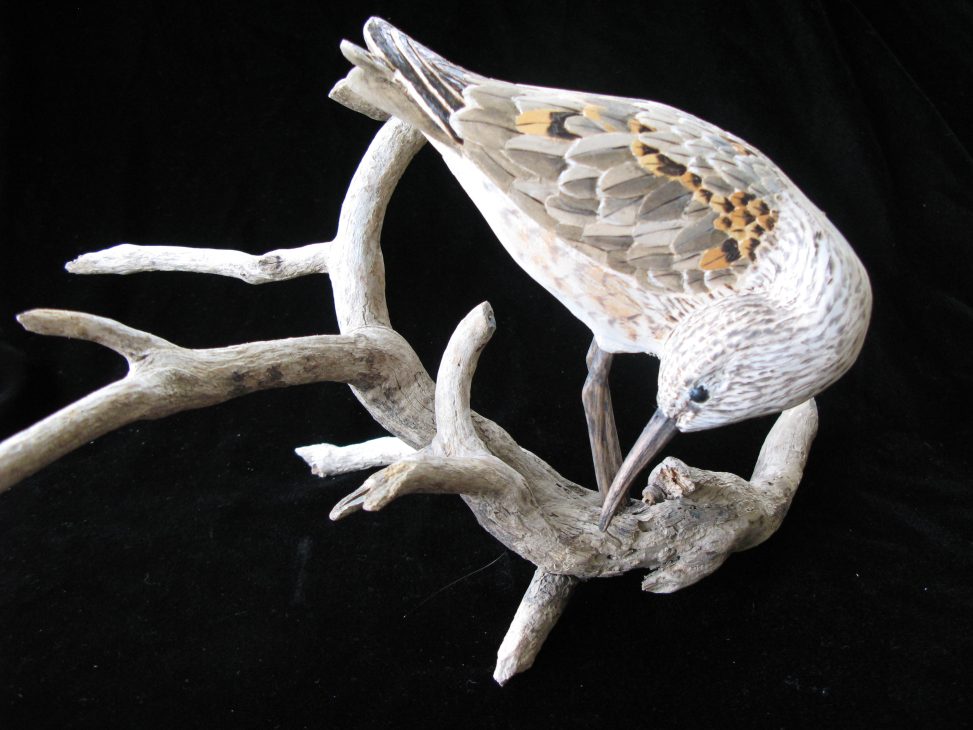
‘Curlew Sandpiper’ by John and Marilyn Davies
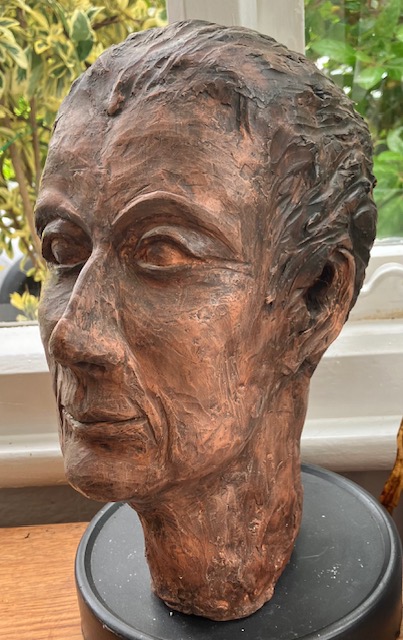
We took a break from lunch and I was shown around the house and garden. There were birds carved by John and painted by Marilyn, and artworks in various media created by Marilyn, especially ceramics.
‘Ceramic Head’ by Marilyn Davies
Outside, under a tree was a little sculpture garden.
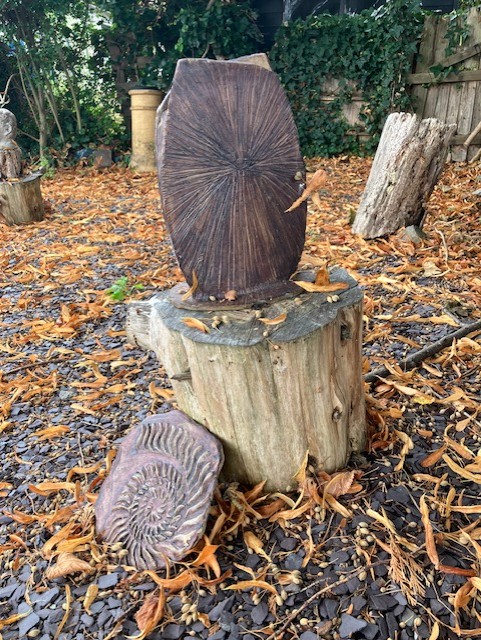
Ceramics and found objects by Marilyn Davies
Unlike John, who comes from Cymmer Afan in South Wales and does not speak Welsh, Marilyn comes from Pwllheli in the north-western heartland of the Welsh language, and spent her career teaching in Welsh-medium schools. She did not seem to push her own creations forward, though we were surrounded by them, but indicated that she had been a lifelong maker of art objects. John was more specific. When he was eleven there had been a school eisteddfod, he was encouraged to contribute some poetry and was hooked, haunting the school magazine with his poems, and continuing through a long teaching career, notably as head of English at Prestatyn High School. Important too were some sabbaticals he spent teaching creative writing at universities in the United States, in Michigan, Washington and Utah: alongside the poems about Deeside, the North Wales coast and the wider Welsh scene, his books have many poems derived from his experiences in America, contrasting but clearly linked with his depiction of Wales: there are miners, displaced first nations, powerful religion and a host of sharply-drawn characters, some of them carvers of birds in wood.
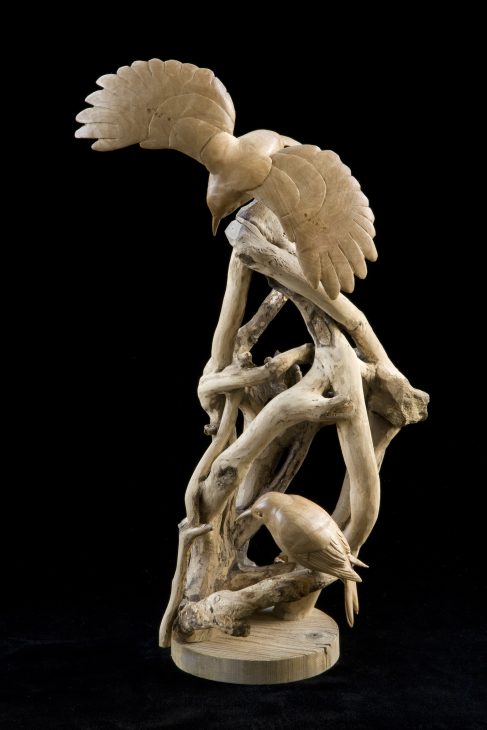
While John could pinpoint the origin of his involvement in poetry, the origin of his interest in woodcarving, and especially in carving birds, seemed less clear, but grew somehow out of a childhood love of making things like Airfix model aircraft. He recalled his mother questioning whether it was worth doing, a discouragement which nonetheless spurred him on. The skill did not come easily, perhaps in contrast to his facility for writing, but the carving of birds in wood ran alongside and perhaps behind his writing of poetry throughout his adult life, and was given a big push by his contact with others who carved birds in wood in the United States. He talks about the process at length in his most recent book, Bird River (Carreg Gwalch, 2023), from which most of the illustrations of bird carvings in the present feature are taken. The book is an absorbing mix of encounters related to the carving of birds, descriptions of the creative process, discussion of influences, poems, and photographs. The title points to the amount of time John spends walking the banks of the nearby river, the Clwyd, collecting driftwood for the mounts which have become such a feature of the carvings. As we spoke, he suddenly interjected that he loves collecting the driftwood and putting it together with the birds. Really, he told me, the driftwood has become the main event, a sort of gift that appears twice, first when he finds it, and again when he opens up the store in which it has been left to dry. He felt so thankful for it.
As in the poetry collections, Bird River contains a good deal of humour:
Then there was the small tribe of young men living by the Clwyd for about four months last summer, on a muddy creek at Rhyl. Some lived in a sod hut they’d built, flying a Welsh flag. Some lived in tents. Nearby was a handsome structure made of driftwood and a large bakery tray. By the time I encountered them, they were shooting rabbits and fishing but had decided not to kill pheasants because it was the breeding season. They were jobless. A lot of the money saved on accommodation went on drinking in the scenery. And they left behind, filling two burned-out cars already there when they’d arrived, hundreds of beer cans shining silver against the rust-brown like an Arts Council installation. I admired their enterprise, living, as one of them put it, ‘the rock ’n’ roll lifestyle’. So when later one of them checked out my armful of wood and driftwood-collecting costume and asked, ‘Sleeping rough, are you?’, I felt oddly flattered.
John carves the birds and they are then coloured by Marilyn:
Once John has finished the carving, it’s usually over to me. The first stage is to use a pyrography tool to produce the texture of the feathers… A low temperature will produce a light mark and hundreds of these barbs are required to give the bird a feathery look. At a high temperature, the tool can also be used to produce dark brown markings. Sometimes, with a bird such as a curlew, which is basically white and brown, white paint or dye and the use of pyrography is all that is required. Compared with a paintbrush, even a very fine one, it’s more accurate. But most birds will be painted. Many British birds are what birders call ‘little brown jobs’, so achieving shades of brown and grey is vital. The colours I use most are earth tones: Raw Umber, Burnt Umber, Raw Sienna, Burnt Sienna, and White.
(Marilyn Davies, quoted in Bird River)
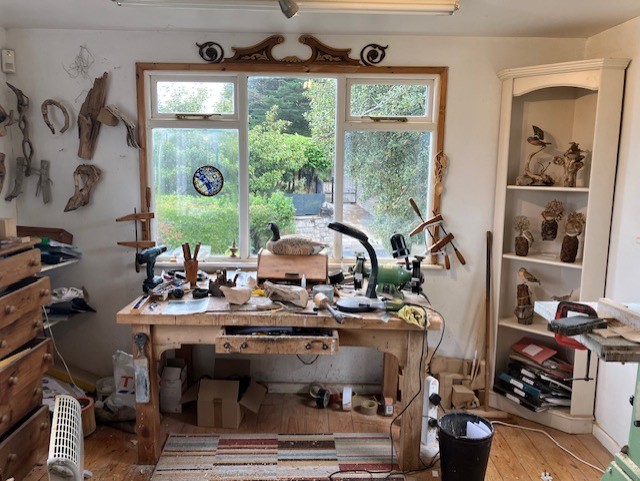
My tour of the Davies’ house and garden concluded in John’s workshop.
Workbench in John Davies’ workshop.
Surrounded by tools, partly fashioned carvings and driftwood pieces waiting for use, it was the tactile nature of it all that struck me. I asked John if carving the birds had replaced writing poetry. He was emphatic: yes, that was right. How did that happen? Again he was quite direct: he had found that he was writing rubbish, and it was embarrassing when editors who had once eagerly accepted his work now sent it back with a more or less polite rejection. He thought that poets commonly ran out of steam as they got older: the reactiveness that fires the images becomes less, one is not so much moved by events. I asked him if the tactile nature of carving and the fact that driftwood is a found object – a gift, as he put it – helped him to get the artwork going. He seemed to think that this was right. He was so grateful, he said, that the carving was there when his poetry gave out. It was the second time in our conversation that he spoke of his gratitude for what this form had given him.
In Bird River, John adapts a poem from Flight Patterns which ties together his preoccupations with woodcarving, birds and the environment of the estuary. This is Decoys. It takes the form of a dialogue between the poet and the Parkgate wildfowler Harold Gill. Gill was and remains a somewhat legendary figure in his locality, one of the last people to earn his living by wildfowling in the Dee estuary, and certainly the only one to record much about the life, in a remarkable memoir Dee Wildfowler: the last professional (1982), edited and published by Leslie Brockbank. Here is the complete original version of the poem.
Decoys
(in memory of Harold Gill)
My timber for carving’s from the shore,
driftlumps water sluices out
so it dries fast and won’t crack. Elm most of all.
Bones in the woodshed’s drought,
they clench. Opened months later, a store
of ripeness surprised is the windfall.
We’d leave for Mostyn, cross
the Shrouds. You had to know the water.
What use is a duck-punt once a week?
You’re not informed. Birds on the ebb won’t stir,
just sit there packed. The flood brings chaos.
High tide meant hide-and-seek.
I carve birds, ducks often: pintail
and mallard, a teal, shapes wood lays for the hand.
Bandsaw for roughing out — check the grain
runs with the bill. Chisels, rasp. Elm is hard sand.
With oil or polish, what’s been fingered stale,
another late surprise, is sunburnt terrain.
Each day — start early. We liked a NE
in the face when we picked our spot:
no wobblings, steady as she… Sixty yards
for a clean kill. 20 ounces. AA shot.
But for food, I wouldn’t have killed — at least
not birds. Smooth the feathers, keep no scorecard.
Best I like the curve where crown, cheek,
sweep down through the swell of chest,
the sweptback, cleared-for-action prow
of a poised gathering unrest
that, from the moment’s peak,
though wood, might just take off, go anyhow.
It wasn’t the birds mainly,
that’s something I can’t nail.
One chap I took, a February morning,
sang for hours — threats to shoot him failed.
Never sung before. The estuary
was fine, I lived on dusk and dawn.
Beyond wood: an airy something
from nothing wood’s a pretext for.
Alone at last with the whole mind’s scope,
you drift. Almost a familiar shore.
Stirrings, gleams are stalked, and springing
this time they are yours, you hope.
Not that bird carving is entirely without drawbacks. John told me that it was hard to find others working in the same field locally, or even further afield. In the United States he appears to have found a vigorous community of fellow carvers of birds, leading to various escapades which find their way into the poems; but not in the UK. He thought that this might be because of the time the work takes: he recalled a woodworker at a craft fair who had “Bloody Ages” printed on the back of his jacket, in answer to the question which is always asked. But John said that the slowness of the work did not bother him: it was the whole process, not so much the end product, which was engaging.
As I made my goodbyes, the Davies’ thanked me for taking an interest in their work, as if few people noticed it. I confessed myself baffled: there is so much there to take an interest in. I hope you have enjoyed reading about their art in this edition of Between Rivers. If you would like to find out more about their carvings of birds you can visit their website, Birds In The Wood, or visit their Facebook page.
‘Treecreepers in Sycamore’ by John and Marilyn Davies
BETWEEN RIVERS is a quarterly series edited by Alan Horne. It is focused on the area bounded by the rivers Alun, Dee and Gowy, on the border between England and Wales in Flintshire, Denbighshire and Cheshire. You can read about the background to Between Rivers in the Introduction
In 1973 a book of my poems entitled ELSEWHERE appeared in the first Peterloo Poets Series edited by Harry Chambers and published by E.J. Morten (Manchester).
2023 being the fiftieth anniversary of the book’s publication I have decided to re-publish the original volume on my website as a flipbook and as a pdf. Each has been painstakingly produced by Sam Hutchinson, who designed my website and maintains it.
Each is a facsimile of the original book and not just a copy of the poems. Readers need to bear this in mind when searching for a particular piece. For example, the first poem Connections 1 is on page 15 of the pdf but listed in the Contents as being on page 11 of the actual book.
View the pdf page turner:
View / download original .pdf:
The ELSEWHERE 1973 & 2023 project will be in four parts, appearing in April, June, September and December 2023 respectively. The flipbook and the pdf will be included in each part, accompanied by an article about the work.
ELSEWHERE Poems by David Selzer: A personal review by John Huddart
Packed in behind the dashing photograph of the author on the back cover, whose enigmatic gaze conceals the trace of a smile, is a portrait of a life devoted to family, and to the world that made it. Here is an explorer whose interests already range from modern history to the display of scholarly erudition, and from felt experience to quizzical distance. And, as a book about family, it is immersed in ancestry, in forbears, and in the magic circle of the three people who make his world, who see him through.
It is also rooted in literary tradition, echoing the themes and perceptions of many writers, and paying homage to their influence.
Travel the fifty years to where we are, and ELSEWHERE still dominates David’s world – with the addition of a fourth person– a granddaughter who makes the trio a quartet. And the voice is still the same – sounding out from the corner of his front room study, with its view of the street and the outer world of traffic and pedestrians, and the vague threat of anarchy and crime; still filled with reference and connectivity – but now transformed into a poetic journal uniting the daily, the personal, the urgency of politics and compassion, and a continued radical despair – to which age has brought a ripeness, an acceptance, and a deeper love above all of everything, and everything that’s close.
But to the beginning. I first met David in 1974. Shortly after that I collected my copy of ELSEWHERE from a bookshop near Chester Cathedral. Its poetry taught me the serious value of words, and the respectability of ironic detachment. That gaze, often satiric, together with the handling of phrase and sound, makes for the excitement of the verse. Also the verse line – rhythmic, spare, usually free in form, but also happy to pursue a traditional metre when demanded. Finally, a use of concealment which allows the reader freedom to pursue his own ambiguities.
This meeting also led to the refreshment of Wrexham Lager, and the mighty power of usquebaugh – so great I hardly dare speak its English name! I was told by Margaret Spence, whose kindly wisdom launched the careers of many English teachers in Liverpool University’s Education Department, where she was a Senior Tutor, that David was a sensitive man with whom I would enjoy working, and she missed only one thing – that his friendship would become a strong and necessary part of life itself, and the sharing of a dram its most blessed sacrament!
The contents of the book announces only fourteen poems, but neglects to indicate the range they cover, the way the inner and the outer worlds are so deftly handled. Does not indicate the promise that in so many lines will be found the memorable idea, the magic phrase that persists upon the tongue, and haunts the memory.
As an ordered collection it begins with two poems of connections that illustrate that reading really matters, and that everything connects to everything else, then tackles the same thing in Monuments, which depicts his honeymoon in Ireland. Here love calls above the estuaries of history and nature, which ostensibly are the monuments in the poem, so by the end he’s home, behind his own high windows, if still surrounded by the ghostly menace of the past and its scurrying rats.
Then he’s waking, in New Year 1970, from a restless sleep on a New Year’s Eve – the three of them are there – wife, daughter and himself, and he is caught up in a storm of confusion, where the tokens of his twenty eight years are banished by a world of triviality, and he is (first choice of memorable phrase) ‘pacing vanity’s iron zoo’
It is a world of punishing inequalities, and of imperial echoes which are glimpsed with satiric affection in Old West Africa Man, and then in New Heroes, the new imperialism of space conquest propels the newly dominant Americans to occupy the moon as pointless conquest, mere expense – as futile a because-it-was-there adventure to match Scott’s in the last poem of the collection. New Heroes also contrasts the three astronauts with their ‘monstrous crepe soles’ scouring the Moon’s surface with the earth-bound Selzer family, staring out over the fading facades of commerce, and the wider human achievements of Auschwitz and the industrial revolutions whose advances led to all of it, and to our prosperity and present inequalities.
This intensifies in The Chimney, where the wastes from a nearby oil refinery present the worrying menace of polluted fields and gardens. Here is a poem well rooted in its era, where questions about those processes which once signalled, and brought, the wealth of nations were making challenges to our too easy progress.
And then, The Zoo. Each zoo homes species whom contemporary Noahs have endowed to save, while presenting their infinite variety for us to marvel at. David’s zoo presents them for the strangeness they often possess – whether striped, copulating, or swivelling their monstrous eyes. Somewhere in the background stalks Ted Hughes’ poem The Jaguar, which was then a proud centrepiece for English teachers, but Hughes sought to make the cat the subject. The true inmates of David’s poem are the people whose habits and behaviours are equally alarming. He shares the amusement and delight of inmates looking out at their human captors. There’s genuine horror in observed human behaviour – witness the visitors who today would be described as having special needs, but the poem identifies, using the cruelty of the age, as ‘mental defectives’.
David’s zoo is rich, engaging and eternal – zoos have both moved on, and stayed compellingly the same. There is a touch of Brueghel in the splendid grotesques on view, either side of the cages. Also, a whiff of proud English amateurism in the conduct of the keepers, especially as they seek to feed or placate their elusive gibbon. Three years ago my daughter and I visited Delhi Zoo, there being nothing else to do on Monday in India, and here was David’s poem, stalking the cages.
Babel’s Villa is partly a homage to a Selzer home. These have been their lair and refuge for as long as ELSEWHERE has been abroad. This one, bomb-damaged in the war, and repaired with sea-sand, both reflects its history and menaces its inmates. On this night, wind and rain are threatening tumult and destruction, and both David and Sylvia are showered in plaster dust from the raging storm. They lie side by side, covered in grey dust, like the couple in Larkins’ Arundel Tomb. And this poem too proves to be about love, and it ends with a kiss, and happiness.
Jacob is steeped in so many stories and European myths and you can invent countless narratives to provide a key. As soon as you think it’s a personal story, its slips away into allusion and mystery. We are tripping though the same worlds as Eliot’s Waste Land, but with a theme that repeatedly echoes Jewish histories. These echoes draw you back repeatedly, as do delightful lines like ‘Old crow, I think, kissing her beak’, and the crow performs a central and repeated role in the narrative – much maligned of birds, but watchful mourners, hungry for our remains.
Times Countries alludes to many times and places where they do things differently. Living near to Berwick and the Scottish lowlands I’m straight way immersed in the authenticity of the local detail, but this presented childhood memory runs on through references to many things that make our present history. Wars, empires, sports, the dance, all there. A novella in verse, skilfully and uniquely, rhymed throughout, it is Tolstoy striving to get out.
And in Suicides there is a hint of Ariel’s description of the drowned man in The Tempest, and her death is indeed made beautiful and strange – as nature claims her body back again. The poem creates narrative that entirely plausibly accounts for her life and death.
At the centre of ELSEWHERE is the line ‘Elsewhere is metaphor’. It’s a pivotal moment in the volume’s title poem, for, from then on, it becomes a hallmark poetic journal through experience and his family’s visit to North Wales. Before the quoted line, the poem is the typical meditation on history that David does so well, and how it impinges on the visitor if they are alert to read the landscape and the back story. ELSEWHERE is therefore both in the present and forward looking to the writer David has become. We can only be thankful that he’s there to bear witness and continues to report on what he sees and knows.
And so to Scott of the Antarctic in Scott’s Last Expedition. These are the kinds of heroes David cares to celebrate. Not any VC or a boy upon a burning deck – three men who freeze to death for nothing, and whose sacrifice became a fitting comment on the English and their love of futility. Imperial echoes resonate, and all is capped with the inadequate values of the public school which spawned them. This is summed up in the powerful symbol of the tent – providing shelter in no way equal to the task ahead. Although there is much to mock in the values that impelled the mad dash to the Pole, for the men themselves there is a deep respect. ‘O brave, recumbent boys in sliding ice!’ There is always the satiric edge to David’s view of those whose vanity and values he finds wanting, but he never misses the humanity, and sometimes the grandeur of the human condition, in its folly.
And now, for fifty years these poems have lain here, alive like the memory of Scott’s men. They have been doing their work, inspiring others who have met them, and can summon up their lines. How good to see them re-published in a new online version, where their inventive insights can kindle a new generation of readers.
So ELSEWHERE is here, and now, at last. Of course, where else?

 By David Selzer