
I was somewhat surprised when David Selzer contacted me to contribute to OTHER PEOPLE’S FLOWERS; in part, because I would struggle to describe myself as a poet and have no formal training in that field. I have nevertheless written profusely in the last five years and occasionally in the time before that. It has however, not been a lifetime experience of studying and honing this craft. So, please excuse the ragged edges of my words and what may appear to be a lack of scholarship.
The Unknowing
I know not from whence it came.
It’s origins little matter.
It is a flow.
Sometimes unceasing.
I am not learned in these matters.
Of verse, of rhythm and rhyme.
I am ignorant of iambic pentameter.
Of the subtleties of poetic expression
I follow
the words
as they tumble
somewhat chaotically,
from an
overactive psyche.
Often, I trip over them, as in a rush,
where grammar and typos are
stuttered onto the small
screen held in my hand.
No fountain pen and florid
handwriting, in this impatient
execution of thoughts and
feelings.
A staccato pom, pom of
vocabulary, fired at
unseen targets.
Momentary flashes of
cognition and impulse.
Feelings unprocessed, as
screamed into a roaring gale.
Lost, as soon as uttered, swept
away by elemental forces.
Meaning denied thoughtful
reflection and editing.
Words, just words.
They are existential.
I ponder briefly on their
lack of depth. I remain
untroubled by this stream
of consciousness.
Entering The Maze
I come to this platform with a story to tell, of a life lived differently. Many of my years were spent masking two fundamental personal and challenging truths – that I was neurodivergent and gender-variant. The former was eventually diagnosed last year at the age of 71, the latter, a realisation at the age of seven, but not acted upon until 49. Both combined to set me on a heroic quest, in the style of the Homeric poem, The Odyssey. I had to face my own demons, otherness and cognitive struggles; having a brain that didn’t function as my many neurotypical colleagues did and having an identity that was at odds with itself. Not all challenges are a product of the external world, though I encountered many of those. Having an identity that differed in two significant domains created a maelstrom of emotional and psychological turbulence.
Identity and how I made sense of myself, was intertwined with familial and social mores. Underpinning how I would engage with the world were words which, as a child, had little or no meaning; ‘freedom to act’, ‘liberty’, ‘permission’, ‘autonomy’, ‘agency’, ‘authenticity’ and ‘otherness’. These concepts flowed through my lived experience as the years passed. They were lifelong, in their resonance and their implications, for me, and the relationships of which I was a part. These were not merely the harpies and sirens of Odysseus’ ten-year voyage; they were an existential struggle that would shape and define me. Whist I have navigated significant obstacles, I recognise that this does not negate the distinct hardships others have faced and continue to do so.
Seven years ago, quite accidentally, I started writing what would become my autobiography. As Maya Angelou sagely observed, ‘There is no greater agony than bearing an untold story inside you’. So, I started writing a chapter around my family’s history. I had just completed our family tree, back to the late 17th century, and submitted a sample for DNA tracing. I am part Viking or berserker. This will come as no surprise to those who know me!
The Vikings found their way to the Wirral Peninsula and caused chaos, as they had throughout the isles,in places formerly settled by the Anglo-Saxons and Jutes. There was a savage battle at Brunanburh (now Bromborough) in 937AD. It has often been described as, ‘the mother of all dark-age bloodbaths’, between King Aethelstan’s Anglo Saxons and the combined forces of Vikings, Scots and Strathclyde Britons. Aethelstan was victorious in this existential fight for English identity. (There’s been some debate as to the location of the battle, but Bromborough is most likely.) So, I begin this tale of my historical identity with a crushing defeat. More setbacks were to follow.
Saxons
I meander along lanes set
by old enclosures.
Never far from history here,
in this land of invaders.
When Saxon ploughs once
tilled the soil.
When times felt settled.
But turbulence arrived with
the Northmen from across
the straits.
Their number was many,
their resolve unbowed.
They met us in battle
on Senlac Hill.
Ground walked by
our ancestors by way
of the downlands
and valleys.
The battle was bloody
and robbed us of our
place in this land.
A land, we too had
invaded, and made our own.
How cruel fate turned us
from masters to slaves.
Where justice was
metered out by the sword.
Our land assayed to
proffer geld for the king.
We now scratch a living
through briar and bramble.
The fertile lands seized
by Norman barons.
Our lives blackened by
reprisals and cruel assaults.
We cower beneath the many
oppressions that steal our
dignity, year upon year.
All this, whilst old kings
of Saxony lie buried in
their longships.
There, bejewelled in
intricate designs of garnet
and gold, their bones
cling to sovereignty still.
Beyond that first chapter of my book, an evidence-based narrative emerged, interleaved with family history and framed by various disciplines; psychology, educational theory and practice, sociological discourse, epidemiology, the various political perspectives on poverty and inequality, feminist studies of sex and gender, and a smattering of the hundreds of poems that rushed into my head and out onto the page like an outpouring of lava. (Yes, I used to teach Geography along with Humanities and PSHE [Personal, Social & Health Education], in the same high school as David. Our first coincidence of trajectories).
This book remains unfinished and the reasons for that sit within my ADD inattentive psychology ; perfectionism and procrastination – I struggle with the ‘absent’ completer/finisher role – and also due to a certain poverty of spirit caused by over a decade of a profound energy-limiting illness, ME/CFS.
I have been an innovator in both education and health sectors, and an observer and curator of my life and others, through prose, poetry and photography. For the visual could often help me to express and convey what words could not, particularly through the stark imagery of monochrome. I aspired to be a professional photographer in the 2000’s. My business was called ‘The Space In-Between’, and reflected the relationship between the photographer and subject. An elusive moment in time captured by framing, composition and aesthetics. From a business sense, my timing coincided with the mass acquisition of smart phones. Everyone had a phone with a built-in camera – and believed that they were all photographers.
Failed business ideas aside, it is worth reflecting upon how we each develop and communicate our personal narratives that are as unique as our DNA signatures. As the educationalist and orator, Sir Ken Robinson remarked, ‘our like will never be seen here again’. So, this opportunity, through David’s invitation, is one of my defining moments, like inky fingerprints on white paper. Leaving my mark. It is a pause in a long and sometimes turbulent and dynamic story – though not one of criminality!
Being outside the characteristic norm I was so involved in disguising my true self. Looking back, I recognise how exhausting this was. It resulted in more than a handful of burnouts. It was a process of ‘navigating normality’, through various mazes, whilst hiding within them, desperate for my truths to be unseen.
Betwixt & Between
Existence as a continuum;
moving internally from one identity
to another. Skating on thin ice.
Dangerous and exhilarating.
No one tells you how exhausting
this way of being is. The pretence,
the masking, the hiding, the fitting in,
the re-appearing. So many roles.
And yet, for most of it all, presenting
consistently. The person they needed.
The comedian, philosopher, strategist,
socialist, lover, parent, close friend.
Burnout, just around the bend, in
this madcap kaleidoscope of me.
Too much acting, too little authenticity.
Shape-shifting and lost in a dervish dance.
And in the background – despair, and
blackness – down below those surface layers.
Below what they saw on the outside.
For there, almost dying, was my soul.
Catherine, lost, in the shadowlands.
After my B. Ed, and with the collapse of LEA teaching pools, in 1977 I applied for thirty-three jobs, in my best handwriting. Desperation was creeping in. I applied to Stanney High School in Ellesmere Port. [It was the only job application outside my preferred radius of the East and West Midlands. I had been at College in Nottingham, and it is where I felt I belonged].
The Northwest reminded me too much of home and school and the ripples of dysfunction that lay there. Some of those were to do with a miserable experience of grammar school education at Prescot Grammar School. It was characterised by bullying from my peers. I had unfortunately disclosed something of my identity to someone I thought I could trust – the news swept through the testosterone-ridden year group like a wildfire. For three years I was known as ‘The Girl’. An identity that was reinforced by being in the school play, The Miser, an 18th century French farce by Moliere. I had auditioned, based on what proved to be a rumour of a joint production with the Girl’s Grammar School. This was a fiction. I was cast as Marianne. The bullying intensified, but I was revelling in my own dream world.
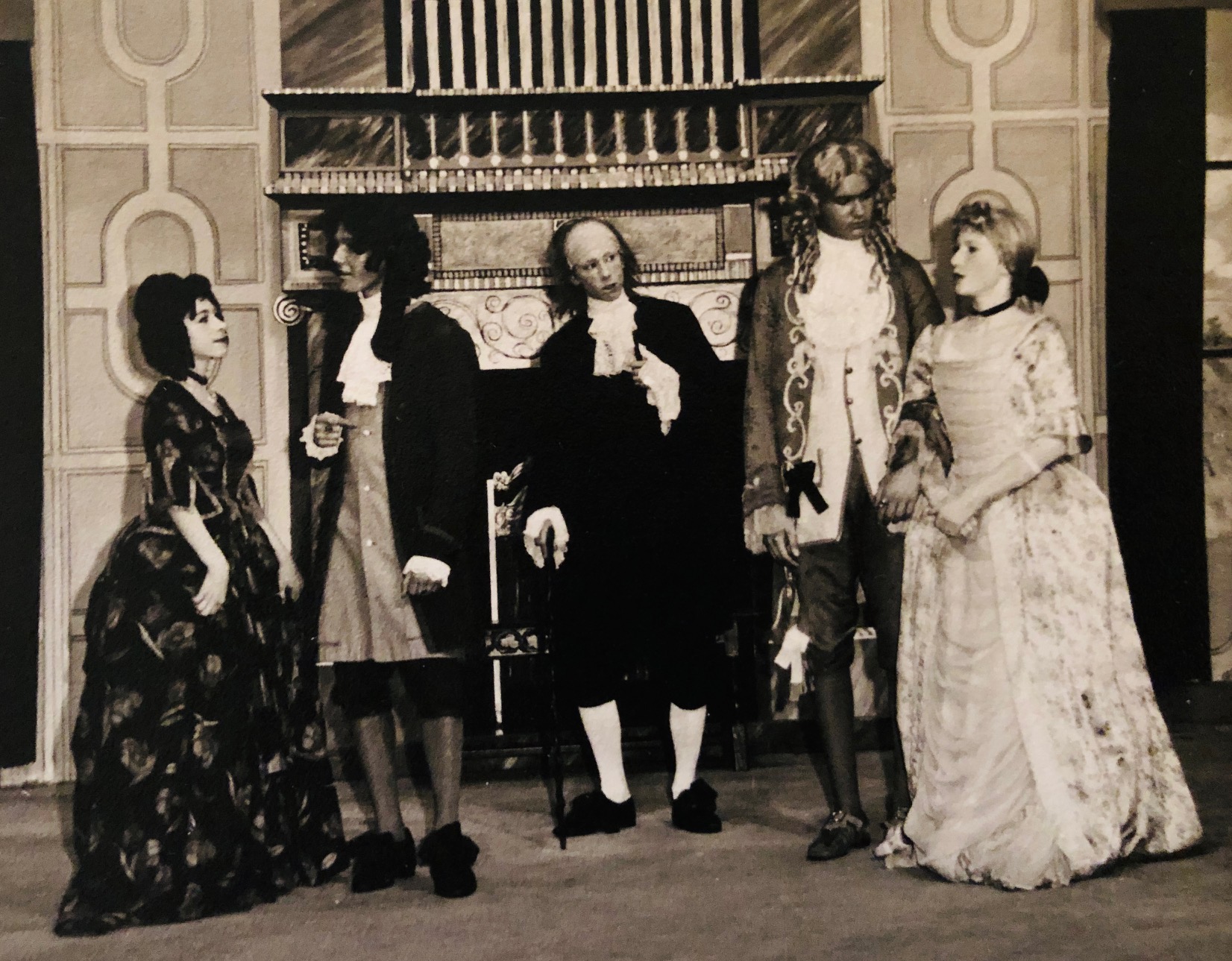
Just pause for a moment and look at the photo of me on the far right. You’ll see that I am wearing evening gloves, they were gold, for those watching in black and white. My mother was something of a diva. If she’d known any gay men, she’d have had her own coterie of followers. As I mentioned these were my mum’s evening gloves (not mine) which she donated to my costume. Look carefully on my left arm you’ll see a white strip beyond the gloves. This was a long bandage.
I had taken a shortcut across the school field, after the Dress Rehearsal. I was hurrying across the field, it was pitch black. I knew the skills of following a trail as I had been in the scouts for a week. Despite such advanced woodcraft skills, I didn’t see a six-foot-wide field aerator in front of me. This was a medieval piece of equipment, which was normally dragged around the playing fields by the groundsman’s old red tractor. I fell with some force onto the long, truncated metal prongs. I saved myself from serious mutilation by extending my left arm as I fell. Unfortunately, my left arm, about 6 inches from my wrist was impaled, just missing my radial artery. There was, nevertheless, much blood. I struggled home. There as now a trail of blood from the scene of the accident. My father rushed me to A&E, where the wound was cleaned and stitched rather clumsily. I still have the crooked scar. In another life ,with such a scar, I could have presented well as a pirate. The evening gloves hid a dramatic back story in my brief acting career. I stayed clear of acting after that and carried on masking. It is known that at the Carnivale, in Venice, men wear masks over their masks. I was following a long tradition of disguise.
As if this wasn’t enough to deal with, there was the sadistic behaviour of many teachers, and the monotony and tedium of a curriculum more fitted to the 19th century. Indentured servitude comes to mind. None of this was well matched to a high functioning but chronically errant neurodivergent brain whose morphology was akin to Emmental.
Pedagogy as pain, then as passion
1544
Founded in 1544, and, since my
enrolment, in terminal decline.
A small enclave of learning in
the late Middle Ages, when
serfdom was the lot of the many.
A time, when Prescot was a
place of substance and
held judicial and clerical rank.
Granted Royal Charter; the town
and lands, inherited by Henry IV.
It’s educational allegiance to
King’s College, Cambridge,
where the gifted few still
gained scholarships and degrees.
Outside privies, the place of
torture for newbies, in short
pants, caps and new blazers.
The smell of Jeyes fluid
catching in their throats.
Wooden desks etched with
blue-black ink and witness
to generations of tedium.
Teachers in black gowns,
none by Balenciaga.
‘Salve Magister’ and the
terror of my Latin Master.
Cruelty across the curriculum,
and of punitive detentions.
There was little joy, as each
day blurred into the next.
Evenings consumed by the
strict demands of homework.
This was serfdom re-imagined.
Tied to the daily toil of
beatings and boredom.
No reprieve for the inmates.
The school, a brick base
with creosote cladding, a
temptation for any
aspirant arsonist.
It met its fiery end from
one of the many prisoners,
pouring petrol on empty
hopes and promises.
The school motto,
Futuram
civitatem
inquirimus.
‘We seek a future state’.
Who knew that it would be
a funeral pyre to drudgery?
These were experiences I didn’t share at my interview. No, I wasn’t the arsonist, but I had a history that I was never going to disclose, that was just as flammable.
Little did I realise that it would be a challenging experience. I was young, naive, and hoped my quiet desperation didn’t show at interview. Fortunately, senior staff took to me and offered me the job. One of the benefits of being a shapeshifter is that I can adapt, chameleon-like, in any given situation. A helpful superpower for ‘teacher as performer’. I was the second person in my final year to get a teaching job, many didn’t.
The reality was that I was trying to progress a career in a downbeat comprehensive school, formerly a Secondary Modern, serving the neighbouring social housing estate and outlying villages. It fell in the bottom quartile of educational metrics across Cheshire. Week after week it felt that I was sprinting a marathon and my neurodivergent brain was never really in control. During this ‘life in the liquidiser’ I found myself more interested in how students ‘are’ in this world, ‘their sense of being’, rather than what geographical knowledge I could impart to them.
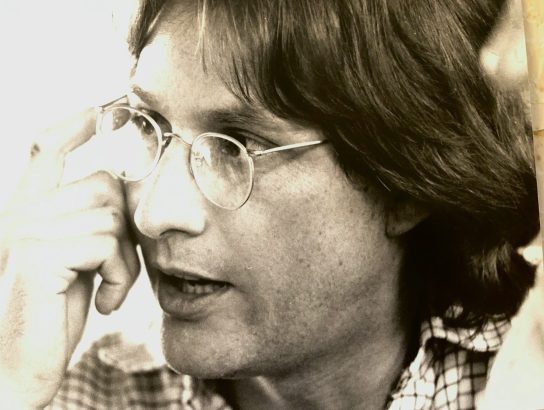
Photo taken by a colleague, Tony Kelly. Lunchtime at Stanney – in the staff room, circa 1983.
Some years later, following training and being part of Cheshire LEA’s ‘Counselling Skills Training Team’, I became the School Counsellor. A sense of peacefulness prevailed. It was one of the most meaningful times I experienced in a long professional career.
Caught in mid air
Somewhere between the firmness
of ground and the free moving air;
there is a place of stillness where
the eddies of life don’t trouble me.
Distanced from those times of
perpetual motion, of freneticism.
When work often demanded more
than I could give. But still, I gave.
Times of stress and tension
when perfectionism became
an unkind mistress.
When work became a necessary
distraction from pervasive thoughts.
As if I could hide from myself,
remove temptation and be
normal.
When normal was real and yet
inauthentic.
When life was only partly lived.
When I was not yet me.
David Selzer had been seconded to the University of Liverpool for the year, 1985-6, to undertake his M.Ed. It seemed that was the domain of Deputy Heads and Senior Teachers, and that middle-ranking teachers didn’t aspire to such goals. Nevertheless, I was keen to immerse myself in an academic experience, I wasn’t so much ambitious as educationally curious. It had been nine years since I started my teaching career at Stanney. I talked it over with David and, with his support, I applied to study for an M.Ed. I didn’t expect to succeed and yet I was accepted. More coincidences of trajectory. My secondment went well, until it didn’t.
In the May of 1987, during the final semester of my M.Ed. my father was hospitalised with pancreatic cancer. At this time I’d picked up yet another throat infection but, despite two courses of antibiotics, the symptoms worsened. I experience dreadful fatigue and brain fog. The data analysis for my dissertation ground to a halt. I was struggling to read The Beano, never mind journal articles on phenomenology. My father’s condition worsened and within a month he had died. My mother was bereft and attempted suicide. It was the worst of times, and I was unable to complete my Master’s. I didn’t return to school until the summer term of ’88. My body was, as I have mentioned above, enfeebled by the experience of having Myalgic Encephalomyelitis (M.E.), known in the press as Yuppy Flu, as it had an unfortunate habit of striking down high achievers. I took me a further two years to get my strength back. I was one of the fortunate few to recover, that is until my 60’s when it struck again.
The Normality of Difference? Maybe around the next bend?
Let me digress. From my days in college to the present day, I have been passionate about photography. My interest in it led me to the writing of Susan Sontag. In one of her many interviews, she touched upon the notion of storytelling, which is elemental to life, literature, film and the narrative within photography. She described the duality of storytelling. ‘Don’t you think at the very centre of the whole enterprise of storytelling, there is the fact that storytelling is an activity that faces in two directions. On the one hand, it’s connected with an idea of truth. On the other hand, it’s connected with an idea of invention, imagination, lies’. We experience this in fiction but also in everyday life, where we are privy to people’s stories, for example, OTHER PEOPLE’S FLOWERS, that they choose to share with us. Telling stories is another matter entirely.
I was wary of sharing anything of my gender diversity, after my dreadful school experience. In the 70s and 80s jobs could be lost by such foolhardy disclosures. Despite a gregarious and seemingly open demeanour, I carried my sins of omission, as increasingly heavy baggage. In the context of film, I am drawn to Mike Leigh’s ‘Secrets and Lies’. This portrayal of this unravelling of family dynamics, is a cautionary tale of duplicity, shame and guilt.
So, for much of my life, I hid behind such deception. My secrets, my lies. If there is any justification for these behaviours, it is in the very essence of self-preservation and the avoidance of rejection ad exclusion. There is a characteristic that many people with ADHD share – Rejection Sensitivity Dysphoria. Oh no, not another dysphoria to add to the mix! It means that neurodivergent people experience an extreme emotional sensitivity and pain triggered by perceived or actual rejection, criticism, or failure. Best to be avoided at all costs then!
In my birth family, dynamics were problematic. In this Oedipal collection of father, mother, daughter and son, there were ever-present, one-sided allegiances and tensions. I refer to myself here as AMAB, assigned male at birth. I never revealed my identity issues to either of my parents, but I had, unfortunately, in a moment of despair, shared my truth with my elder sister, an action that would have serious consequences.
My sister, out of duty, would invite our mother over for Christmas, after my dad had died in 1987. They were difficult times. It was some Christmases later, in my early 40’s, that the lack of Christmas spirit played out damnably. By this time my 16-year marriage had broken down due to my dysphoria. (Because of the love that still maintained, we became a reconstituted family of two children and four grandchildren). My mother was, once again, invited for Christmas. During a spiteful row between my mother and sister, my sister, who had been accused by my mother as being “always tricky to deal with’’ and who ended with the comment, “at least our John is ok”. My sister immediately retorted with, “Oh no, he’s not”, and then shared my confidence with her. My mother, a very self-obsessed woman and not noted for her empathy, was shattered by this disclosure. It was left to me to pick up the pieces. Once a peacemaker always a peacemaker.
No son of mine
It is what he would have said,
if he had known.
If I’d had the courage
to wrench the words,
from the terror in my belly.
For I knew him and his
small world view.
His many prejudices,
his fearful insecurities.
We had never been close.
He never shared his feelings.
Austere and distant from my
experience of life.
Separated as we were
by frosted glass.
So, the deep sense of shame
I carried, sat with me.
I was burdened and saddened.
I kept it from him, from all.
He had probably wanted
another daughter.
And yet he had one,
in different guise.
A feminine spirit hidden
these many years, from view.
And in time, he died,
none the wiser.
My authenticity denied by
the fear of his rejection.
My life paused by prejudice.
Let me rewind the video and stop at an extract from my draft manuscript. This illustrates how the origins of my story started to unfold over one weekend, whilst staying with my grandparents.
After he’d taken his time squinting through the papers, Pop (my grandfather) tended to the garden. The garden surrounded the house on three sides, lawned to the front, rose garden to the side and allotment and greenhouses at the back. It was always beautifully tended. This gave me the chance to rummage through the papers – The News of the World and The Sunday People. It was Sunday, the 19th of November 1961. I was seven years old. I was flicking pages and came across an article about a woman, April Ashley in ‘The People’.
She had been a Vogue model and was so beautiful. As I read the paper, I had one of the most formative experiences of my life, in fact, it changed my self-concept forever. More accurately, it confirmed what I already felt. April had been outed to this newspaper. She had been born, George Jamieson, in Liverpool in 1931.
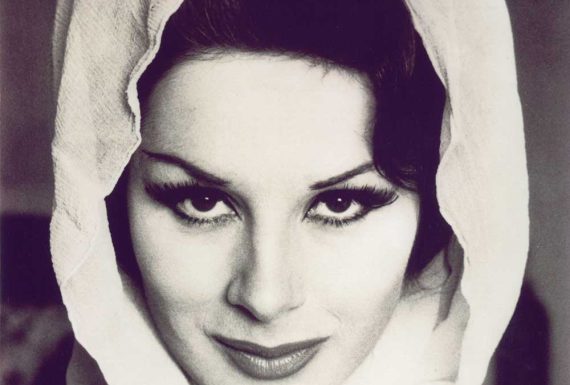
She was to become an icon of the Trans Community and by her example, many children, young people and adults with gender dysphoria, who would have led miserable lives of repression, guilt and shame, unfurled and led authentic lives. I cannot recall the moment with absolute clarity, but I was left with the awe and wonderment of it all. I had a revelation that my sole reality was also someone else’s. I wasn’t alone, and it wasn’t just a daydream.
Apparently in 1961, John F. Kennedy was inaugurated as the 35th President of the United States, Soviet cosmonaut Yuri Gagarin became the first human to fly in space, Freedom Riders took buses into the South to challenge segregation, and East Germany began construction of the Berlin Wall. Within a year the world would come to the brink of nuclear war and annihilation as the Cuban Missile Crisis played out. However, for me, this personal, gendered revelation was the only thing that mattered. I hadn’t a clue what to do with what I had just read. One thing was certain though, I must tell no one about it, or I’d end up in the papers like April, or perhaps incarcerated.
From the station bridge, beyond the end of our road, and just before the long wooden stairway down to the platform and the Victorian Waiting Room, could be seen the Clock Tower and the rooftops of Rainhill Asylum, another Victorian construction.
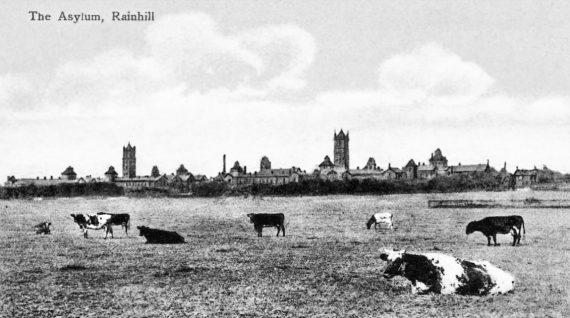
The view, shrouded by farmland, softened its rather chilling and foreboding gothic architecture. It was where mad people were sent. The lunatics. That was the common understanding of mental illness in the early 60’s. A view that had held for a hundred and fifty years.
I didn’t think I was mad, but maybe other people would. What a frightening prospect to be incarcerated in the asylum. I was surrounded by an unfeeling world which saw difference as scary and a threatening. My dad had problems with Catholics, Jews, Queers, Blacks and more. In fact, anyone different to him. There was no hope of finding another kindred spirit in such a wilderness, ever. No one to talk to. No one who would ever understand. Even my Nan, the kindest person in my life, would have been speechless and disbelieving. If she had said anything, it would have been “think on” which was a Lancastrian phrase of caution. She used it regularly. The loneliness of my self-knowledge was truly awful and was to burden me for years to come. My story was being re-written, as though new lines of code were being inserted into my cognitive programme. My shadow self was already there. It had just been awakened.
Fitting in
A lifetime of camouflage,
of masking and meeting
needs, other than my own.
A social subtext learned
in quiet suburbia and in
the panopticon of school;
Foucault’s surveillant society.
Conformity, the defined
path of servitude, played
out in a thousand small ways.
Always with an eye to the
opposite gender, a social
anthropologist of behaviour.
A study in style and deportment,
quietly logged on index cards
in the closet of my mind.
No GCE in this knowledge base
but stored for future reference,
whenever opportunities arose.
The shifting of roles and the
enacting of delayed gratification,
so long in the waiting. So long.
For so many years I dared not speak my truth, to family, to friends, at home, at college, in the award-winning hockey teams I played for, or in the many workplaces where secrecy was necessary for survival and security of tenure. I played a part, and I was convincing in the role, it was worthy of an Oscar – “I’m ready now, Mr DeMille”. It is difficult to communicate the weight of the burden I carried within. The silent disquiet, invisible as clear air turbulence, and yet just as deadly; something that shook my very psyche to near destruction.
In my early 20’s, I was ignorant about gay and trans rights. I had lived in a white, heteronormative culture all my life, and there was little evidence of racial, cultural, sex and gender diversity at college. It was a continuation of a bubble that many of us lived in. As far as sports sub-cultures were concerned, which were typified by the P.E. Mains, rugby, football and hockey teams, gays and transgender folk were figures of fun. Here again my spirit was silenced, and I faced humiliation and rejection if I had been open. We were training to become teachers and there were bigoted views within the culture that conflated our hidden identities with perversion and paedophilia. It would have been a significant barrier to my gay friend and I getting into teaching and developing our respective careers. We sat on it. For a long time – decades. We didn’t disclose our identities to each other until our mid 40’s. Then, in a telephone conversation, he mentioned that he knew he was gay from about 13 years old and had fancied me at college. We were competitive geography students. Competitive with each other. We ended up with the same class of honours degree, which brought a smile to my face, given the time I spent playing representative hockey. So, having listened to his disclosure, I mentioned that I was transsexual. I think my hand had just trumped his.
College was a totally engrossing time but another wilderness period for ‘my spirit’. Between my studies, sport, the occasional session in the college bar and my girlfriend, who had pre-Raphaelite hair, there was no space for exploring my female self. My girlfriend may have looked as though she was from a Burne-Jones painting, but she was from Yorkshire and parochial by disposition.
The 60’s vibe and it’s London-based sub-culture had by-passed Huddersfield. It still had mills, Aldermen and some long-standing views on the roles of men and women. Queers were people that were fodder for jokes in Working Men’s Clubs. Suffrage for women had made little difference to their roles within the family. Marc Bolan and David Bowie were not understood, feared and ridiculed. Brass bands were de rigeur.
So, from that strange cultural brew, my girlfriend had emerged, apolitical but erring towards all things conservative. She would not welcome what I had to say about myself and didn’t have the social savvy to handle it. So less said the better. She would go on to be a primary school teacher in Lincolnshire. In Grantham, home of the demonic Thatcher. Perhaps that would be a good fit for her, – a small-town living, and a small world view. Our relationship came to an end in my first year of teaching. She had already begun putting things away for our bottom drawer. I felt bad about ending the relationship, but I had become energised by meeting the vivacious person that I was to marry.
Finding Meaning in the Maze: Concepts and Connectedness
A false paradigm
Constructs and concepts.
The litany of meanings
explored and examined
for understanding, that
remains out of reach.
I grew up in my family,
no more than an impression
in the clay.
I wondered why the mould
was ill-fitting.
It wasn’t cast with me in mind.
Each generation struggling
with historical genealogy.
Mine was never going to
make sense to a young child.
A false paradigm cloaking
the authentic self.
Too dislocated by such fate
to be congruent.
And so, the process of identity
continued in its flawed design
to the point where I could
not recognise the reflection
in my mother’s mirror.
Animus not Anima.
A Jungian Nightmare.
Having undiagnosed inattentive ADD in a household of two teachers, fixated on scholastic achievement, was to live with their chronic disappointment in my abilities. As my mother used to say, “Our John is funny but he’s lazy”. Over the span of childhood and adolescence this was another experience of difference and shame. Of never coming up to expectations, of always wondering why achievement felt so out of reach. When memory, so taken for granted by many, and so applauded in a sibling whose recall was eidetic, was elusive to me. I lived and failed, in equal measure, within the family and with my peers. My mother’s first and only question, when I mentioned a new friend was, “Are they bright?”. My mother, a Deputy Head of a Primary school, was a devotee of the now discredited Sir Cyril Burt. I was probably the only child at my junior school who had to stay in at night going through past 11+ papers. Her anxiety. Her agenda.
Psychiatrist and author, Bill Dodson, MD, estimates that by age 12, children who have ADHD receive 20,000 more negative messages from parents, teachers, and other adults than their friends and siblings who do not. The message was clear to me. It had been repeated often enough.
Ghosts
There have always been ghosts,
drifting through my life, through
my scattered mind.
Remnants of hardly remembered
memories, translucent and barely
there.
They could belong to someone else;
a forgotten scene from a life not
lived by me but borrowed somehow.
This distance from my past is strangely
disconcerting and separates me from
who I once was.
Strands of vapour, soon to disappear
into the surrounding air, leaving no trace.
Contrails of complexities, once agonised,
but now hardly recognisable.
The intelligible made nonsensical.
Losing touch with past lives and loves.
A world without signposts or structures
that drifts so intangibly, my hand unable
to grasp that which cannot be held.
These silhouetted synapses flashed
for moments before disappearing into
the grey matter that keeps all its
secrets hidden from the clinical gaze.
So, I wonder in bewilderment, at who
I once was, how I stumbled my way
through this consciousness, that
defies exactitude and temporal clarity.
So, I became the ghost and the
embodiment of all that was diffuse.
A cumulus cloud, indistinct and
tempered by the elements, before
disappearing into the very sky
that created it.
In 2010, I was persuaded by a former colleague to apply for a national post; leading on mental wellbeing. I was interviewed. I didn’t get the post, as the former lead for Scotland, was already doing the job. Nevertheless, I was seconded to the National Mental Health Development Unit in London. It was an NHS policy hub and think tank and I worked there part-time in the Population Mental Wellbeing Team as a Project Specialist – a role that had been rooted in my strategic Public Mental Health work of the previous years, in Liverpool. The Cameron-Clegg Coalition viewed the NMHDU as a quango and shut it down. The Public Health Department of the PCT that I had worked for was undergoing restructuring again and I felt that my work there had reached a conclusion, and I left. The alternative was to face the further re-arranging of the deckchairs on the Titanic. I’d had my fill of that.
My first commissioned work, at this time, was a needs assessment of the trans population of Liverpool. I undertook this with a long-term friend and colleague from the 90’s. We had been PSHE Co-ordinators [See NOTE below] in our respective authorities of Cheshire and Lancashire.
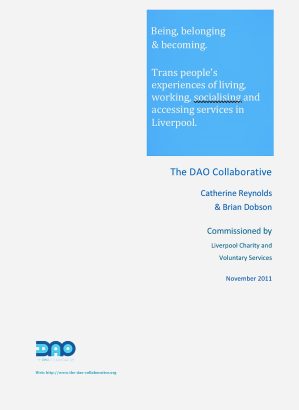
I framed the work around a Canadian study of community-based health promotion that had used three key indicators of wellbeing, namely; Being, Belonging and Becoming. These were concepts that resonated with me powerfully. I had the benefit of seeing the authors present their work at a conference in Scotland.
I write this for context, as it was a coming together of my personal and professional worlds. I had been living and working, as Catherine, since 2003 – 49 years since that initial realisation in 1961. This represented a melding of self. It also reinforced the difficult lived experiences of trans people across the 3B’s and highlighted the powerful impacts of prejudice, discrimination and inequality that characterises many trans lives.
The Politics of Identity and Inequality: the Maze as entrapment.
Reflections
I hadn’t given it that much thought
at the time. It was 22 years ago
and much was in the crossing
of the Rubicon. The river that had
seemed an impossible barrier.
It wasn’t that I was naive, nor
unwilling to sense, that a
shift in gender was still a
social calamity, to many.
But I had run out of choices.
And, I had run out of time.
Too many years spent chained
to the dead weight of my
masculinity and all its privileges.
For it took the living of this new
life to see how blinkered I’d been.
With all that had been granted
to me, by accident of birth.
I had willingly surrendered that
birthright to feel at one with myself.
A transformation of sorts, so long
in the waiting, and in the craving.
But I was to see that it came at a cost.
Power, I once took for granted, was
denied me, in this identity. No longer
within the patriarchy, I was an outsider.
Viewed with suspicion and looked
over for promotion, once promised.
To have power and to lose it to
those I once respected, shifted my
gaze to the prejudices around me.
The costs have been tangible;
familial, friendships, financial,
socio-legal and health-related,
and now, single-sex spaces.
All consequences of authenticity.
We may reflect upon our lives, particularly in our later years, and take stock of the significant experiences that shaped us, for good or ill. The rites of passage and the things that we could wish away, if only we could. Some of these memories may be painful and some unprocessed. They are emotional scar tissue. Sore to the touch. In the common consciousness, trauma is often understood as a significant and injurious singular event – perhaps a car accident, an act of violence, surviving a natural disaster. This is often classed as ‘Trauma’ with a capital T.
There is also the experience of trauma as ongoing experiences. Often referred to as chronic or complex trauma. These experiences are exemplified by emotional neglect, long-term illness, the weight of betrayal or perhaps the ongoing conditional acceptance of ‘coming out’. Coming out is not a one-off event for trans people. As new people entered my life there would come a point where I would need to be congruent and share my post-transition truth. For all trans people there exists a choice – to be true to self and others or to manufacture a fallacious personal history containing a litany of lies. Some trans people do this and have lived their life in stealth, in response to the very real threat, of being seen as ‘other’. Whichever course of action is chosen, sits trauma, a coiled snake in the psyche.
My autobiography, being research-based, has drawn upon many concepts to give meaning to a life framed by ambiguity. It was only in the last five years that I came across the notion of liminality and it became the glue that held together all the disparate experiences of my life, helped to cohere my transition and the book I was writing. Rooted in early anthropological theory by Arnold van Gennep and Victor Turner, liminality describes the transitional middle stage of a rite of passage where old identities are shed but new ones are not yet adopted. It can relate not only to life transitions but physical spaces and to the conditions that are framed by socio-legal precedents. For me, it represents the 49 years of a journey from realisation to actualisation. Liminality is not meant to last that long. To be in an indeterminate space is agonising and traumatic.
Liminality
We find ourselves cast adrift.
No fixed points on this journey
which was once guided by
our lodestone and the heavens.
The clouds obscure the stars
and the night sky blackens
this world, long travelled, by
our kind. The Outsiders.
Our wandering in search
of meaning and purpose,
feels troubled by our
own confusion. We are lost.
Lost to our destiny and to
the disappearing horizon.
The winds driving the white
crests against our longboat.
This is a liminal place
of foreboding and fear.
A place between origin
and endings, not yet found.
Minorities have chronicled their history of oppression and their struggle against the odds for millennia. Prejudice, scapegoating, victimisation, social exclusion, lynching and extermination are all chapters in a playbook underpinned by right-wing politics and ultimately fascistic governments.
The trans community has been under attack from the Right for a decade, noted in their strategic deployment of pressure groups namely gender-critical feminists defending women’s rights against, as they would put it, “men in dresses” who invade women’s spaces, as predators. The shifts in political ideology towards trans people across the world has been funded and fuelled by the alt-right, operating through anti-trans groups such as Sex Matters, in the UK. Funding has come from the ultra-conservative Christian Family Research Council and the Heritage Council, conservative Tech and private billionaire donors. Asserting views on biological determinism rather than self-identification, their goals are to segregate and isolate trans people from public life.
The European Parliamentary Forum has identified, up to 2018, funding of £520 million for anti-gender activity. There are significant data gaps, and the actual figure is likely to be much higher. Recent evidence indicates that Russian influence has emerged as a new actor in the anti-gender movement. These influencers have begun to shape the socio-legal status of trans people in the UK.
The UK Supreme Court’s unanimous ruling on 16 April 2025 held that ‘sex, ‘man’ and ‘woman’ in the Equality Act 2010 mean ‘biological’ and not ‘certificated’ sex. The initial case that gave rise to this was brought by For Women Scotland and was funded, in part, by J K Rowling.
The EHRC issued an interim practical update on 25 April 2025, revised in June 2025, to guide employers and service providers in the immediate aftermath. This culminated in the EHRC’s updated draft Code of Practice for Services, Public Functions and Associations, laid before Parliament on 21 May 2026.
The Code – which will carry statutory authority once Parliament’s 40-day review period passes – confirms that single-sex and separate-sex services must operate on the basis of biological sex, removes the previous self-identification approach, and clarifies that admitting trans people of the opposite biological sex to a service destroys its status as a single-sex service entirely.
Trans people must be offered gender-neutral or third-space alternatives, and the Code extends similar principles to associations and gender-based sport. By this judgement trans people become a ‘third sex’. Identification and separation by decree. Whilst we lobby MPs, we continue to live in a liminal space. This faulted and partisan guidance will further restrict trans freedoms.
No Access
We may not tread, in ways,
we once could. When the
law was gentler in its sway.
And ordnances fewer in the making.
When, both old and young,
could join in and be welcomed
without censure and derision.
When convention was inclusive.
And so it was, in the W.I. and
Girlguiding, that sex at birth,
was of little import. When
preferred gender was allowed.
We little thought, these 10 years
past, that we would be a target
for those who would make our ilk,
a cause for concern.
As the zero-sum game overwhelmed
the debate. As our rights, hard won
in the making, now seen as threats
by certain women, of malicious intent.
When, right and might, forged in
the bitter crucible of enmity, came
crashing down upon our existence.
Not a war of our making, embattled
as we are in defence of former Acts.
So, we beseech our advocates to
tilt against these many injustices.
To speak out, with righteous indignation,
against the many foes we now face.
The doors are shut in our faces.
No Access; the message, in law.
Fateful histories play out in this
badge of shame, our Pink Triangle.
Conclusion
Undoubtedly, this has been a journey of gendered physicality but at a deeper level, it has been one of emotional exploration and congruence. There have been times of dread and despair and those of euphoria and completeness.
I have been blessed by loving relationships and crushed by heart-wrenching endings, and then, saved by reconciliations. Underlying all this has been my intellectual curiosity in personal development and mental health, driven by compassion and empathy. This helped shape my career choices, from education to health, from local to national.
I was on a quest from the age of seven; from confusion to clarity, from aching to actualisation. This rite of passage across forty two years of liminal space was informed by therapy and my post-grad studies into the notion of ‘sense-making’ (K.E. Weick – see BIBLIOGRAPHY).
Music has underscored my life from my first album at 11; The Beatles, A Hard Day’s Night. Life was in mono then and monochrome too. The emotional timbre of my life can be summed up by the stripped-down song, ‘Every Feeling’ by the trans musician, Ezra Furman. She scored the music for the drama series, ‘Sex Education’.
If there was ever to be a film of my journey, the director looking for a score, could select from this playlist. It is a roller-coaster of rhythm, textures, harmonies, lyrics and stories across more than six decades. It reflects an emotional odyssey. In this way it is a manuscript of my life and an insight into my psyche!
Having made this compilation I recognise that it is infused with melancholy. Forty-two years of hiding myself from the world will do that to a sensitive soul. Loss of self and the burden of shame is much to side-step. Nevertheless, authenticity is a balm and agency is a forthright expression of ‘becoming’.
‘You don’t wanna be anyone else/ It turns out you’re good enough as yourself/And you’re free, you’re free’
From Up Here, Ingrid Olava
The Mountain, Maddy Prior; My Love, Florence+The Machine; Something Inside So Strong, Labi Siffre; Angel By The Wings, Sia; Smalltown Boy, Bronski Beat; In This Shirt, The Irrepressibles; Only A Woman’s Heart, Eleanor McEvoy; Wasted Time, The Eagles; Wind Up, Jethro Tull; You Can’t Always Get What you Want, The Rolling Stones; Time To Move On, Tom Petty; The Living, Nathalie Merchant; Fallen, Sarah McLachlan; Something’s Always Wrong, Toad The Wet Sprocket; The Road Not Taken, Bruce Hornsby; Free As A Bird, The Beatles; Both Sides Now, Joni Mitchell; Nothing Lasts, Steve Miller Band; Can’t Get It Out Of My Head, ELO; Behind The Mask, Fleetwood Mac; Glory Box, Portishead; After Afterall, William Fitzsimmons; What It Feels Like For A Girl, Madonna; Bittersweet Symphony, The Verve; white Flag, Dido; Sad Girl, Lana Del Ray; Still Waiting, Tom Chaplin; Saving Grace, Tom Petty; Pacing The Cage, Bruce Cockburn; Laid, James; I Hope You Dance, Lee Anne Womack; Dreamweaver, Gary Wright; Go Insane, Fleetwood Mac; Tangled Up In Blue, Bob Dylan; Beware Of Darkness, George Harrison; Do I still Figure In Your Life?, Joe Cocker; (I Know) I’m Losing You, Rod Stewart; Valentine Heart, Tanita Tikaram; Who Am I?, Gary Wright; If You Could Read My Mind, Gordon Lightfoot; Who’s That Girl?, Eurythmics; Running On Empty, Jackson Browne; You Are A Memory: Message To Bears; Small Hours, John Martyn; My Favourite Game, The Cardigans, Wasting My Young Years, London Grammar; Beautiful, Christine Aguilera; Fade Into You, Mazzy Star; The Logical Song, Supertramp; Atlas: Sleeping At Last; Let Me Make Something In Your Life, Julie Covington; Where Are You Tonight, Bob Dylan; Journey From Eden, Steve Miller Band; An Ending; Brian Eno.
Thank you to my two dear children, who brought my musical appreciation into the 21st century. For that, and so much more. You adjusted to your father morphing into herself and recognised that my essential self is still here, loving you. And to Chris, for all your love, kindness and acceptance.
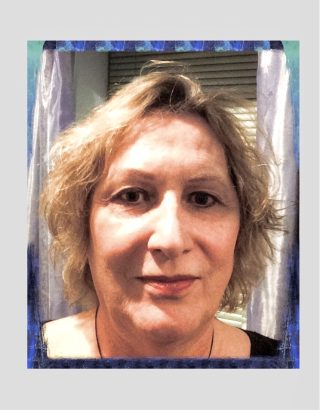
If you got to this end point, thank you so much for your perseverance.
With gratitude,
Catherine
NOTE: For four years I was seconded from Stanney High School to the role of County Co-ordinator for Personal, Social and Health Education, Cheshire LEA. The role was to support all schools, colleges and the Youth Service in matters relating to this diverse brief. That entailed; policy development, training, school-based curriculum development, supporting school teachers who had a PSHE responsibility, advising governors and continuing my training role with the LEA’s Counselling Skills Team.
Bibliography and Further Reading
‘Aesthetics of Debate. In Voices – To Tell a Story. A dialogue between John Berger and Susan Sontag (1983) https://photographytheoryintopractice.wordpress.com/2017/02/15/john-berger-and-susan-sontag-telling-stories/
Angelou, Maya. 1969. I Know Why The Caged Bird Sings. New York. Random House.
April Ashley | Life stories: National Museums Liverpool
https://share.google/JlMhgSSPyS6eO5Xa1
Dodson, William https://www.researchgate.net/publication/234763069_Attention_Deficit-Hyperactivity_Disorder_ADHD_The_Basics_and_the_Controversies
European Parliamentary Forum. 26 June 2025. The Next Wave: How Religious Extremism Is Reclaiming Power. https://www.epfweb.org/node/1152
Faye, Shon. 2021. The Transgender Issue: An Argument for Justice. Penguin.
Maté, Gabor. 2019. Scattered Minds: The Origins and Healing of Attention Deficit Disorder. London: Vermillion.
Partridge, Alex. 2026. Why does Everybody Hate Me? Living and Loving with Rejection Sensitivity Dysphoria. John Murray Press
Robinson, Ken. 2009. The Element. New York, NY: Penguin.
Reynolds, Catherine & Dobson, Brian. 2011. Being, Belonging & Becoming: Trans people’s experiences of living, working, socialising and accessing services in Liverpool. The DAO Collaborative. Commissioned by Liverpool Charity and Voluntary Services (LCVS). https://drive.google.com/file/d/1RrwlpYCkq3Lb7pRFDzog3Gcy7CECaxHU/view?usp=drivesdk
Natalia Ramos, Mollie C. Marr, Traumatic Stress and Resilience Among Transgender and Gender Diverse Youth, Child and Adolescent Psychiatric Clinics of North America, Volume 32, Issue 4, 2023, Pages 667-682. https://pmc.ncbi.nlm.nih.gov/articles/PMC10914351/
Reynolds, Catherine. Date TBC. Transness: Navigating Liminal Space. Unpublished Autobiography.
Services, public functions and associations: Code of Practice. Updated 21 May 2026. https://www.equalityhumanrights.com/equality/equality-act-2010/codes-practice/services-public-functions-and-associations-code-0
The Independent: £70,000 donation from J K Rowling to FWS. https://www.independent.co.uk/news/uk/home-news/uk-supreme-court-transgender-women-jk-rowling-b2734820.html
The ME Association https://meassociation.org.uk/
Van der Kolk, Bessel A. 2014. The Body Keeps the Score: Brain, Mind, and Body in the Healing of Trauma. Penguin Books.
Weick, K. E.(1976). Educational organizations as loosely coupled systems. Administrative Science Quarterly, 21(1), 1–19.
 By David Selzer