Tag Archives

Holywell

BETWEEN RIVERS MAY 2026: THOMAS PENNANT’S ‘TOURS IN WALES’ – ALAN HORNE

David Selzer By David Selzer2 Comments14 min read765 views

BETWEEN RIVERS is a quarterly series edited by Alan Horne. It is focused on the area bounded by the rivers Alun, Dee and Gowy, on the border between England and Wales in Flintshire, Denbighshire and Cheshire. You can read about the background to Between Rivers in the Introduction.

**************************************************************************************


If you were to go north-west from Holywell in Flintshire, you would come to the small village of Whitford: a pub, a church, a school and a few houses. Pretty walks lead eastwards towards the Dee estuary, and here are the remains of an ancient estate. First of all is Downing Ucha’, once the estate dower house, later a children’s home and now a derelict but still substantial building with an online presence among those who like to explore such places. Next come the former estate cottages, now attractive rural homes. Finally, there are a few ruins – most of what survives is underground – of Downing Hall, built in 1627, badly damaged by fire in 1922, eventually but not very thoroughly demolished in 1953: the home of Thomas Pennant (1726-1798), naturalist and travel writer.

Pennant is not a household name today, but if we had to choose the most influential cultural figure from the Between Rivers area his claim would be serious. He was a well-known Enlightenment scholar who was prominent in two separate fields. He took the usual route for young gentlemen of the day, via Oxford University and the Grand Tour, making copious notes of animals, plants, landforms, minerals and other natural phenomena he encountered, keeping detailed travel diaries, and contacting other natural historians including Linnaeus, the inventor of the system of botanical classification still in use. But it was not until he was in his mid-30s that he made the defining move to begin work on a publication, eventually issuing British Zoology in 1766. This was ultimately a tremendously successful work: its concern for accuracy, its systematic approach and the inclusion of many detailed illustrations set a new standard for books on natural history in English, and Pennant followed it up with others, Indian Zoology, Synopsis of Quadrupeds, Genera of Birds and Arctic Zoology, which made him a prominent figure in Enlightenment science.

At the same time, Pennant began working up his travel diaries into publications. He made two trips to Scotland and published first A Tour In Scotland, 1769, and then A Tour In Scotland And Voyage To The Hebrides 1772, works which would justify an edition of Between Rivers to themselves. They were very successful, and he followed them up with several accounts of travel in various regions of England and, perhaps the best received of all, with his Tours In Wales.

Tours In Wales was published between 1778 and 1783, in three volumes ostensibly detailing three different tours, although in reality Pennant incorporated material from his many travels in Wales over the years into his accounts of journeys made specifically for this publication. The first tour stayed close to Pennant’s home, describing a trip through Flintshire and Denbighshire with a notable diversion into Chester. The second and most famous tour took him into Eryri to the literal high point of his enterprise, the ascent of Y Wyddfa, before continuing to Anglesey and home along the north coast. That journey is sometimes published separately as The Journey To Snowdon and is our focus today. The third tour runs through parts of Montgomeryshire close to the English border before moving into England, to Shrewsbury, and ends with an excursion to the iron age fort at Caer Caradoc in the Shropshire hills. The three volumes end with a hundred pages of Appendices on every conceivable topic, from Owain Glyn Dwr to potato exports, via notes on the Beaumaris Shark.

As regards the title of the book, Tours In Wales, the operative word is In. Pennant does not pretend to offer a comprehensive tour of Wales, and does not penetrate into South Wales at all. Instead, he sticks to areas with which he is well acquainted, or where he has good local contacts. This seems to have given the book an enormous advantage with the public because of its detail and accuracy. He took with him John Lloyd, vicar of Caerwys, an expert on Welsh antiquities and a fluent Welsh speaker: although Pennant was very proud of his Welsh ancestry, his grasp of the Welsh language was poor. With him also went Moses Griffith, a gifted artist and draughtsman whom Pennant employed to make illustrations for the forthcoming book. The contribution of these men greatly increased the value of Pennant’s work in a market full of superficial and ill-informed travel literature on Wales mainly written by English gentlemen with no knowledge of Welsh. The fruit of Griffith’s work in particular can be seen in the ‘extra-illustrated’ edition prepared for Pennant’s own library, and now held by the National Library of Wales: this contains all sorts of visual art, with landscape watercolours, paintings on mythical subjects, scientific drawings of plants and animals, detailed drawings of antiquities, ‘portraits’ of the houses of great gentlemen, coats of arms and much else, really a rather breathtaking achievement. Illustrations to the present feature are taken from that edition.
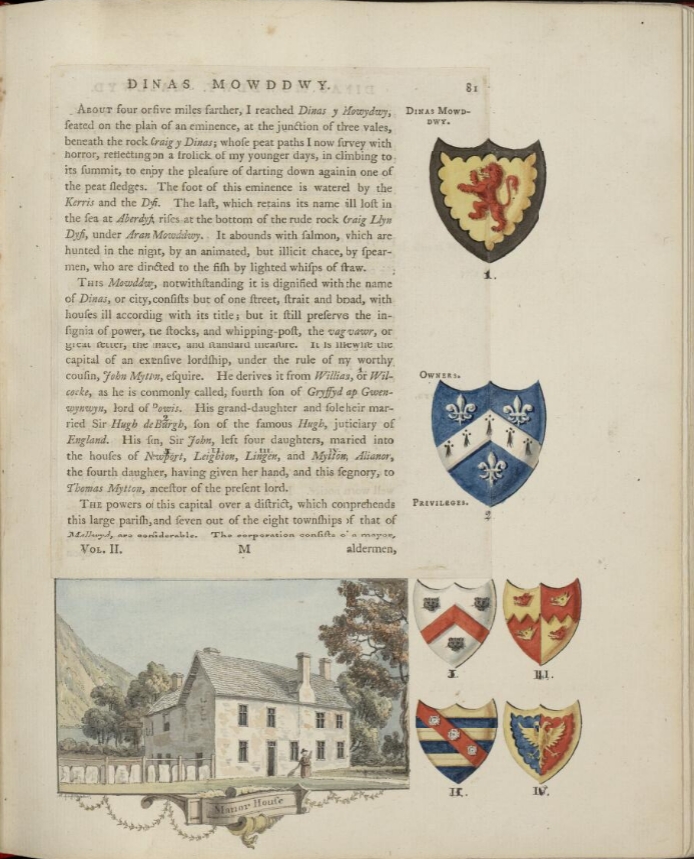
 

Pennant – Tours in Wales. National Library of Wales/Llyfrgell Genedlaethol Cymru.


Pennant took a most indirect route to Snowdon, traveling from his home along the Vale of Clwyd to join the River Dee at Corwen, going south to Dolgellau and then northwards up the coast via Barmouth and Harlech before taking a route which seems unlikely now, but less so then, across the moors via Ysbyty Ifan and Pentrefoelas, to finally approach Snowdon from the east, passing through Capel Curig into Dyffryn Mymbyr. Today this valley might seem a blasted wilderness. Pennant records much farming activity.

The bottom is meadowy; at this time enlivened with the busy work of hay harvest, and filled with drags, horses, and even men and women, loaden with hay.

He describes the lifestyle of the farmers.

This mountainous tract scarcely yields any corn. Its produce is cattle and sheep, which, during summer, keep very high in the mountains, followed by their owners, with their families, who reside in that season in Hafodtai, or summer dairy-houses, as the farmers of the Swiss alps do in their Sennes. These houses consist of a long low room, with a hole at one end, to let out the smoke from the fire, which is made beneath. Their furniture is very simple: stones are the substitutes of stools; and the beds are of hay, ranged along the sides. They manufacture their own cloaths… During summer, the men pass their time either in harvest work, or in tending their herds: the women in milking, or making butter and cheese. For their own use, they milk both ewes and goats, and make cheese of the milk, for their own consumption. The diet of these mountaineers is very plain, consisting of butter, cheese and oat-bread, or Bara Ceirch: they drink whey: not but that they have a reserve of a few bottles of a very strong beer, by way of cordial, in illness. They are people of good understanding, wary and circumspect; usually tall, thin, and of strong constitutions, from their way of living. Towards winter, they descent to their Hen Dref, or old dwelling, where they lead, during that season, a vacant life.

In this tour, Pennant’s intentions are not primarily scientific, but he is still keen to make observations of plants and animals, and Griffith provides many illustrations.

As we are on the subject of grasses, it may be pleasing to observe, how wonderfully some of them change their appearance as they ascend the higher hills; the turfy hair grass, Aira caespitosa, sheep’s fescue grass, Festuca orina, Alpine meadow grass, Poa Alpina, and some others, which in the low countries, where they enjoy the due influence of the sun, and length of summer, to ripen their seeds, are propagated in the usual manner of grasses; but as they reach a more exalted situation, where they want a continuance of summer, and the necessary power of the sun, to perfect their seeds, they become viviparous; that is, the rudiment of the germen vegetates, and shoots into blade in the cup, from whence falling, it readily takes root, and grows; a kind and providential dispensation, for the advantage of those colder climates, which are less favourable to vegetation!
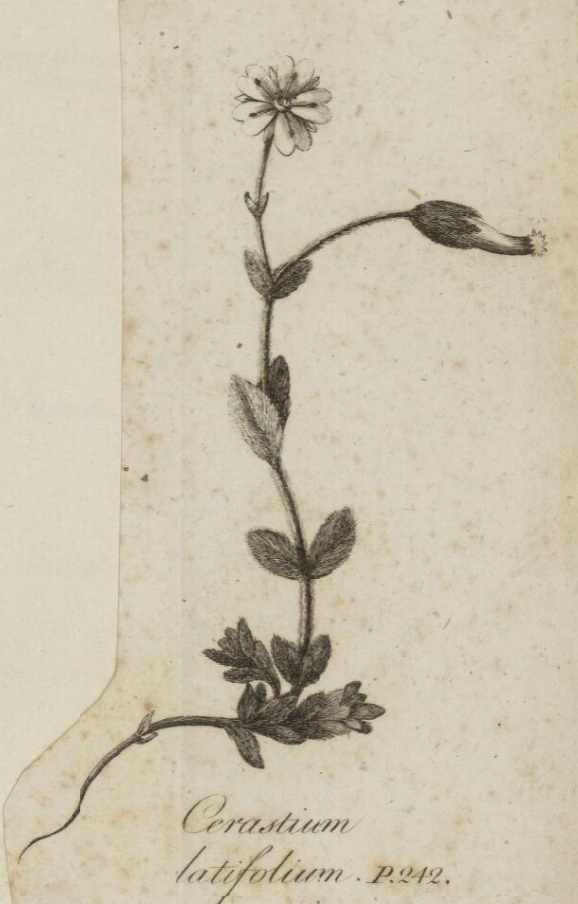
 

Pennant – Tours in Wales. National Library of Wales/Llyfrgell Genedlaethol Cymru.


The party sent their servants on with the horses to Llanberis, and climbed the Glyders on foot. Like many a traveller after him, Pennant was absorbed by the rock formations on the summits of these hills. Here he is on Glyder Fawr: and while Pennant’s writing generally chooses clarity over poetry, now he gives us both.

The prospect from this mountain is very noble. Snowdon is seen to great advantage; the deep vale of Llanberis and its lakes, Nant Ffrancon, and a variety of other singular views. The plain which forms the top is strangely covered with loose stones like the beach of the sea; in many places crossing one another in all directions, and entirely naked. Numerous groups of stones are placed almost erect, sharp-pointed, and in sheafs: all are weather-beaten, time-eaten, and honey-combed, and of a venerable grey-color. The elements seem to have warred against this mountain: rains have washed, lightnings torn, the very earth deserted it, and the winds made it the constant object of their fury. The shepherds make it the residence of storms, and style a part of it Carnedd y Gwynt, or The Eminence of Tempests.
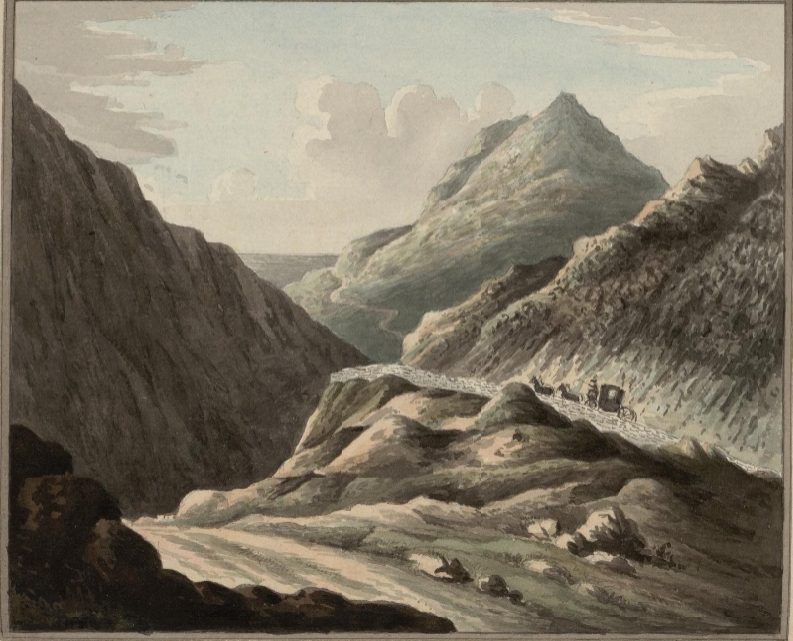
 

Pennant – Tours in Wales. National Library of Wales/Llyfrgell Genedlaethol Cymru.


The party moved on to Llanberis. While staying there, Pennant rode around the two lakes, Llyn Peris and Llyn Padarn. One feature of Pennant’s travel writing is a love of recording the local gentry and their houses. Sometimes this may be a kind of recompense for hospitality offered; sometimes perhaps a strategy to motivate those so recorded to buy his books. He plainly likes to celebrate members of his class of wealthy Enlightenment gentlemen. But he also enthuses about those he sees as the ancient Welsh gentry, whose lives were perhaps not much changed from those of their forbears two or three centuries previously. His visit to Llyn Padarn occasions one such portrait.

Near this end of the lake lives a celebrated personage, whom I was disappointed in not finding at home. This is Margaret uch Evan, of Penllyn, the last specimen of the strength and spirit of the antient British fair. She is at this time of about ninety years of age. This extraordinary female was the greatest hunter, shooter, and fisher, of her time. She kept a dozen at least of dogs, terriers, greyhounds, and spaniels, all excellent in their kinds. She killed more foxes in one year, than all the confederate hunts do in ten: rowed stoutly, and was queen of the lake: fiddled excellently, and knew all our old music: did not neglect the mechanic arts, for she was a very good joiner: and, at the age of seventy, was the best wrestler in the country, and few young men dared to try a fall with her. Some years ago, she had a maid of congenial qualities; but death, that mighty hunter, at last earthed that faithful companion of hers. Margaret was also a blacksmith, shoemaker, boatbuilder and maker of harps. She shoed her own horses, made her own shoes, and built her own boats, while she was under contract to convey the copper ore down the lakes. I must not forget, that all the neighbouring bards paid their addresses to Margaret, and celebrated her exploits in pure British verse. At length she gave her hand to the most effeminate of her admirers, as if predetermined to maintain the superiority which nature had bestowed on her.

At last Pennant came to Snowdon and the ascent of Y Wyddfa. Led by a local guide the party followed a route which might today seem very roundabout, riding due south from Llanberis until they met what is now the Snowdon Ranger path, which they ascended on foot, leaving their horses behind.

Days of fine weather on Snowdon are at a premium, and Pennant pauses his narrative to recall one such from an earlier journey to the summit.

The view from this exalted situation is unbounded. In a former tour, I saw from it the county of Chester, the high hills of Yorkshire, part of the north of England, Scotland , and Ireland: a plain view of the Isle of Man; and that of Anglesey lay extended like a map beneath me, with every rill visible. I took much pains to see this prospect to advantage: sat up at a farm on the west till about twelve, and walked up the whole way. The night was remarkably fine and starry: towards morn, the stars faded away, and left a short interval of darkness, which was soon dispersed by the dawn of day. The body of the sun appeared most distinct, with the rotundity of the moon, before it rose high enough to render its beam too brilliant for our sight. The sea which bounded the western part was gilt by its rays, first in slender streaks, at length glowing with redness. The prospect was disclosed like the gradual drawing up of a curtain in a theatre. We saw more and more, till the heat became so powerful, as to attract the mists from the various lakes, which in a slight degree obscured the prospect. The shadow of the mountain was flung many miles, and shewed its bicapitated form; the Wyddfa making one, Crib y Distill the other head. I counted this time between twenty and thirty lakes, either in this county or Meirioneddshire. The day proved so excessively hot, that my journey cost me the skin of the lower part of my face, before I reached the resting-place, after the fatigue of the morning.

On the present journey the weather proved more typical.

On this day, the sky was obscured very soon after I got up. A vast mist enveloped the whole circuit of the mountain. The prospect down was horrible. It gave an idea of numbers of abysses, concealed by a thick smoke, furiously circulating around us. Very often a gust of wind formed an opening in the clouds, which gave a fine and distinct vista of lake and valley. Sometimes they opened only in one place; at others, in many at once, exhibiting a most strange and perplexing sight of water, fields, rocks, or chasms, in fifty different places. They then closed at once, and left us involved in darkness; in a small time they would separate again, and fly in wild eddies round the middle of the mountains, and expose, in parts, both tops and bases clear to our view. We descended from this various scene with great reluctance; but before we reached our horses, a thunder-storm overtook us. Its rolling among the mountains was inexpressibly awful: the rain uncommonly heavy. We remounted our horses, and gained the bottom with great hazard. The little rills, which on our ascent trickled along the gullies on the sides of the mountain, were now swelled into torrents; and we and our steeds passed with the utmost risque of being swept away by these sudden waters. At length we arrived safe, yet sufficiently wet and weary, to our former quarters.

After resting, the party returned up Nant Peris, and passed through Nant Gwynant to Beddgelert, spending a few nights there while Pennant explored the locality. They then passed southwards to Pont Aberglaslyn. Pennant gives us the painting below, which seems to show a druidic figure praying at a cromlech in the locality.
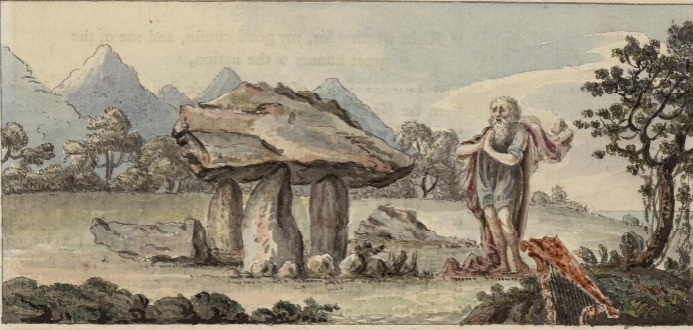
 

Pennant – Tours in Wales. National Library of Wales/Llyfrgell Genedlaethol Cymru.


At this point, heading for Criccieth and its castle, they had to pass around the edge of the Traeth Mawr, the treacherous tidal marsh, drained in the nineteenth century, which in Pennant’s time extended to the coast. Pennant records a correspondence of elaborate politeness about a proposed drainage scheme. Sir John Wynn, a local gentleman, writes to his cousin, Sir Hugh Myddleton, who has experience of reclaiming land from the sea in the Isle of Wight. Sir John declares that his skill is little, and his experience none at all in such matters, yet ever he has had a desire to further the profit of his country, and is ‘content to adventure a brace of hundred pounds to joyne with you in the worke’. Sir Hugh replies that it would need not hundreds but thousands, £200 being his usual weekly charge. ‘Noble sir, my desire is great to see you, which should draw me a farr longer waie; yet such are my occasions at this tyme here, for the settlinge of this great worke, that I can hardlie be spared one howre in a daie’. Pennant includes an etching of Traeth Mawr in its flooded state with boats sailing on what is dry land today.
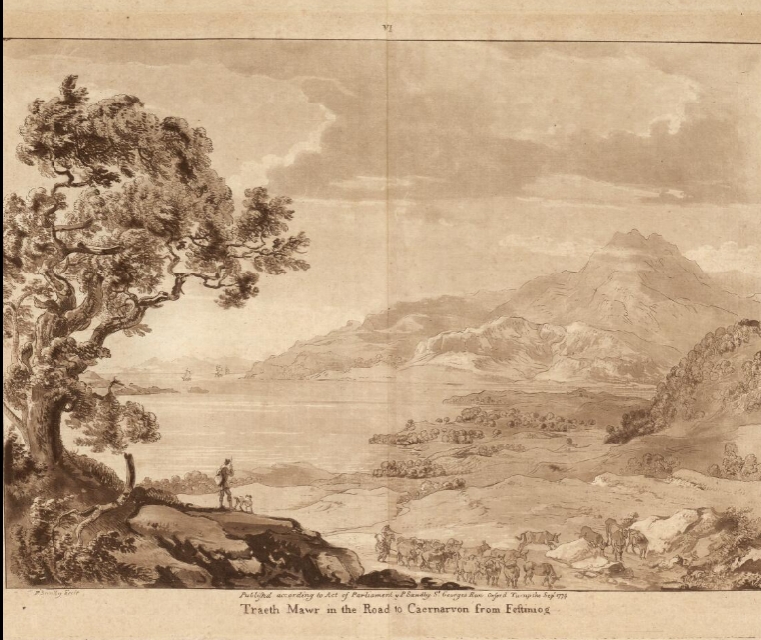
 

Pennant – Tours in Wales. National Library of Wales/Llyfrgell Genedlaethol Cymru.


The party visited the Llyn peninsula, spent some time in Caernarfon, and then crossed to Anglesey. Pennant has much to tell of the druids, some of it rather lurid including sacrifices in a ‘Wicker Colossus’ as in the 70s horror movie. There is a map of sacred groves at Tre’r Dryw, shown below. Even Pennant admits that some of this history is conjectural.
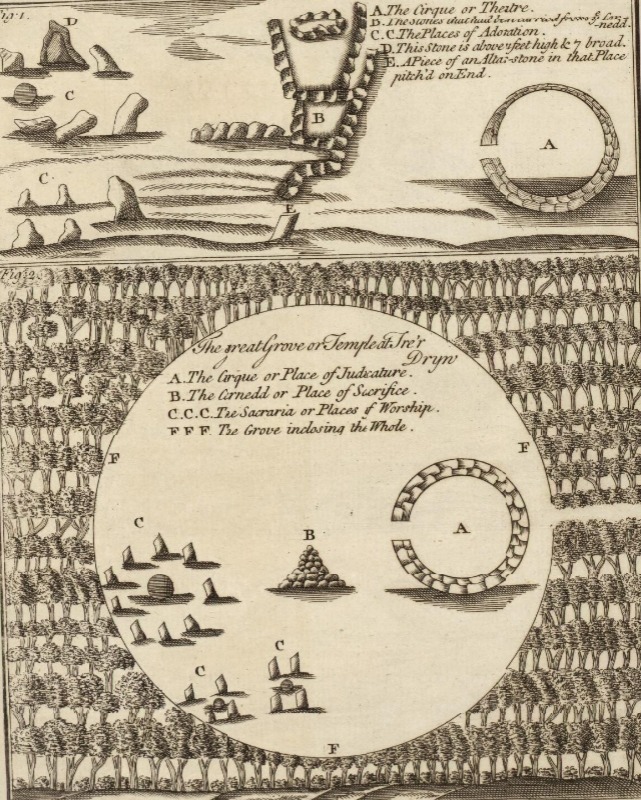
 

Pennant – Tours in Wales. National Library of Wales/Llyfrgell Genedlaethol Cymru.


As he travelled around Anglesey he came to the mineral mining area around Parys Mountain, and this yields a very different species of writing. After enumerating various phases of exploration, amounts of copper ore extracted, ways of burning the ore or otherwise getting the copper from it, and the worth of the companies involved, Pennant speaks of the mode of work.

The ore is not got in the common manner of mining, but is cut out of the bed in the same manner as stone is out of a quarry. A hollow is now formed in the solid ore open to the day, and extends about an hundred yards in length, about forty yards in breadth, and twenty-four yards in depth. The ends are at present undermined, but supported by vast pillars and magnificent arches, all metallic; and these caverns meander far under ground. These will soon disappear, and thousands of tons of ore be gotten from the columns and roofs. The sides of this vast hollow are mostly perpendicular, and access to the bottom is only to be had by small steps cut in the ore; and the curious visitor must trust to them and a rope, till he reaches some ladders, which will conduct him the rest of the descent. On the edges of the chasms are wooden platforms, which project far; on them are windlasses, by which the workmen are lowered to transact their business on the face of the precipice. There suspended, they work in mid-air, pick a small space for a footing, cut out the ore in vast masses, and tumble it to the bottom with great noise. In such situations they form caverns, and there appear safely lodged, till the rope is lowered to convey them up again.

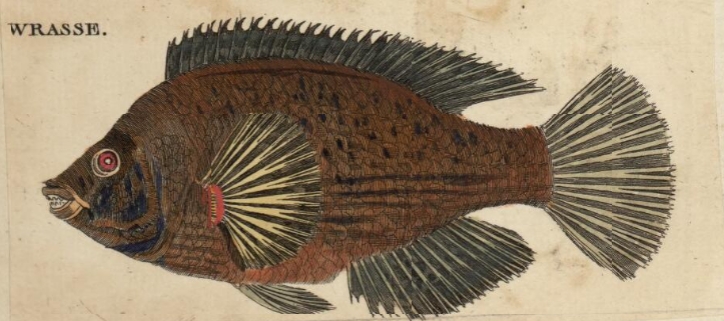
Another aspect of Pennant’s visit to Anglesey is that he turns his attention to sea creatures, with spectacular illustrations of crabs and some beautiful coloured illustrations of fish.
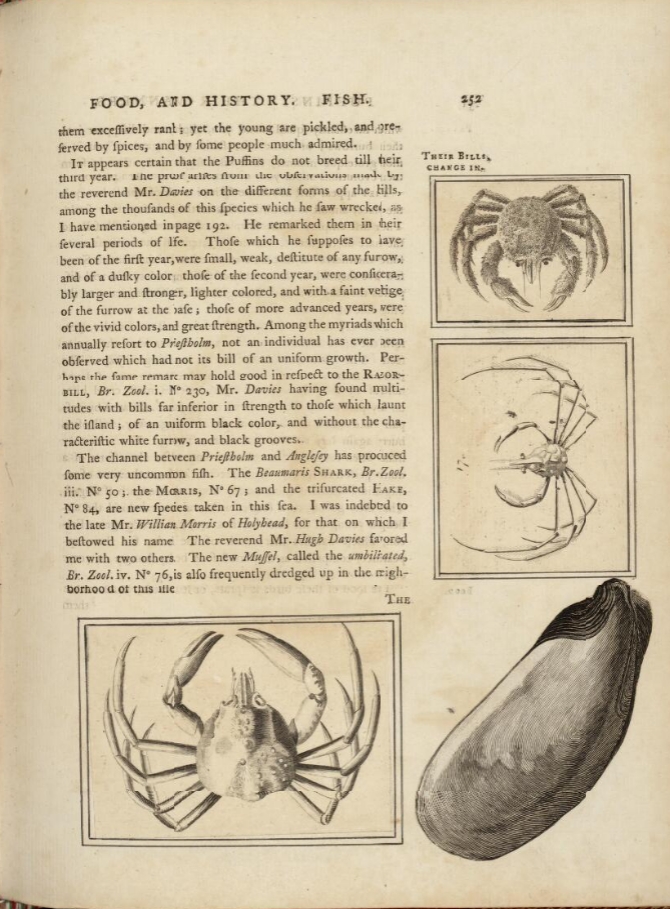
 

Pennant – Tours in Wales. National Library of Wales/Llyfrgell Genedlaethol Cymru.


At last Pennant turned for home, travelling east along the coast of North Wales, taking in the formerly perilous road around Penmaenmawr and exploring Conwy and Llandudno on the way.

If you would like to read more, Pennant’s Tours in Wales are readily available in facsimile reprints. I found those available from Forgotten Books to be well reproduced, and they are based on an edition first produced in 1883 which uses the modern ‘s’ rather than the original long ‘f’ of  Pennant’s day, which makes for ease of reading. The complete extra-illustrated edition is available here from the National Library of Wales and is well worth a look. A recent, accessible study of Pennant’s life and work is Thomas Pennant (1726-1798): Natural Historian and Curious Traveller by Chris Park (2020); I have found Park’s book to be of great help in getting to grips with Pennant’s multifarious interests and writings.
 

Pennant – Tours in Wales. National Library of Wales/Llyfrgell Genedlaethol Cymru.


BETWEEN RIVERS: NOVEMBER 2025 THE WORK OF JOHN AND MARILYN DAVIES – ALAN HORNE

Welcome to another edition of Between Rivers. In this edition we look at the work of John and Marilyn Davies: poetry and a variety of visual art, especially carvings of wild birds.

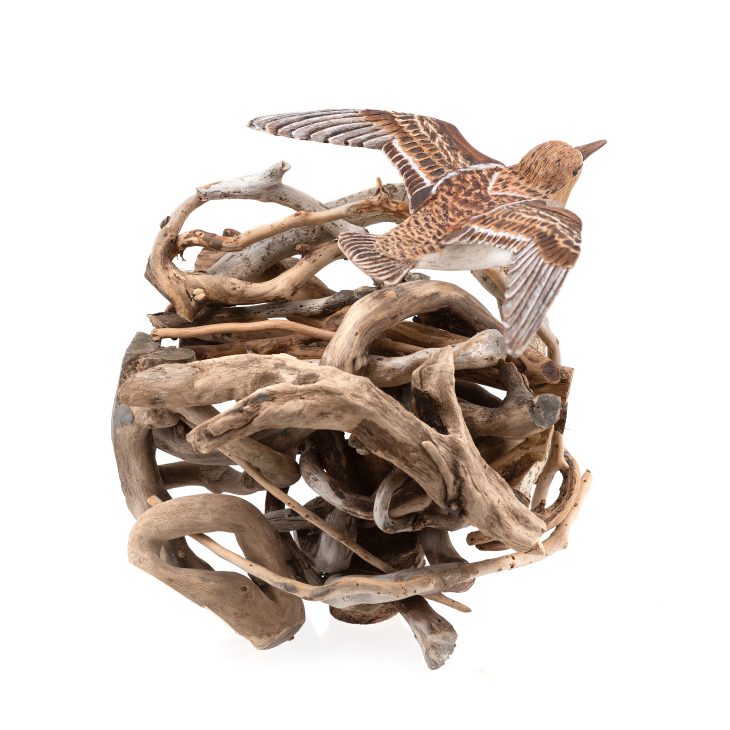
‘Little Stint’ by John and Marilyn Davies


When I arrived in Prestatyn to meet John and Marilyn Davies it was September, just as in John’s poem Things To Do When The Town’s Closed. Rain and the start of the school term had chased most visitors away, and it was easy to get into the mood of the poem. Like the others quoted here it was first published in his collection Flight Patterns (Seren 1991).

Things To Do When The Town’s Closed

Our choir dressed as guerrilla butlers
has driven the holidaymakers back.
It is September. Seagulls
are critics prying over spilt ink.
The town’s scraped off its silver lining
to get at the cloud instead.

In search of a bit of life,
Ron has started taxidermy, juggling
bags of skin like a homicidal vet.
They grin from furry cells,
near-squirrels.
You can’t keep a good man up.

And Mr. S has emptied his firm’s safe.
Self-bloodied, he faked
assault then described the villain
so well for the police photofit,
like a shout his own face rang out.

On the library wall: ANACKY.
Draughts from the Mersey Tunnel quicken
across the Dee. Wait,
slow down
at the station.
You can find yourself elsewhere.

Balloons were released in August
from Frith Beach for Holiday Fun
with addressed labels. W’s returned
all the way from Builth. His prize?
First cash, soon a court appearance:
winds blew north that day so how come W’s balloon
went south? Well, live in town
and wind is just a ghost. The label went
via his aunt in Builth, both ways by post.

Yesterday, high on a ladder with acres
to paint, Mr. S was whistling ‘Born Free’.
And although the Pleasant Sunday Afternoon Society
now meets all week, although the slipper women
at the launderette seem lively
and waves roll up in fits watching dunes
fail to outwit caravans,
it’s a bad time.

We are alone together.
Even our jeweller’s stopped twinkling.
You can’t help but feel
someone out there might be planning chainsaw
psychiatry or florist pressing.


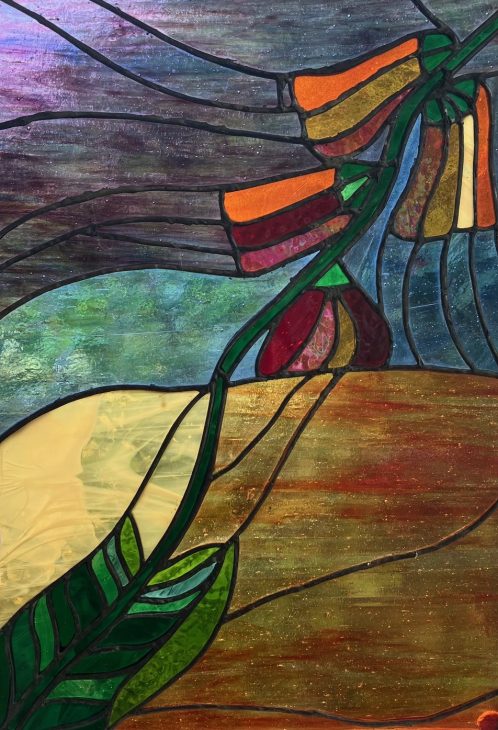
Arriving at the Davies’ home I felt some slight trepidation, having contacted them out of the blue and invited myself round, but they were most welcoming. Marilyn, a small, bright woman, came out to conduct me in, and then here was John, slower, but very thoughtful, and remarkably open in our discussions. I straight away encountered some of Marilyn’s stained glass in the windows. As we ate lunch and discussed some of John’s poems, I started to realise that the house is full of art objects which the couple have created.

Stained glass by Marilyn Davies


I first encountered John’s poems when I was looking for material for Between Rivers, and David Selzer pointed me to A Clwyd Anthology, edited by Dewi Roberts and published by Seren Books. Not all the items in the book were on topic, but one that I knew we had to use was Downing, a Davies poem set in Whitford, near Holywell in Flintshire, on the former estate of Thomas Pennant, the eighteenth-century  traveller and natural historian.

Downing

Seventy, rasping, he lives in the saddlery

of the estate now run out of paths.

He keeps the tv. busy. The past? The brisk squire

who toured the eighteenth century and met Voltaire?

Not interested. But around pleasure garden, summer house,

Bob Weston cleared gullies for parched ironworks,

lopped trees in the dingles, was tolerant it seems

of poachers. The house, burned down as an insurance job,

is a DIY kit. Its drive can’t find the gateway.

Tunnels though and waterways built by miners

are intact, theirs or land’s revenge on stateliness

where ponds sag under weed.


Below on Mostyn sands, cockles have been found

by diggers in balaclavas linked to the underground economy.

Jobs, they’re rare as oysters. Unmarked trucks

sidled, and from dunes, they say, the DHSS took photos.

Bob Weston’s watched – Dunkirk again, another

scramble, grab what you can then home, the brass

will know the score. Except the brass aren’t on your side.


Now that it’s wanted for caravans, what no one could visit

is lamented. People will flood in, there’ll be petitions.

But he’ll not be collecting who likes that brandnew

pub at the junction and leaves his dog at home.


I found a copy of his Flight Patterns and was much taken with the vivid characterizations, humour and the sharply cut phrasing. This led me to other volumes of his poetry: The Visitor’s Book (Poetry Wales Press, 1985), Dirt Roads (Seren 1997), and North by South: New and Selected Poems (Seren 2002) which also includes poems from his earlier books, At the Edge of Town (Gomer, 1981) and The Silence in the Park (Poetry Wales Press, 1982). There was also a book of short stories by Welsh authors which he had edited, The Green Bridge (Seren 1988), which introduced me to several unfamiliar voices, notably Caradoc Evans, who unfortunately can in no way be construed as a Between Rivers author. Some of the poems were about belonging or not belonging in small towns on the coast of North Wales or around the Dee estuary. Before our meeting John had already sent me typed notes he had made in 1986 preparatory to the poem Downing. What really struck me was a handwritten marginal note, about the cargoes shipped in via Mostyn Dock on the Dee: bulk phosphate, woodpulp, sulphur, potash. These were not drafts of poetic lines so much as a gathering of ideas and information: to get the poem going, as John said to me. Now over lunch he produced yellowed sheets of typed and annotated historical material about the Flintshire town of Holywell, it’s mythical origins and industrial heyday, out of which he had made the sonnet sequence Burying the Waste. At the time, he said, he thought his poems had to rhyme, and the rhymes helped him to get to the images. Here is the sequence.


Burying The Waste

(Holywell)

Trapped by Caradoc, favourite of a king,

even Winifred could not deny his sword.

Where hair leaked blood, a well of healing

sprang, then the stream hurrying its hoard

of news woke up the valley. Winifred

drew pilgrims limping, eager to be whole.

He signed up slaves of cotton, copper, lead.

Her stream, severed by water wheels, rolled

machines. When Winifred spread her arms wide

to make from shadows trees, he cut them down

but she thinned the Dee channel. Its quayside

became silent, the valley a ghost town.

Now buildings sprawl headless. All around,

sprung green, half-buried: still misshapen ground.

*

Not just the Church preferred its blessings high.

This cotton mill snatched six storeys of sky

with stone from the nearby abbey’s shell

then, power untapped, St. Winifred’s Well.

An act of God, a world in seventy days.

High too squire Pennant’s recorded praise:

all the workers flourished, dined on meat,

fish, “in commodious houses”. Work was sweet.


Poet Jones of Llanasa, muffled voice

of the backwater – why couldn’t he rejoice?

“Rods doom’d to bruise in barb’rous dens of noise

the tender forms of orphan girls and boys.”

Poets. They build nothing. Just hover, stare,

write maudlin history. Except he’d worked there.

*

Ingenuity flowers in such fumes.

New copper bolts were roots helping great ships

spread wide. Brass beakers moistening the lips

of Africa, exchanged for slaves, seemed blooms.


Up there, notice, a fly-wheel gouged the wall.

In this bank, too, an opening faced with brick

like an oven gone drowsily rustic;

no grass, webs or wormcasts though. Earth, that’s all


almost. Hereabouts being where the knack

of refining human brushes took hold –

twigs bound in rags who carefuly swept back

arsenic from this flue and lived to rot –

last year they found a skull, some ten-year-old

ingenuity planted then forgot.

*

The wall keeps on haemorraging dark green

through the bricked-up centuries, through soil

Meadow Mill injected with copper spoil.

And its damp spillway is coloured gangrene

in memory of times, as Pennant said,

when workers obeyed the “antient law”

of sluicing thoroughly before meals or

watched “eruptions of a green colour” spread.

(They knew dogs, if they licked the sheeting, slept

for good.) So justice as well, urbane,

copper-bottomed, is remembered here. Yet

though the wall’s washed scrupulously by rain,

strange that metal still heaves through. Dogs drop.

It has tasted men and starves and cannot stop.

*

For three years, Frederick Rolfe alias

Baron Corvo, the Crow, pecked at the shell

of Holywell. He saw in it himself,

more idea than place, a proud man mostly

beak who squabbled, wrote and painted, furious

with “Sewer’s End”, obscurity’s rebel

till fury grew him wings. Two crows he left

in painted banners still caw “Look at me!”


Flashing, art’s narrowed gaze will open

on polluted water and turn even stones

to mirrors. The Well running wheels ran men.

Its stream’s “uproll and downcarol” Manley

Hopkins sang rang walls from where Poet Jones,

apprenticed to heartache, jumped to sea.

*

Ice tore a trench to the estuary.

Grass healed its sides. Water devised a well.

An idea, grown around it like a tree

surviving as an arched stone spell,

towered so pilgrims are still beckoned here,

a welling of belief that named a town.

When another idea for water

bricked up the flow, its weight wore people down.


The centuries keep waking to change dreams.

Dug from the undergrowth: brickwork’s feud

with stone for possession of the stream.


And voices insisting water is alive –

those pursuing always and, pursued,

those in need of miracles to survive.


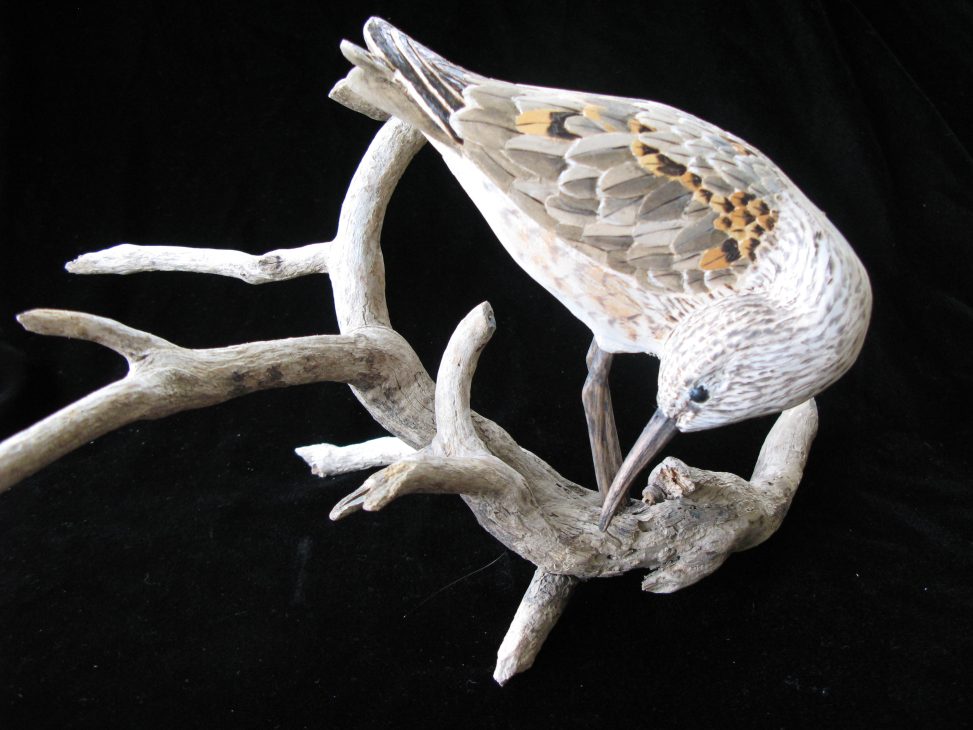
‘Curlew Sandpiper’ by John and Marilyn Davies


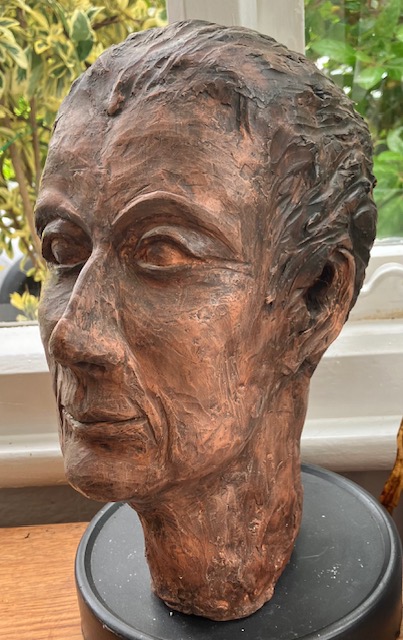
We took a break from lunch and I was shown around the house and garden. There were birds carved by John and painted by Marilyn, and artworks in various media created by Marilyn, especially ceramics.


‘Ceramic Head’ by Marilyn Davies


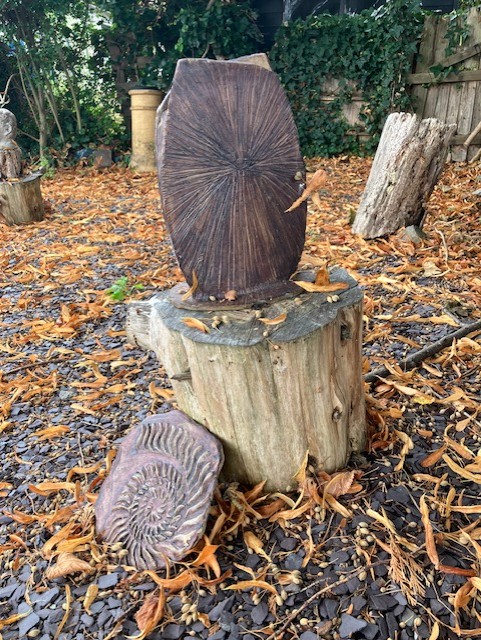
Outside, under a tree was a little sculpture garden.

Ceramics and found objects by Marilyn Davies


Unlike John, who comes from Cymmer Afan in South Wales and does not speak Welsh, Marilyn comes from Pwllheli in the north-western heartland of the Welsh language, and spent her career teaching in Welsh-medium schools. She did not seem to push her own creations forward, though we were surrounded by them, but indicated that she had been a lifelong maker of art objects. John was more specific. When he was eleven there had been a school eisteddfod, he was encouraged to contribute some poetry and was hooked, haunting the school magazine with his poems, and continuing through a long teaching career, notably as head of English at Prestatyn High School. Important too were some sabbaticals he spent teaching creative writing at universities in the United States, in Michigan, Washington and Utah: alongside the poems about Deeside, the North Wales coast and the wider Welsh scene, his books have many poems derived from his experiences in America, contrasting but clearly linked with his depiction of Wales: there are miners, displaced first nations, powerful religion and a host of sharply-drawn characters, some of them carvers of birds in wood.

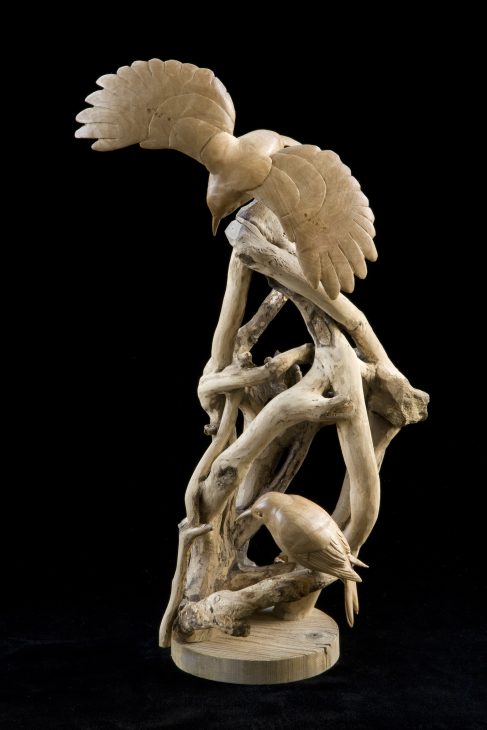
While John could pinpoint the origin of his involvement in poetry, the origin of his interest in woodcarving, and especially in carving birds, seemed less clear, but grew somehow out of a childhood love of making things like Airfix model aircraft. He recalled his mother questioning whether it was worth doing, a discouragement which nonetheless spurred him on. The skill did not come easily, perhaps in contrast to his facility for writing, but the carving of birds in wood ran alongside and perhaps behind his writing of poetry throughout his adult life, and was given a big push by his contact with others who carved birds in wood in the United States. He talks about the process at length in his most recent book, Bird River (Carreg Gwalch, 2023), from which most of the illustrations of bird carvings in the present feature are taken. The book is an absorbing mix of encounters related to the carving of birds, descriptions of the creative process, discussion of influences, poems, and photographs.  The title points to the amount of time John spends walking the banks of the nearby river, the Clwyd, collecting driftwood for the mounts which have become such a feature of the carvings. As we spoke, he suddenly interjected that he loves collecting the driftwood and putting it together with the birds. Really, he told me, the driftwood has become the main event, a sort of gift that appears twice, first when he finds it, and again when he opens up the store in which it has been left to dry. He felt so thankful for it.

As in the poetry collections, Bird River contains a good deal of humour:

Then there was the small tribe of young men living by the Clwyd for about four months last summer, on a muddy creek at Rhyl. Some lived in a sod hut they’d built, flying a Welsh flag. Some lived in tents. Nearby was a handsome structure made of driftwood and a large bakery tray. By the time I encountered them, they were shooting rabbits and fishing but had decided not to kill pheasants because it was the breeding season. They were jobless. A lot of the money saved on accommodation went on drinking in the scenery. And they left behind, filling two burned-out cars already there when they’d arrived, hundreds of beer cans shining silver against the rust-brown like an Arts Council installation. I admired their enterprise, living, as one of them put it, ‘the rock ’n’ roll lifestyle’. So when later one of them checked out my armful of wood and driftwood-collecting costume and asked, ‘Sleeping rough, are you?’, I felt oddly flattered.

John carves the birds and they are then coloured by Marilyn:

Once John has finished the carving, it’s usually over to me. The first stage is to use a pyrography tool to produce the texture of the feathers… A low temperature will produce a light mark and hundreds of these barbs are required to give the bird a feathery look. At a high temperature, the tool can also be used to produce dark brown markings. Sometimes, with a bird such as a curlew, which is basically white and brown, white paint or dye and the use of pyrography is all that is required. Compared with a paintbrush, even a very fine one, it’s more accurate. But most birds will be painted. Many British birds are what birders call ‘little brown jobs’, so achieving shades of brown and grey is vital. The colours I use most are earth tones: Raw Umber, Burnt Umber, Raw Sienna, Burnt Sienna, and White.

(Marilyn Davies, quoted in Bird River)

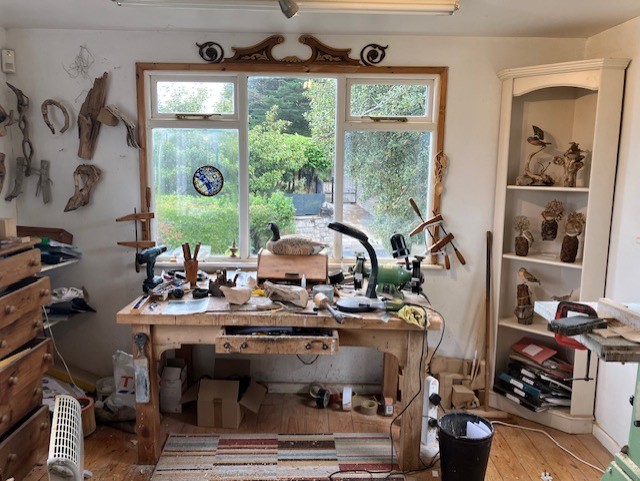
My tour of the Davies’ house and garden concluded in John’s workshop.

Workbench in John Davies’ workshop.


Surrounded by tools, partly fashioned carvings and driftwood pieces waiting for use, it was the tactile nature of it all that struck me. I asked John if carving the birds had replaced writing poetry. He was emphatic: yes, that was right. How did that happen? Again he was quite direct: he had found that he was writing rubbish, and it was embarrassing when editors who had once eagerly accepted his work now sent it back with a more or less polite rejection. He thought that poets commonly ran out of steam as they got older: the reactiveness that fires the images becomes less, one is not so much moved by events. I asked him if the tactile nature of carving and the fact that driftwood is a found object – a gift, as he put it – helped him to get the artwork going. He seemed to think that this was right. He was so grateful, he said, that the carving was there when his poetry gave out. It was the second time in our conversation that he spoke of his gratitude for what this form had given him.

In Bird River, John adapts a poem from Flight Patterns which ties together his preoccupations with woodcarving, birds and the environment of the estuary. This is Decoys. It takes the form of a dialogue between the poet and the Parkgate wildfowler Harold Gill. Gill was and remains a somewhat legendary figure in his locality, one of the last people to earn his living by wildfowling in the Dee estuary, and certainly the only one to record much about the life, in a remarkable memoir Dee Wildfowler: the last professional (1982), edited and published by Leslie Brockbank. Here is the complete original version of the poem.

Decoys

(in memory of Harold Gill)

My timber for carving’s from the shore,
driftlumps water sluices out
so it dries fast and won’t crack. Elm most of all.
Bones in the woodshed’s drought,
they clench. Opened months later, a store
of ripeness surprised is the windfall.

We’d leave for Mostyn, cross
the Shrouds. You had to know the water.
What use is a duck-punt once a week?
You’re not informed. Birds on the ebb won’t stir,
just sit there packed. The flood brings chaos.
High tide meant hide-and-seek.

I carve birds, ducks often: pintail
and mallard, a teal, shapes wood lays for the hand.
Bandsaw for roughing out — check the grain
runs with the bill. Chisels, rasp. Elm is hard sand.
With oil or polish, what’s been fingered stale,
another late surprise, is sunburnt terrain.

Each day — start early. We liked a NE
in the face when we picked our spot:
no wobblings, steady as she… Sixty yards
for a clean kill. 20 ounces. AA shot.
But for food, I wouldn’t have killed — at least
not birds. Smooth the feathers, keep no scorecard.

Best I like the curve where crown, cheek,
sweep down through the swell of chest,
the sweptback, cleared-for-action prow
of a poised gathering unrest
that, from the moment’s peak,
though wood, might just take off, go anyhow.

It wasn’t the birds mainly,
that’s something I can’t nail.
One chap I took, a February morning,
sang for hours — threats to shoot him failed.
Never sung before. The estuary
was fine, I lived on dusk and dawn.

Beyond wood: an airy something
from nothing wood’s a pretext for.
Alone at last with the whole mind’s scope,
you drift. Almost a familiar shore.
Stirrings, gleams are stalked, and springing
this time they are yours, you hope.

Not that bird carving is entirely without drawbacks. John told me that it was hard to find others working in the same field locally, or even further afield. In the United States he appears to have found a vigorous community of fellow carvers of birds, leading to various escapades which find their way into the poems; but not in the UK. He thought that this might be because of the time the work takes: he recalled a woodworker at a craft fair who had “Bloody Ages” printed on the back of his jacket, in answer to the question which is always asked. But John said that the slowness of the work did not bother him: it was the whole process, not so much the end product, which was engaging.

As I made my goodbyes, the Davies’ thanked me for taking an interest in their work, as if few people noticed it. I confessed myself baffled: there is so much there to take an interest in. I hope you have enjoyed reading about their art in this edition of Between Rivers. If you would like to find out more about their carvings of birds you can visit their website, Birds In The Wood, or visit their Facebook page.

‘Treecreepers in Sycamore’ by John and Marilyn Davies


BETWEEN RIVERS is a quarterly series edited by Alan Horne. It is focused on the area bounded by the rivers Alun, Dee and Gowy, on the border between England and Wales in Flintshire, Denbighshire and Cheshire. You can read about the background to Between Rivers in the Introduction

BETWEEN RIVERS SPRING 2024: ‘SIR GAWAIN AND THE GREEN KNIGHT’ – ALAN HORNE

David Selzer By David Selzer0 Comments1 min read2.4K views

BETWEEN RIVERS is a quarterly series edited by Alan Horne. It is focused on the area bounded by the rivers Alyn, Dee and Gowy, on the border between England and Wales in Flintshire and Cheshire. You can read about the background to Between Rivers in the Introduction.

********************************************************************

Here is the Spring edition:

BETWEEN RIVERS WINTER 2024: A SELECTION OF POEMS BY GLADYS MARY COLES – ALAN HORNE

BETWEEN RIVERS is a quarterly series edited by Alan Horne. It is focused on the area bounded by the rivers Alyn, Dee and Gowy, on the border between England and Wales in Flintshire and Cheshire. You can read about the background to Between Rivers in the Introduction.

For our February 2024 issue Between Rivers features the work of the prolific author Gladys Mary Coles, who has not only published ten volumes of her own poetry, together with a novel, but has also edited thirty anthologies of poetry and prose, and produced volumes combining poetry with visual arts, while teaching Creative Writing at Liverpool University. Her writing has won many prizes. Born in Liverpool and with a longstanding connection to Ruthin in Denbighshire, she writes with an international scope but often with a close attention to the local: Liverpool, the Wirral and the Dee estuary, north-east Wales and the Clwydian hills. In addition to all this, she has a profound engagement with the early 20th Century novelist Mary Webb, author of Precious Bane: Coles’ Flower of Light was the first major biography of Webb, and she has published two further books about the novelist, edited a selection of her poems, and is President of the Mary Webb Society.  Webb’s vivid feeling for the natural world in her Shropshire home plainly resonates with Coles’ own work.  Of which there will be more: in preparation is a further volume of poetry and a book about Webb’s Shropshire.

One way into Coles’ earlier poetry might be through the volume of new and selected verse published by Duckworth as Leafburners in 1986. This includes the poem On Offa’s Dyke, about the eighth century structure which marked the boundary between Mercia and the Welsh kingdoms. Originally published in the 1984 collection Stoat, in Winter, the poem was used in the reopening of the Offa’s Dyke Centre following the recent pandemic. One of the ideas behind Between Rivers is that complexities of border and identity can be found right here, at the heart of the United Kingdom. So, one of the characters in Clay, Coles’ novel of the First World War, announces himself as the Irish invader of a Liverpool street built, named and inhabited by the Welsh. In addition, Coles observes in her biography Mary Webb that, for Webb, “the Border Country that merges into the Beyond” is also a border country of the mind and spirit. On Offa’s Dyke traverses these territories.


On Offa’s Dyke


Once a concept, now returned to concept

except where the mounded soil

hints of activity, toil,

scoopings, bendings, craft

of earthwork unknit by wind-work.


Once a long snake, sinuous over the land,

over hill heights, above cwms:

now it’s disintegrated skin

is ghosted in the ground,

buried in its own earth

yet visible here and there

like the life of Offa, Mercian King.

This, in itself, evidence of him,

hegemony’s power, fear –

the tangible remains.


Their truths the walls of history hold:

Hadrian’s, Jerusalem’s, Berlin’s –

humanity walled in, walled out,

a wall for weeping on, a wall for execution;

and all our inner barriers, divisions

numerous as the species of wild growth

embedded in this dyke –

taken by the only natural army.

Leafburners also includes poems from her Liverpool Folio, also published in 1984. Printed in a large format, Liverpool Folio combines her poems with many photographs in an evocation of personal and family memory of the city and its environs. As the child of Liverpudlians I was pleased to find it a world away from media clichés about the city. Liverpool Folio meets Between Rivers at the extremes of the range of each: on Hilbre Island in the Dee estuary. Coles’ poem From Hilbre Island is accompanied by the photograph of the same name by Lindsay Coles.


From Hilbre Island


Dissolution of day

on the estuary;

night’s vast advance

on the evening tide;

and I, rock lichen, cling

listening to sea-distance,

the murmur of a harmony

within a greater harmony


while from the fretted shore

humanity emits

a thousand brutish sounds

diffused and lost:


as on a distant plain

the sound of centuries repeats

and noise of conflict boils

from blue-skinned warriors

or scaly knights who swarm

like early amphibians

floundering, sea-emerged.


Poems from the 1985 collection Studies in Stone are also represented in Leafburners, including a remarkable sequence, Winter in Clwyd, where close observations of the natural world, built up line by line, open out into an understated drama.


Winter in Clwyd: A Sequence

(for my mother, Gladys M. Reid)


  1. Snow takes the mountains
    advance forces the frosts:
    no field escapes
    each blade sprigged
    like blast-dust on trees
    the fright-white ghosts of summer.
    The vale in frost-sprayed gown
    a thin hemline of mist
    below the hills.
  2. The Clwydian’s great white shoulders
    nude giants turned to stone
    hiding their faces.
  3. A farmer’s fence along the topmost field
    is a charcoal line demarcating
    from white hill to white sky.
    In the distance sheep move in flock –
    a yellow turgid river
    the dog fussing on its banks.Before me, pencilling of undergrowth
    pointillism of stubble. Closer now,
    I see bird-pricks, flick of wings,
    fox-marks narrow with long central toes,
    indentations of dragged tails – rats
    or slender weasels – the matchless blobs
    of rabbits and, behind, unmistakable
    manprints. Secretly in snow
    new graphics have appeared.
  4. Light breaks over eastern Clwyd:
    the hill hollows fill like breakfast bowls
    milky to the brim. Snow on the tops,
    crystalline mounds dissolving
    at the edge. Changing light eludes
    no matter how long I stare.
    I notice how mountains, their fronts
    in deep pleats at early morning
    become smoothed out by coffee-time.
    I hold a steaming mug: froth clings
    like stale snow the rain disperses.
  5. On the chess board of fields
    a dark King stands cornered
    in check to a white Queen:
    the heavy oak, immobile, hedged in
    before a silver birch, slim
    moving in all directions.
    It’s the wind’s game.


A later collection of poems is The Echoing Green of 2001, and our other selections are taken from that. This book contains two sequences about the Shropshire landscape which are outside the remit of Between Rivers but which reward attention: Kingdom of Sphagnum relates to the north Shropshire mosslands and is used by Natural England in its presentation of the area; and The Land Within deals with the life and experiences of Mary Webb. But the first poem from this collection which we will present here is Convolvulus, which picks up on the Roman Catholic tradition in Flintshire.  Note that Coles makes use of the word Nain, Welsh  for grandmother.


Convolvulus


Mid-July, the bindweed high in the hedge –

a ‘tatty’ hedge Nain calls it, sitting in the yard,

tilting her kitchen chair, as sunlight pinks the sandstone

of soot-crusted walls. The tall house casts its shadow

over the dusty privet, shades Nain’s face.


She tells me of the day before –

the large white coach packed with mothers

winding through Flintshire lanes, higher into hills

by Halkyn mountain, to the sheltering greystone Friary –

and how, uncrumpling themselves, the mothers stood

in the peace of Pantasaph, a peace so palpable

they felt they could touch, hold it in their hands,

bring some home with the Holy Pictures.


Each one chingled a rosary, processing uphill,

kneeling on the bare ground of the path

at every Station of the Cross, until at last

they formed a circle round the crucifix,

huge, tethered to the hill-top like a mast.

Here they prayed, made secret requests.

Nain wouldn’t tell me hers, but smiled,

whispering as if the wind would hear –

‘A poet, Francis Thompson, once stayed there.

We were shown the window of his room.’


Afterwards, downhill to Holywell,

a blessing at St Winefride’s ceaseless spring.

Some mothers wept in the candle-lit shrine,

clear waters calling, reflecting inner wounds;

and constantly rising from the source

its bubbles seemed, Nain thought,

a waterchain of souls, renewing forever.


I wanted to bring her flowers, plucked convolvulus

but the white chalices folded in my hand.


Our final selection, also from The Echoing Green, is a markedly different poem. Augury draws on the legend of Blodeuwedd from the collection of Welsh folk tales known as the Mabinogion.

In the tale, Llew Llaw Gyffes is unable to marry a human wife, and a wife, Blodeuwedd, is made for him out of flowers. (In English, Blodeuwedd could be translated as ‘Flower-Face’.) She and her lover, Gronw Pebr, conspire to kill Llew. He is injured with a spear but survives and takes his revenge. Gronw is forced to suffer a similar spear-stroke, and is killed, while Blodeuwedd is turned into an owl. Readers of a certain vintage of children’s novel may recognise here the source for Alan Garner’s The Owl Service. In a way, Coles takes the story up after the legend’s endpoint, creating a remarkable contemporary myth. Rather than any conclusion from me, I think we should end with the poem.


AUGURY


Blodeuwedd, The Mabinogion


Tall bedraggled pines, the day’s incessant rain

early nightfall and a river-road. You plunged

swift whiteness into the stream of light

intent on some small creature spotlit

on the camber, caught in my car’s beams.

I felt your winged death impacting,

kept steady as you were woven in

becoming one with metal, rubber.

Not an everyday extinction. Born

of need, and one I saw as a portent.

Next morning, cautious, tense,

I looked at last around the rim

of tyre, wheel-arch, finding you

translated

from feathers into fur into flowers.


And death followed three-fold.


Last night, one year later, your return

waiting on the wires, intent

close to the cottage eaves.

Your ululation as I arrived,

how you opened your wings like a cloak

to enfold me; how you became

one with the moon’s translucency

your call dwindling into the blackness of Bryn Alyn.

Today, on the slate path to our door, I find

three gifts – your feather, white-tipped,

a dead but perfect field mouse,

a sprig of broom.