BETWEEN RIVERS MAY 2026: THOMAS PENNANT’S ‘TOURS IN WALES’ – ALAN HORNE

BETWEEN RIVERS is a quarterly series edited by Alan Horne. It is focused on the area bounded by the rivers Alun, Dee and Gowy, on the border between England and Wales in Flintshire, Denbighshire and Cheshire. You can read about the background to Between Rivers in the Introduction.
**************************************************************************************
If you were to go north-west from Holywell in Flintshire, you would come to the small village of Whitford: a pub, a church, a school and a few houses. Pretty walks lead eastwards towards the Dee estuary, and here are the remains of an ancient estate. First of all is Downing Ucha’, once the estate dower house, later a children’s home and now a derelict but still substantial building with an online presence among those who like to explore such places. Next come the former estate cottages, now attractive rural homes. Finally, there are a few ruins – most of what survives is underground – of Downing Hall, built in 1627, badly damaged by fire in 1922, eventually but not very thoroughly demolished in 1953: the home of Thomas Pennant (1726-1798), naturalist and travel writer.
Pennant is not a household name today, but if we had to choose the most influential cultural figure from the Between Rivers area his claim would be serious. He was a well-known Enlightenment scholar who was prominent in two separate fields. He took the usual route for young gentlemen of the day, via Oxford University and the Grand Tour, making copious notes of animals, plants, landforms, minerals and other natural phenomena he encountered, keeping detailed travel diaries, and contacting other natural historians including Linnaeus, the inventor of the system of botanical classification still in use. But it was not until he was in his mid-30s that he made the defining move to begin work on a publication, eventually issuing British Zoology in 1766. This was ultimately a tremendously successful work: its concern for accuracy, its systematic approach and the inclusion of many detailed illustrations set a new standard for books on natural history in English, and Pennant followed it up with others, Indian Zoology, Synopsis of Quadrupeds, Genera of Birds and Arctic Zoology, which made him a prominent figure in Enlightenment science.
At the same time, Pennant began working up his travel diaries into publications. He made two trips to Scotland and published first A Tour In Scotland, 1769, and then A Tour In Scotland And Voyage To The Hebrides 1772, works which would justify an edition of Between Rivers to themselves. They were very successful, and he followed them up with several accounts of travel in various regions of England and, perhaps the best received of all, with his Tours In Wales.
Tours In Wales was published between 1778 and 1783, in three volumes ostensibly detailing three different tours, although in reality Pennant incorporated material from his many travels in Wales over the years into his accounts of journeys made specifically for this publication. The first tour stayed close to Pennant’s home, describing a trip through Flintshire and Denbighshire with a notable diversion into Chester. The second and most famous tour took him into Eryri to the literal high point of his enterprise, the ascent of Y Wyddfa, before continuing to Anglesey and home along the north coast. That journey is sometimes published separately as The Journey To Snowdon and is our focus today. The third tour runs through parts of Montgomeryshire close to the English border before moving into England, to Shrewsbury, and ends with an excursion to the iron age fort at Caer Caradoc in the Shropshire hills. The three volumes end with a hundred pages of Appendices on every conceivable topic, from Owain Glyn Dwr to potato exports, via notes on the Beaumaris Shark.
As regards the title of the book, Tours In Wales, the operative word is In. Pennant does not pretend to offer a comprehensive tour of Wales, and does not penetrate into South Wales at all. Instead, he sticks to areas with which he is well acquainted, or where he has good local contacts. This seems to have given the book an enormous advantage with the public because of its detail and accuracy. He took with him John Lloyd, vicar of Caerwys, an expert on Welsh antiquities and a fluent Welsh speaker: although Pennant was very proud of his Welsh ancestry, his grasp of the Welsh language was poor. With him also went Moses Griffith, a gifted artist and draughtsman whom Pennant employed to make illustrations for the forthcoming book. The contribution of these men greatly increased the value of Pennant’s work in a market full of superficial and ill-informed travel literature on Wales mainly written by English gentlemen with no knowledge of Welsh. The fruit of Griffith’s work in particular can be seen in the ‘extra-illustrated’ edition prepared for Pennant’s own library, and now held by the National Library of Wales: this contains all sorts of visual art, with landscape watercolours, paintings on mythical subjects, scientific drawings of plants and animals, detailed drawings of antiquities, ‘portraits’ of the houses of great gentlemen, coats of arms and much else, really a rather breathtaking achievement. Illustrations to the present feature are taken from that edition.
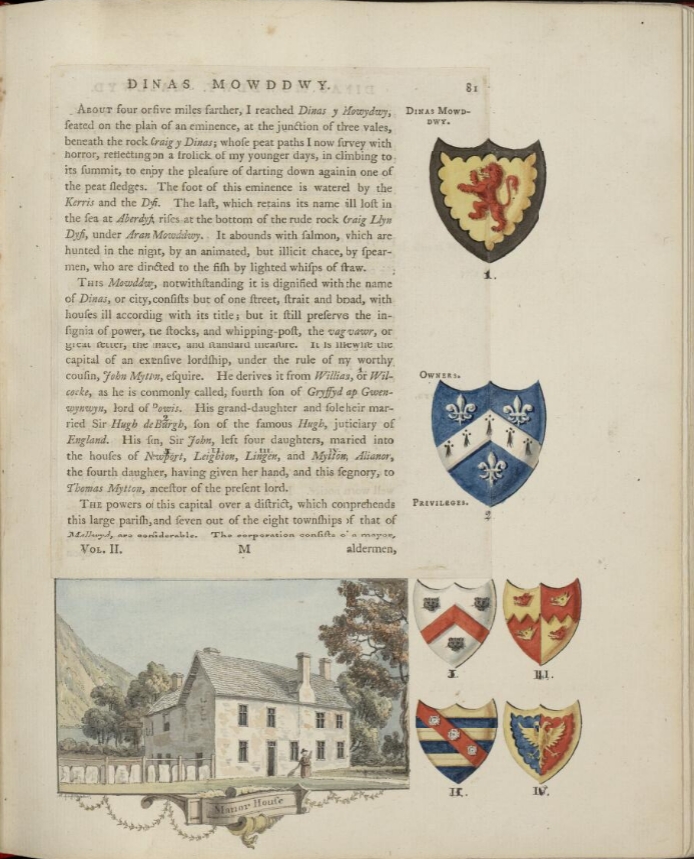 Pennant – Tours in Wales. National Library of Wales/Llyfrgell Genedlaethol Cymru.
Pennant took a most indirect route to Snowdon, traveling from his home along the Vale of Clwyd to join the River Dee at Corwen, going south to Dolgellau and then northwards up the coast via Barmouth and Harlech before taking a route which seems unlikely now, but less so then, across the moors via Ysbyty Ifan and Pentrefoelas, to finally approach Snowdon from the east, passing through Capel Curig into Dyffryn Mymbyr. Today this valley might seem a blasted wilderness. Pennant records much farming activity.
The bottom is meadowy; at this time enlivened with the busy work of hay harvest, and filled with drags, horses, and even men and women, loaden with hay.
He describes the lifestyle of the farmers.
This mountainous tract scarcely yields any corn. Its produce is cattle and sheep, which, during summer, keep very high in the mountains, followed by their owners, with their families, who reside in that season in Hafodtai, or summer dairy-houses, as the farmers of the Swiss alps do in their Sennes. These houses consist of a long low room, with a hole at one end, to let out the smoke from the fire, which is made beneath. Their furniture is very simple: stones are the substitutes of stools; and the beds are of hay, ranged along the sides. They manufacture their own cloaths… During summer, the men pass their time either in harvest work, or in tending their herds: the women in milking, or making butter and cheese. For their own use, they milk both ewes and goats, and make cheese of the milk, for their own consumption. The diet of these mountaineers is very plain, consisting of butter, cheese and oat-bread, or Bara Ceirch: they drink whey: not but that they have a reserve of a few bottles of a very strong beer, by way of cordial, in illness. They are people of good understanding, wary and circumspect; usually tall, thin, and of strong constitutions, from their way of living. Towards winter, they descent to their Hen Dref, or old dwelling, where they lead, during that season, a vacant life.
In this tour, Pennant’s intentions are not primarily scientific, but he is still keen to make observations of plants and animals, and Griffith provides many illustrations.
As we are on the subject of grasses, it may be pleasing to observe, how wonderfully some of them change their appearance as they ascend the higher hills; the turfy hair grass, Aira caespitosa, sheep’s fescue grass, Festuca orina, Alpine meadow grass, Poa Alpina, and some others, which in the low countries, where they enjoy the due influence of the sun, and length of summer, to ripen their seeds, are propagated in the usual manner of grasses; but as they reach a more exalted situation, where they want a continuance of summer, and the necessary power of the sun, to perfect their seeds, they become viviparous; that is, the rudiment of the germen vegetates, and shoots into blade in the cup, from whence falling, it readily takes root, and grows; a kind and providential dispensation, for the advantage of those colder climates, which are less favourable to vegetation!
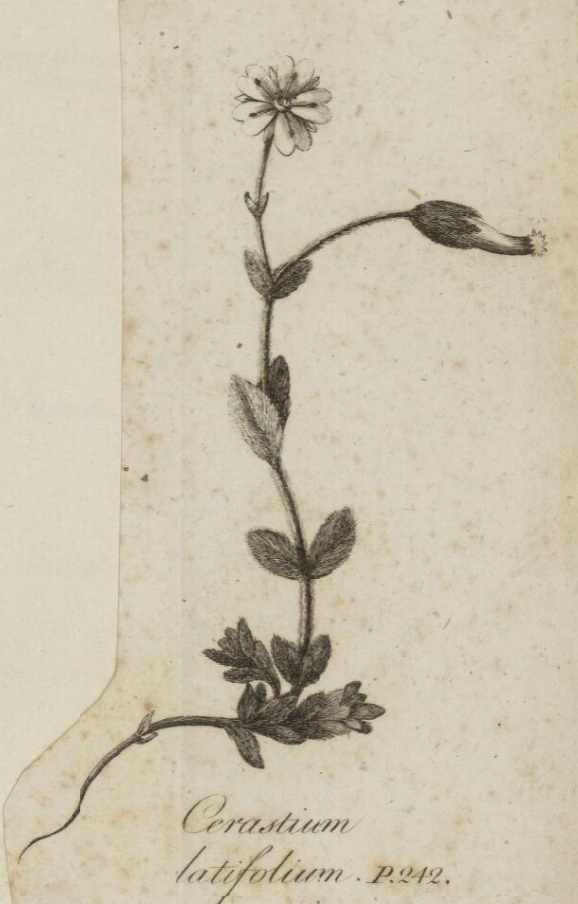 Pennant – Tours in Wales. National Library of Wales/Llyfrgell Genedlaethol Cymru.
The party sent their servants on with the horses to Llanberis, and climbed the Glyders on foot. Like many a traveller after him, Pennant was absorbed by the rock formations on the summits of these hills. Here he is on Glyder Fawr: and while Pennant’s writing generally chooses clarity over poetry, now he gives us both.
The prospect from this mountain is very noble. Snowdon is seen to great advantage; the deep vale of Llanberis and its lakes, Nant Ffrancon, and a variety of other singular views. The plain which forms the top is strangely covered with loose stones like the beach of the sea; in many places crossing one another in all directions, and entirely naked. Numerous groups of stones are placed almost erect, sharp-pointed, and in sheafs: all are weather-beaten, time-eaten, and honey-combed, and of a venerable grey-color. The elements seem to have warred against this mountain: rains have washed, lightnings torn, the very earth deserted it, and the winds made it the constant object of their fury. The shepherds make it the residence of storms, and style a part of it Carnedd y Gwynt, or The Eminence of Tempests.
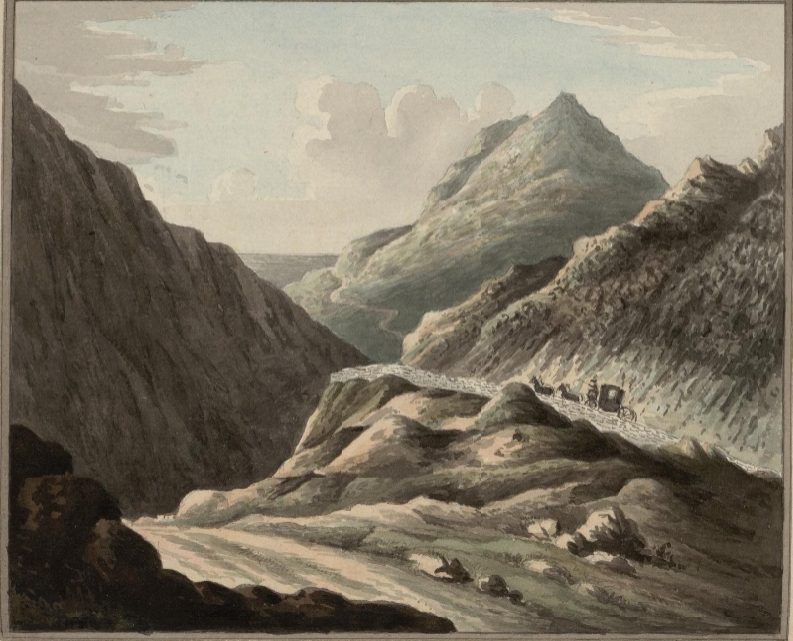 Pennant – Tours in Wales. National Library of Wales/Llyfrgell Genedlaethol Cymru.
The party moved on to Llanberis. While staying there, Pennant rode around the two lakes, Llyn Peris and Llyn Padarn. One feature of Pennant’s travel writing is a love of recording the local gentry and their houses. Sometimes this may be a kind of recompense for hospitality offered; sometimes perhaps a strategy to motivate those so recorded to buy his books. He plainly likes to celebrate members of his class of wealthy Enlightenment gentlemen. But he also enthuses about those he sees as the ancient Welsh gentry, whose lives were perhaps not much changed from those of their forbears two or three centuries previously. His visit to Llyn Padarn occasions one such portrait.
Near this end of the lake lives a celebrated personage, whom I was disappointed in not finding at home. This is Margaret uch Evan, of Penllyn, the last specimen of the strength and spirit of the antient British fair. She is at this time of about ninety years of age. This extraordinary female was the greatest hunter, shooter, and fisher, of her time. She kept a dozen at least of dogs, terriers, greyhounds, and spaniels, all excellent in their kinds. She killed more foxes in one year, than all the confederate hunts do in ten: rowed stoutly, and was queen of the lake: fiddled excellently, and knew all our old music: did not neglect the mechanic arts, for she was a very good joiner: and, at the age of seventy, was the best wrestler in the country, and few young men dared to try a fall with her. Some years ago, she had a maid of congenial qualities; but death, that mighty hunter, at last earthed that faithful companion of hers. Margaret was also a blacksmith, shoemaker, boatbuilder and maker of harps. She shoed her own horses, made her own shoes, and built her own boats, while she was under contract to convey the copper ore down the lakes. I must not forget, that all the neighbouring bards paid their addresses to Margaret, and celebrated her exploits in pure British verse. At length she gave her hand to the most effeminate of her admirers, as if predetermined to maintain the superiority which nature had bestowed on her.
At last Pennant came to Snowdon and the ascent of Y Wyddfa. Led by a local guide the party followed a route which might today seem very roundabout, riding due south from Llanberis until they met what is now the Snowdon Ranger path, which they ascended on foot, leaving their horses behind.
Days of fine weather on Snowdon are at a premium, and Pennant pauses his narrative to recall one such from an earlier journey to the summit.
The view from this exalted situation is unbounded. In a former tour, I saw from it the county of Chester, the high hills of Yorkshire, part of the north of England, Scotland , and Ireland: a plain view of the Isle of Man; and that of Anglesey lay extended like a map beneath me, with every rill visible. I took much pains to see this prospect to advantage: sat up at a farm on the west till about twelve, and walked up the whole way. The night was remarkably fine and starry: towards morn, the stars faded away, and left a short interval of darkness, which was soon dispersed by the dawn of day. The body of the sun appeared most distinct, with the rotundity of the moon, before it rose high enough to render its beam too brilliant for our sight. The sea which bounded the western part was gilt by its rays, first in slender streaks, at length glowing with redness. The prospect was disclosed like the gradual drawing up of a curtain in a theatre. We saw more and more, till the heat became so powerful, as to attract the mists from the various lakes, which in a slight degree obscured the prospect. The shadow of the mountain was flung many miles, and shewed its bicapitated form; the Wyddfa making one, Crib y Distill the other head. I counted this time between twenty and thirty lakes, either in this county or Meirioneddshire. The day proved so excessively hot, that my journey cost me the skin of the lower part of my face, before I reached the resting-place, after the fatigue of the morning.
On the present journey the weather proved more typical.
On this day, the sky was obscured very soon after I got up. A vast mist enveloped the whole circuit of the mountain. The prospect down was horrible. It gave an idea of numbers of abysses, concealed by a thick smoke, furiously circulating around us. Very often a gust of wind formed an opening in the clouds, which gave a fine and distinct vista of lake and valley. Sometimes they opened only in one place; at others, in many at once, exhibiting a most strange and perplexing sight of water, fields, rocks, or chasms, in fifty different places. They then closed at once, and left us involved in darkness; in a small time they would separate again, and fly in wild eddies round the middle of the mountains, and expose, in parts, both tops and bases clear to our view. We descended from this various scene with great reluctance; but before we reached our horses, a thunder-storm overtook us. Its rolling among the mountains was inexpressibly awful: the rain uncommonly heavy. We remounted our horses, and gained the bottom with great hazard. The little rills, which on our ascent trickled along the gullies on the sides of the mountain, were now swelled into torrents; and we and our steeds passed with the utmost risque of being swept away by these sudden waters. At length we arrived safe, yet sufficiently wet and weary, to our former quarters.
After resting, the party returned up Nant Peris, and passed through Nant Gwynant to Beddgelert, spending a few nights there while Pennant explored the locality. They then passed southwards to Pont Aberglaslyn. Pennant gives us the painting below, which seems to show a druidic figure praying at a cromlech in the locality.
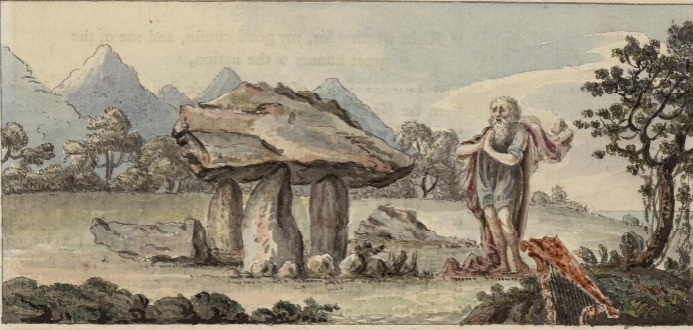 Pennant – Tours in Wales. National Library of Wales/Llyfrgell Genedlaethol Cymru.
At this point, heading for Criccieth and its castle, they had to pass around the edge of the Traeth Mawr, the treacherous tidal marsh, drained in the nineteenth century, which in Pennant’s time extended to the coast. Pennant records a correspondence of elaborate politeness about a proposed drainage scheme. Sir John Wynn, a local gentleman, writes to his cousin, Sir Hugh Myddleton, who has experience of reclaiming land from the sea in the Isle of Wight. Sir John declares that his skill is little, and his experience none at all in such matters, yet ever he has had a desire to further the profit of his country, and is ‘content to adventure a brace of hundred pounds to joyne with you in the worke’. Sir Hugh replies that it would need not hundreds but thousands, £200 being his usual weekly charge. ‘Noble sir, my desire is great to see you, which should draw me a farr longer waie; yet such are my occasions at this tyme here, for the settlinge of this great worke, that I can hardlie be spared one howre in a daie’. Pennant includes an etching of Traeth Mawr in its flooded state with boats sailing on what is dry land today.
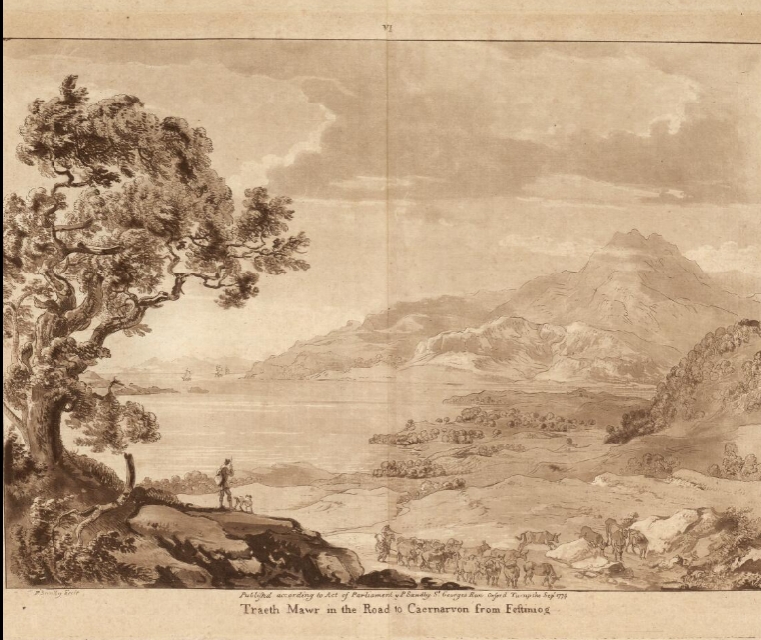 Pennant – Tours in Wales. National Library of Wales/Llyfrgell Genedlaethol Cymru.
The party visited the Llyn peninsula, spent some time in Caernarfon, and then crossed to Anglesey. Pennant has much to tell of the druids, some of it rather lurid including sacrifices in a ‘Wicker Colossus’ as in the 70s horror movie. There is a map of sacred groves at Tre’r Dryw, shown below. Even Pennant admits that some of this history is conjectural.
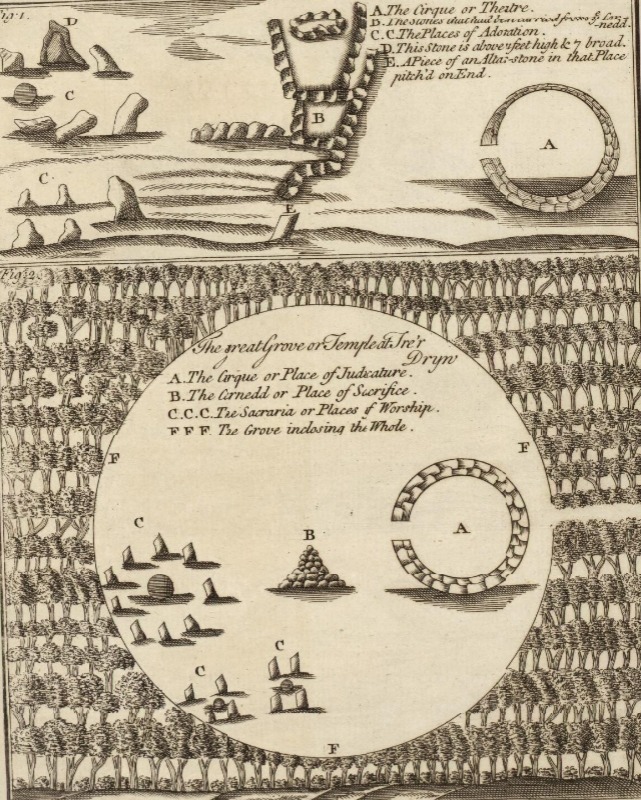 Pennant – Tours in Wales. National Library of Wales/Llyfrgell Genedlaethol Cymru.
As he travelled around Anglesey he came to the mineral mining area around Parys Mountain, and this yields a very different species of writing. After enumerating various phases of exploration, amounts of copper ore extracted, ways of burning the ore or otherwise getting the copper from it, and the worth of the companies involved, Pennant speaks of the mode of work.
The ore is not got in the common manner of mining, but is cut out of the bed in the same manner as stone is out of a quarry. A hollow is now formed in the solid ore open to the day, and extends about an hundred yards in length, about forty yards in breadth, and twenty-four yards in depth. The ends are at present undermined, but supported by vast pillars and magnificent arches, all metallic; and these caverns meander far under ground. These will soon disappear, and thousands of tons of ore be gotten from the columns and roofs. The sides of this vast hollow are mostly perpendicular, and access to the bottom is only to be had by small steps cut in the ore; and the curious visitor must trust to them and a rope, till he reaches some ladders, which will conduct him the rest of the descent. On the edges of the chasms are wooden platforms, which project far; on them are windlasses, by which the workmen are lowered to transact their business on the face of the precipice. There suspended, they work in mid-air, pick a small space for a footing, cut out the ore in vast masses, and tumble it to the bottom with great noise. In such situations they form caverns, and there appear safely lodged, till the rope is lowered to convey them up again.
Another aspect of Pennant’s visit to Anglesey is that he turns his attention to sea creatures, with spectacular illustrations of crabs and some beautiful coloured illustrations of fish.
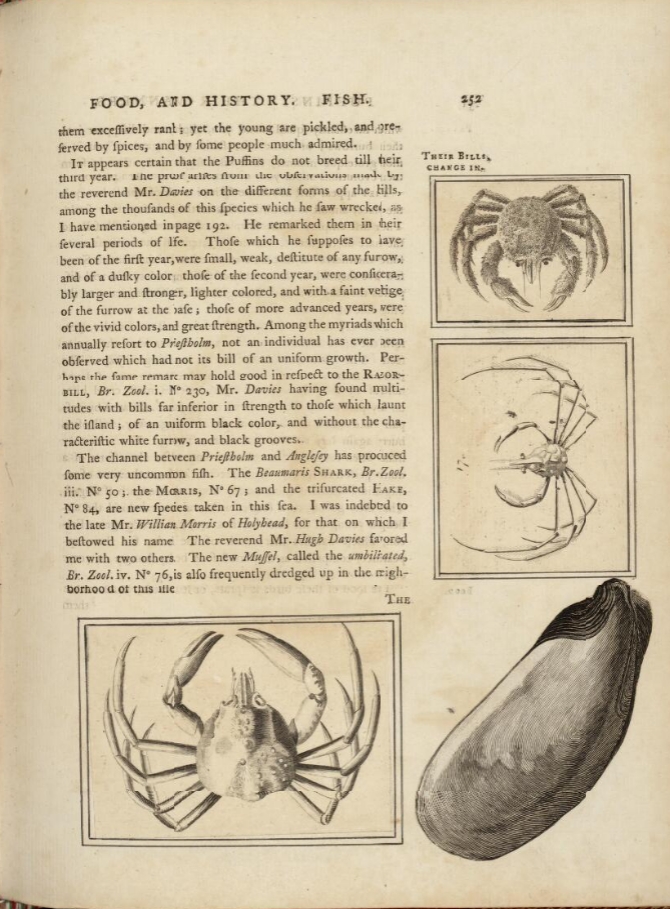 Pennant – Tours in Wales. National Library of Wales/Llyfrgell Genedlaethol Cymru.
At last Pennant turned for home, travelling east along the coast of North Wales, taking in the formerly perilous road around Penmaenmawr and exploring Conwy and Llandudno on the way.
If you would like to read more, Pennant’s Tours in Wales are readily available in facsimile reprints. I found those available from Forgotten Books to be well reproduced, and they are based on an edition first produced in 1883 which uses the modern ‘s’ rather than the original long ‘f’ of Pennant’s day, which makes for ease of reading. The complete extra-illustrated edition is available here from the National Library of Wales and is well worth a look. A recent, accessible study of Pennant’s life and work is Thomas Pennant (1726-1798): Natural Historian and Curious Traveller by Chris Park (2020); I have found Park’s book to be of great help in getting to grips with Pennant’s multifarious interests and writings.
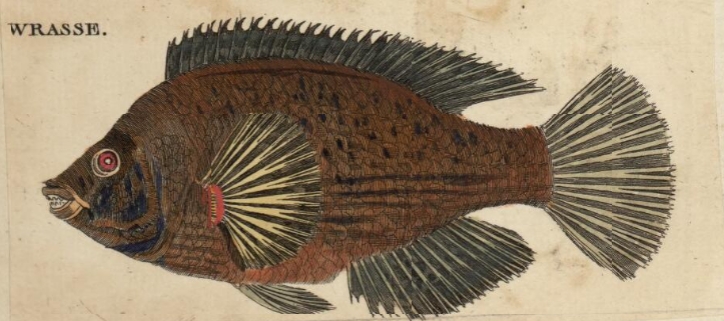 Pennant – Tours in Wales. National Library of Wales/Llyfrgell Genedlaethol Cymru.


Jeff Teasdale
May 15, 2026Thank you…. excellent descriptions of places I thought I knew well…. Layers of personal and historical details which will make revisiting these places a richer experience.
Mary Clark
May 16, 2026Because of my mother, an amateur botanist, I’ve heard of Thomas Pennant. I’ll add him to my To-Read list. The Internet Archive has a lot of his work, including several versions of A Tour in Scotland.