
For this quarter’s edition we use three poems by David Selzer as lenses through which to view the gardens at Erddig, the country estate a little south of Wrexham.
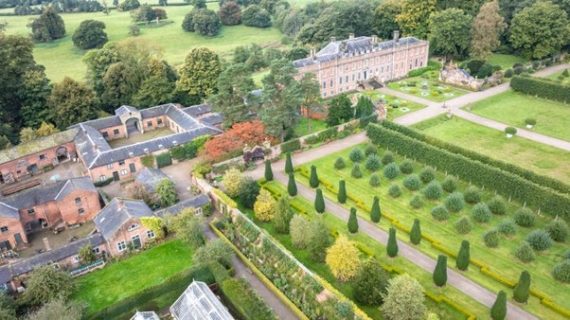
Erddig. Photo: National Trust.
If you follow David’s poems you become aware of the way in which he returns to certain locations which are examined in depth over time. While Erddig does not appear as frequently in the poems as Hoole or Beaumaris, it surfaces from time to time, and each time we get a new vantage point.
Erddig does not have the grandeur and history of its neighbour, Chirk Castle, or of some of the large Cheshire estates. There are no re-enactments of past battles, of sieges during the English Civil War that culminate with the re-staged summary execution of recalcitrant defenders. This is a gentleman’s house originating in the 1680s, with more building in the 1720s. It was owned by the Yorke family from 1733 until 1973 when it was given to the National Trust.
The National Trust may merit a brief explanation for non-UK readers: it is a public charity, set up in 1895 to preserve countryside and buildings for public access, which owns large tracts of open countryside. During the post-war period it received donations of many country houses and estates which were no longer economically viable, and Erddig is one of these. Entry to National Trust countryside is usually free, but to the houses it is often quite expensive; however, membership of the Trust makes it much cheaper, and so millions of people with a little spare cash join the Trust and regularly take their children to play in the gardens, dress up in period clothes in the houses, go sledging in winter or eat ice cream in summer. These are the ‘diverse families’ who appear at the end of the first poem below.
The Yorkes financed the house through trade, especially the exploitation of coal reserves which lay on the estate, with an ironic conclusion when the house began to subside into the workings underneath. As a building Erddig is substantial rather than spectacular, though with an unusual collection of 17th Century furniture. But it is marked out by two features which might elicit the return of any first-time visitor.
Firstly, not only did the Yorkes have an untypically close relationship with their servants, compose poems about them and have them painted; but care has been taken to preserve the servants’ quarters, an extensive range of estate buildings, and many objects used by workers in the house and on the estate. As a result, the visitor gets a detailed view of sorts into the lives of servants and estate workers in the 18th and 19th Centuries, lives often dismissed elsewhere with a few cliches at best.
Secondly, this house has remarkable gardens. Both productive and ornamental, they sit within a park laid out, at the height of the 18th Century enthusiasm for landscaping, to include a section of the Anglo-Saxon boundary called Wat’s Dyke and a Norman motte-and-bailey fort. The whole is set at the junction between the Cheshire plain to the east and the hills of North Wales to the West. All of David’s poems about Erddig make use in some way of these tremendous outside spaces. The three poems we look at here explore the potential of the gardens as a focus for writing about the history of Erddig and its people.
The first poem we shall look at is Erddig: Reflections on Patrimony, which was first published in this site in March 2013. Starting off in a little corner, the poem looks across the gardens to see the whole history of house and estate, grand and businesslike by turns, to end in a moment of calm before night falls.
Erddig: Reflections on Patrimony
From the corner summerhouse set in the wall,
the towering lime trees between the canals –
at the eastern end of the formal garden –
are still leafless, like jet lace work, like nets
disentangling, against the light blue skies
and the white, driven, cumulus clouds of March.
This was a medium-sized business. They made
their money the usual gentry way from rents
plus coal, were typically self-sufficient,
using and selling their managed timber,
were unusually innovative in
hydraulic projects, exploiting Afon Ddu,
the stream that flows through the estate, named black
for the coal dust gathering in its bed.
The pit they owned was a couple of miles
away, its slagheap, now greening, still
clearly visible from the west front.
Factories took the small tenant farmers, wars
the gardeners and nationalisation
literally undermined the house. The last squire –
Oxbridge, of course, then priest manqué, thespian,
war service, holiday tour courier
before inheriting – bequeathed house, gardens,
park, his redundant patrimony,
to the National Trust’s service industry
of conservation, crafts and carrot cake.
In October when the apples and the pears,
in all their traditional varieties,
have been harvested and the grounds are full
of diverse families and music plays,
there is a sense of something shared – not a
common culture but a moment of ease
and tranquillity, an event of order
and fruition before the sweet dusk enfolds.
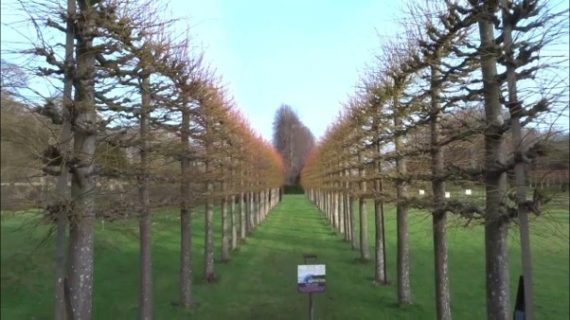
Erddig: lime avenue in winter. Photo: National Trust.
This first poem uses the trees in the garden as a frame within which to view the house and its history. The second poem, The Old Lime Trees at Erddig, shifts the attention onto an aspect of the frame, the avenues of lime trees, which turn out to have a significance of their own. Both poems close with the close of day: in the previous poem this gives us a moment of human commonalty but, in the present one, something mythical emerges.
The Old Lime Trees at Erddig
for Glyn Smith
When the meticulously landscaped gardens
were left to hazard, during the estate’s
long, reclusive neglect, some of the trees
in the two avenues either side
of the wide ornamental canal – whose
perspective frames the classical proportions
of the house – began to grow together
like errant, statuesque teeth. A couple
have been extracted to save the rest.
… Limes are almost indestructible – felled trunks
will sprout. Honey bees favour them. For aeons
they have been planted in rows for blessings,
and for battles – their bark used for basketry,
and rope. Their flowers mend the heart, and the soul…
Perched roisterously on topmost branches,
here, in autumn, are parliaments of rooks.
Against the sky, in winter, the trees
are wild filigree, black fretwork – in spring
flickering shade in the afternoon’s sun.
On summer evenings, after the park has closed,
dryads waltz amongst them.
The poem was first published on David’s site in July 2018, and came with a long explanatory note, reproduced below in full. It includes an eloquent response to the poem from the then head gardener to whom the poem is dedicated. He speaks not only of the generations of people who have worked with the limes but also of the work which, in a sense, the limes have done themselves.
The poem was inspired by the trees, their setting [https://www.nationaltrust.org.uk/erddig] – and by an e-conversation with Glyn Smith, the current Head Gardener at Erddig. I sent Glyn the final draft of the poem for comment and asked if I might dedicate it to him.
He wrote:
I really appreciate your poem and thoughts to dedicate it to me. The only comment I might make is this one about time. I’m not the first head gardener, or gardener for all that, to work here and I’ll not be the last. Someone had the vision and had to plant the lime avenues, amongst other trees and flowers. Over the years there have been many others who contributed their sweat to the garden. On those lines I would like to modestly just be one of those dedicated artisan gardeners who made, developed and curate this garden. The limes stand as a testament to those generations of gardeners who over the years were watched over by them, by the limes themselves. In a way we were the children and the limes the parents and teachers in this school. What learning they must have witnessed and how proud they must be of our achievements.
I have been steadily looking at lime avenues on and off over the last few years and it would appear that our lime avenues are, historically, much more important than ever previously thought. Before c.1700 the only limes in this country were small leaved limes, Tilia cordata. A native species and less suited to the lime avenues we see. On the continent there were hybrid limes between T.cordata and T. platyphyllos and it was this hybrid lime that became so popular for avenues. Now called Tilia x europea it became particularly popular in northern Europe and there are now several slightly different forms of it that are broader, taller, or less or more covered in basal sucker shoots. Just walk in any estate where there are limes and you will quickly spot how densely some are shooted amongst their lower canopy branches.
As gardening spread, particularly the influence of French and Dutch gardening on British horticulture, so we saw introductions of this hybrid lime. It probably achieved its greatest influence around the end of the 17th Century and the great Dutch influence of the Glorious Revolution and William III. One of the more recent forms of lime to be introduced and possibly the most common, is Tilia x Europa ‘Pallida’ and our limes are of this. Perhaps it was best adapted to the wetter Dutch lands, and as such prospered best.
We usually see lime avenues planted across estates. It seems exceptionally rare that shorter avenues of trees were planted within walled gardens. That really makes our lime avenues virtually unique and they should be kept for as long as possible.
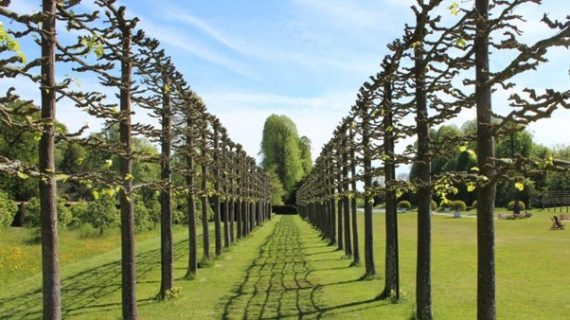
Erddig: lime avenue in spring. Photo: National Trust.
I have watched the gardeners tending the limes from tall ladders which curve outwards at the base to give a stable footing. They give an almost balletic air to the work.
The final poem begins at the limes, and evokes the atmosphere of the garden at the end of summer – with the bees, the blossoms, a mole – before one of those switches which are a feature of David’s poems, which takes us through time and space to the ancient Caucasus before returning at length with its harvest, the apples. Apples at Erddig: a Glimpse of Avalon. was first published on this site in 2019. This poem too ends with a glimpse of something transcendent, but things have changed, and this time the hint of possibility comes in the morning.
Apples at Erddig: a Glimpse of Avalon
Beneath the rows of limes edging to yellow,
the air, tangible with precipitation,
appears almost emerald, a sea green.
In the border beside the high wall, which marks
the tended gardens from the unkempt woods,
there are blooms still. A bee gathers nectar –
and the black, turned earth ripples slowly
as a mole forages in the underworld.
***
Beyond ruined Troy, and north of Paradise
abandoned, from where our words began,
far over the plains and ranges of Europe,
on steep mountain slopes in haphazard orchards
are wild fruit the colour of blood and grass,
which travellers on the Silk Road – merchants,
conquerors, slaves – might once have eaten.
***
In the wooden barn where the tools are cleaned,
sharpened, hung, this year’s apples are displayed
in small pyramids: Lord Lambourne Dessert,
Gloria Mundi, Keswick Codlin,
Grenadier, Crimson Queening, Wise…
When the heavy doors are rolled back each morning
the air is overwhelmed with that keen, sweet scent –
as if Ynys Afallach, Isle of Apples,
Avalon were just below the horizon,
and landfall imminent.
I had not previously grasped the link between Avalon and afal, the Welsh word for apple. The poem leaves us here, perhaps not quite sure whether we are being shown the hope of a new morning or something about our mortality. What sort of landfall will it be?
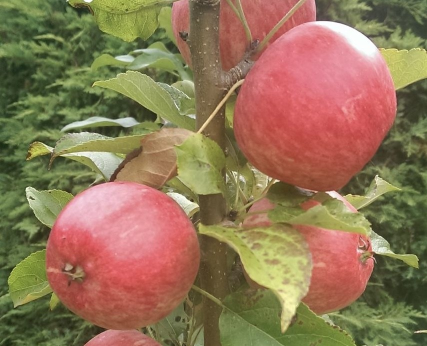
Fiesta apples. Photo: Heather Kirby
BETWEEN RIVERS is a quarterly series edited by Alan Horne. It is focused on the area bounded by the rivers Alun, Dee and Gowy, on the border between England and Wales in Flintshire, Denbighshire and Cheshire. You can read about the background to Between Rivers in the Introduction
 By David Selzer